
Lowered to 24 steel frames on Scotland’s Moray Firth seabed, underwater cameras found haddock and flatfish crowding around older turbine foundations in numbers two to three times higher than the open sea
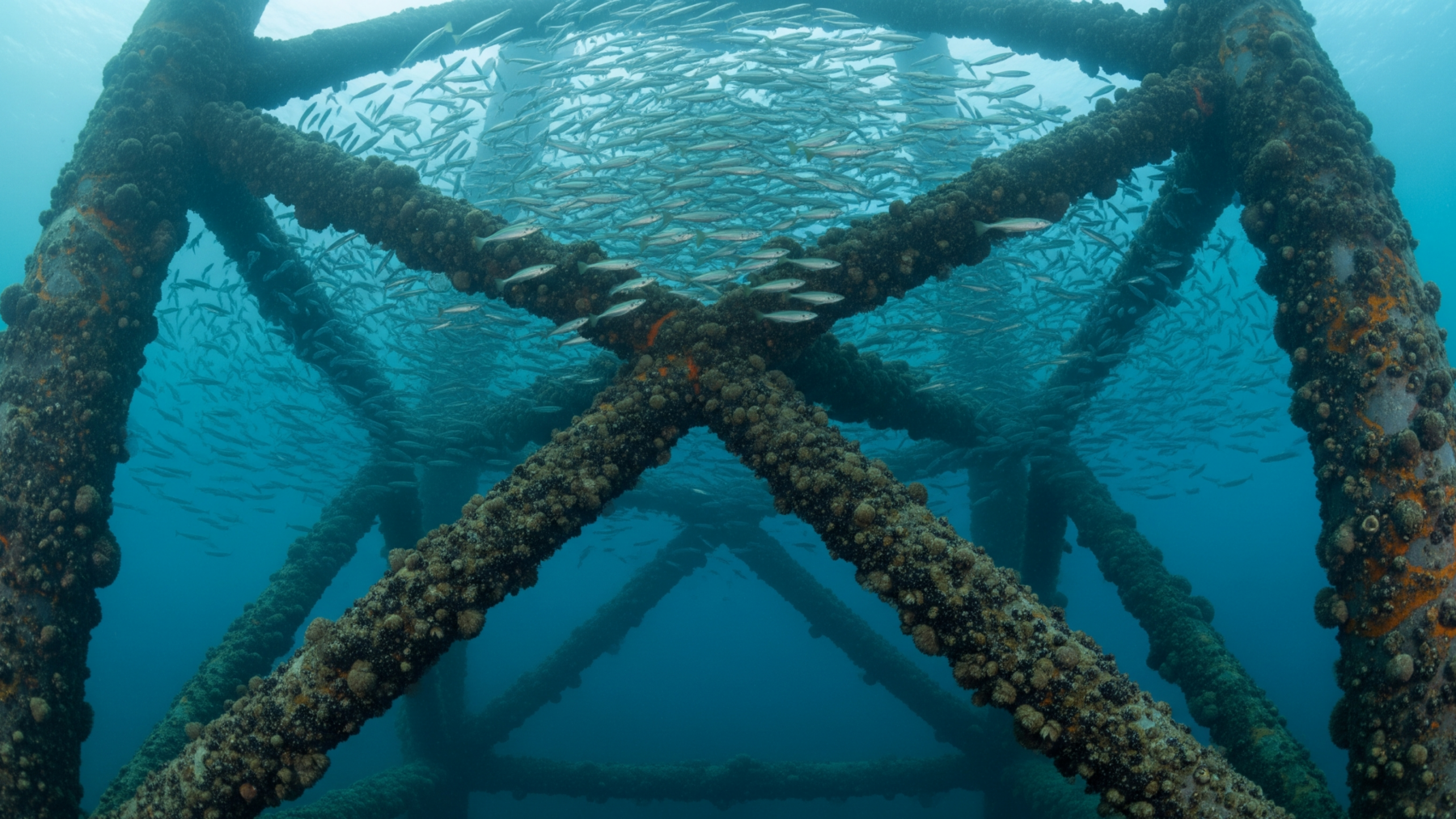 Image generated with artificial intelligence
The water off Scotland’s Moray coast is cold, grey and mostly featureless.
A long flat plain of sand stretches in every direction with almost nothing solid to break it.
Then steel arrived from above.
Any hard surface placed in a sea otherwise made of sand will, within weeks, attract bacteria, then algae, then filter feeding animals such as mussels and barnacles.
Engineers drove jacket foundations into the seabed, and each one introduced something the fish had never encountered at that latitude: hard vertical surface rising through the full water column.
What did the cameras find when researchers sent them down after?
Why a steel lattice in open water becomes a dinner table
The mechanism starts at the very bottom of the food chain. Any hard surface placed in a sea otherwise made of sand will, within weeks, attract bacteria, then algae, then filter feeding animals such as mussels and barnacles. These colonisers coat the steel in a living skin, concentrating nutrients from the passing current in a way that bare sand simply cannot.
Mussels and barnacles are, in turn, food. Small crustaceans move in to graze on them, and small crustaceans are food for larger fish. Because the steel jacket rises through the entire water column, it offers feeding opportunities at every depth simultaneously, with predators hunting mid water while flatfish work the rubble below. The result is what marine scientists call an artificial reef effect: a cascade that begins with steel and ends with fish biomass that would otherwise have no reason to exist in that stretch of ocean.
The cascade is self sustaining. Once mussels establish, each generation of encrustation becomes denser, which is why foundation age matters so much to what the cameras eventually found.
Ninety-six cameras, one cold corner of the North Sea
The Beatrice wind farm sits roughly 13 miles off the Caithness coast in the Moray Firth, its foundations set in around 150 feet of water. Researchers deployed baited remote underwater video cameras across 24 separate jacket foundations, running 96 deployments in total during two weeks in July.
Some of the studied turbines were built in 2017, while others went in around 2020, giving the team a rare natural comparison: foundations of different ages, in the same sea, measured at the same moment. The age difference mattered more than anyone had expected. The older the foundation, the more fish, and sometimes bigger fish, including flatfish, haddock and cod, gathered around it.
The numbers the cameras brought back
Demersal fish abundance, biomass and size were all greater around wind farm foundations than at reference sites away from the structures, and the gap was not marginal. The roughly two to three fold increase in biomass at turbine structures may influence energy fluxes and change the foraging landscape for predators across the wider Firth.
A stretch of Moray Firth sand that would normally hold a few scattered flatfish is now running, within 150 feet of each jacket, at two to three times that density. A foundation with eight years of accumulated mussels, anemones and encrusting algae is not the same ecological object as one installed last summer. Time, it turns out, is part of the design.
Where the finding gets complicated
It has not been determined conclusively whether the higher fish biomass occurs through redistribution of existing fish or genuine production of new ones. That distinction matters enormously for conservation. If fish are simply moving from nearby areas to crowd around the foundations, the net gain for the wider sea may be smaller than the local numbers suggest.
The researchers are careful not to overstate. The cumulative ecosystem consequences are not fully known, but evidence for localised reefing effects can be of strategic interest for future wind farm design. There is also the question of foundation type: the Beatrice structures are latticed steel jackets, more complex than the simpler single pile designs used at most European offshore wind farms, and results may not transfer directly.
What it means for the sea floor being built across right now
Thousands of turbine foundations are planned for the North Sea and waters around Britain over the next decade, each one a potential hard surface habitat in a sea swept nearly clean of natural reef by centuries of bottom trawling. Marine planners are actively looking for ways to design wind farms that deliver measurable gains for ocean life, not just for electricity grids. Research tracking turbines off Portugal pointed in the same direction: given enough time, the structures themselves become anchors for biodiversity.
The PrePARED research programme, which funded the Beatrice camera surveys, is continuing into 2027, with further surveys designed to test whether the aggregation effect holds across different foundation types and distances from the steel. The peer-reviewed findings confirm that abundance, biomass and size of haddock and flatfish were all higher close to jacket turbine foundations, with the effect larger at the older and more complex structures. Meanwhile, environmental monitoring at other North Sea sites has been finding unexpected species in water samples taken close to operating turbines, suggesting the biological story is still far from complete.
For the haddock working the lattice at 150 feet below the Moray surface, none of that uncertainty is the point. The steel is there. The mussels are there. And every season the foundations age a little more, the crowd around them gets a little larger.
Hugo is an engineer with strong technical expertise. Multilingual from an early age, his writing combines technical clarity with a strong interest in science and energy.
