
Geothermal energy sits on a “sleeping giant” of clean power beneath the American West and states are finally starting to wake it up
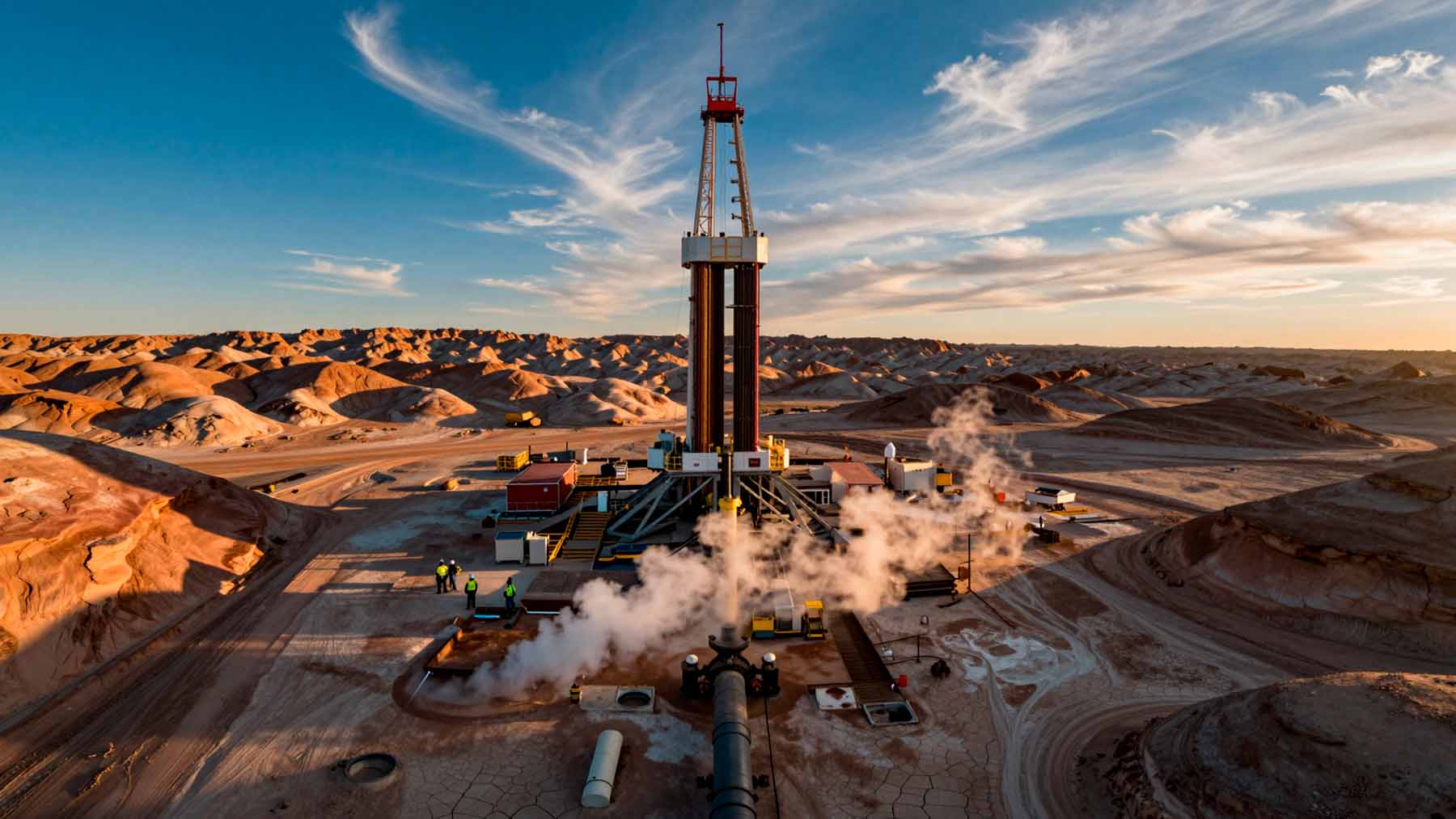 Image generated with artificial intelligence
Thousands of feet beneath the surface, intense heat radiates through ancient bedrock, offering a continuous reservoir of carbon-free electricity.
As power grids face skyrocketing demand from massive data centers, industrial electrification, and expanding cities, energy operators are urgently searching for reliable power. Solar panels that go dark at night and wind turbines that idle during lulls cannot meet this relentless, around-the-clock need alone.
While traditional energy sources struggle to keep pace with modern grid demands, an ocean of clean heat remains locked beneath the earth.
Regulatory clarity is equally vital; Texas passed a 2023 law confirming that geothermal energy belongs to surface landowners rather than subsurface mineral owners.
A technology ready to expand—but stuck at 4 gigawatts
Next-generation geothermal systems differ fundamentally from legacy power plants built near volcanic hotspots like California’s geysers. Instead of depending on rare natural steam vents, advanced techniques drill deep into hot, dry rock anywhere temperatures are high enough.
Engineers create artificial fluid pathways to extract thermal energy, vastly expanding potential development across vast swaths of the country. Researchers estimate this next-generation technology could ultimately supply hundreds of gigawatts of firm, weather-independent electricity.
Despite this boundless potential, total U.S. installed geothermal capacity sits at roughly 4 gigawatts.
Heavy upfront drilling costs, slow financial returns, and uncertain permitting timelines continue to stall large-scale private investment.
Creating demand: The most powerful lever states can pull
Capital markets require guaranteed buyers before financing complex deep-drilling infrastructure projects.
State-level procurement mandates—requiring utilities to purchase specific amounts of clean, firm power—have emerged as the most effective catalyst. In 2021, the California Public Utilities Commission ordered utilities to procure 1 gigawatt of clean firm resources, sparking immediate commercial activity.
This mandate enabled Fervo Energy to secure a massive power purchase agreement with Southern California Edison for its 500-megawatt Cape Station in Utah. With 320 megawatts bound for Southern California Edison, institutional investors gained the revenue certainty needed to fund construction.
California already leads the nation with nearly 2.9 gigawatts of traditional geothermal capacity, proving that policy mandates drive rapid scaling.
From Colorado to New Mexico: States placing early bets
Other Western states are adopting novel policy frameworks to unlock their own subterranean thermal resources.
Colorado passed bipartisan legislation requiring investor-owned utilities to solicit proposals for geothermal projects exceeding 25 megawatts. The state also granted $494,000 to Fervo Energy to map regional thermal development potential.
New Mexico tapped its $75 billion sovereign wealth fund, built on oil and gas royalties, to finance clean energy ventures. The state partnered with startup XGS Energy and tech giant Meta to build a 150-megawatt closed-loop geothermal system.
Meanwhile, Nevada boasts 892 megawatts of existing capacity and is expanding through a 115-megawatt project built by Fervo Energy alongside Google.
Unlocking the underground: Geological data and permitting reform
Developing deep geothermal projects requires precise subsurface geological data regarding temperature, rock composition, and structural faults. Decades of oil and gas exploration generated massive geological archives, but much of that data remained locked in physical paper files.
North Dakota digitized its historic subsurface records, providing free access to researchers and paid access to commercial energy developers. Arizona invested $1 million to merge legacy records with high-tech airborne laser imaging.
Washington state enacted legislation directing its geological survey to construct a public subsurface database and fund exploratory drilling grants.
Regulatory clarity is equally vital; Texas passed a 2023 law confirming that geothermal energy belongs to surface landowners rather than subsurface mineral owners.
The missing pieces: Transmission and what no state has done yet
Even with streamlined permitting and rich geological data, developers face severe regional transmission bottlenecks. Connecting remote geothermal wellfields to urban power grids requires multi-state transmission lines that remain unbuilt.
Test facilities like the federally funded Utah FORGE laboratory in Beaver County help de-risk technology by refining drilling techniques in real-world conditions.
Fervo Energy strategically built Cape Station adjacent to Utah FORGE, leveraging existing geological mapping to accelerate commercial deployment. However, no single state has yet combined procurement mandates, open data, streamlined permitting, and transmission planning into one unified policy framework.
Harmonizing these policies across state borders will determine whether deep thermal power remains an intriguing experiment or becomes a mainstream grid solution.
The technology is fully proven and ready to deploy at scale. Geothermal energy sits on a “sleeping giant” of clean power beneath the American West, and states are finally starting to wake it up.
Kelly is an experienced writer with 15 years of experience exploring the big stories that shape our world, from tech breakthroughs and space exploration to climate, energy, and the fascinating quirks of science. She has a talent for turning complex ideas into sharp, memorable insights that stay with readers long after they’ve finished reading.
