
West Virginia’s New Cumberland Locks could gain a new hydropower plant, sending electricity beneath a railway to the grid

At the edge of the Ohio River in Hancock County, West Virginia, a lock-and-dam structure built by the Army Corps of Engineers has regulated the river’s flow for decades — mostly unnoticed, mostly unchanged. Now, a company called Current Hydro wants to put that current to work.
The proposed New Cumberland Hydroelectric Project would install two turbine-generators inside a new concrete powerhouse on the river’s east bank. To reach the grid, the electricity would first travel underground, crossing beneath an active Norfolk Southern railway line.
A dam that already exists — and a river that never stops flowing
The New Cumberland Locks and Dam isn’t new infrastructure waiting to be built. It’s an Army Corps of Engineers facility that’s already been managing navigation and water flow on the Ohio River for years. Current Hydro’s proposal simply adds a new layer on top of what’s already there — power generation without rebuilding the dam itself.
The applicant also faces a November 24, 2025, deadline to submit water quality certification — or evidence that the certifying agency has waived that requirement.
That distinction matters. The project would run in what’s called run-of-release mode, meaning the plant only generates electricity using flows the Corps already releases as part of its normal river management. No new water gets diverted, and no new disruption to the Ohio River’s rhythm. The Corps stays in charge of water levels and discharge; the turbines just capture energy from what’s already moving.
Current Hydro Project 19, LLC filed its original major license application with the Federal Energy Regulatory Commission on May 8, 2024 — kicking off a regulatory process that typically spans several years before a license is granted or denied.
The curious precision behind this project
Under federal rules, hydropower projects at or above 20 MW face a more intensive licensing process. By landing just a sliver below that threshold, the project qualifies for a somewhat lighter regulatory path. One number, one strategic decision.
The load would split between two identical Kaplan pit turbine-generators. Kaplan turbines are designed specifically for low-head, high-flow conditions — exactly what you find on a large, slow river like the Ohio. The “pit” configuration places the generator in a submerged housing, which suits sites where the vertical drop between upstream and downstream water levels is modest but the volume of moving water is substantial.
Despite the sub-20-MW rating, the projected output is significant. Current Hydro estimates the plant would generate an average of 132.4 gigawatt-hours annually — a meaningful contribution to the regional grid, capable of powering tens of thousands of homes depending on local consumption patterns.
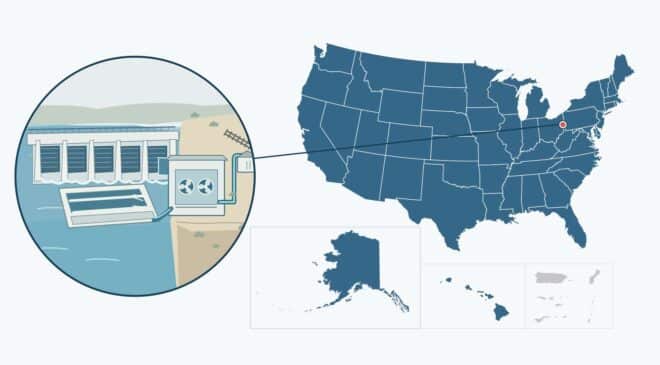
Electricity under the tracks: An underground crossing beneath a Norfolk Southern railway
Generating electricity is one challenge. Getting it to the grid is another, and at New Cumberland, geography complicates that second step considerably.
The concrete powerhouse sits on the east bank of the Ohio River. Between that bank and the regional transmission grid runs an active Norfolk Southern Railway line. Stringing high-voltage lines over active freight rail brings significant engineering hurdles and regulatory coordination — so the project takes a different route: underground.
A 180-foot underground transmission line, rated at 12.47 kV, would cross beneath the railway. Once clear of the tracks, it transitions to a 350-foot overhead line running to a substation, and from there a 1,050-foot, 138-kV three-phase overhead line connects to the existing regional grid. Routing energized cables under active freight rail requires accounting for soil conditions, rail load pressures, and long-term electrical insulation — a detail that rarely appears in hydropower proposals, giving this project a distinctive physical footprint that sets it apart from more straightforward run-of-river installations.
What the powerhouse would look like — and how small a footprint it needs
Picture a concrete structure roughly 187 feet long, 98 feet wide, and nearly 75 feet tall — positioned on the Ohio River’s east bank. Substantial, comparable in footprint to a large warehouse, but not outsized for what it would contain.
Water enters through a 90-foot-wide, 350-foot-long intake section equipped with trash racks that filter out debris before it reaches the turbines. After passing through the generators, water exits through a tailrace channel measuring 95 feet wide and 215 feet long. The entire project — powerhouse, intake, transmission infrastructure, and all associated facilities — would occupy just 2.82 acres of federal land administered by the Corps. For a facility rated at nearly 20 MW, that’s a notably compact footprint.
Where the project stands — and what comes next
FERC – 2026 hydropower environmental documents accepted the application and declared it ready for environmental analysis on September 25, 2025, moving the project into a public comment phase. Comments, recommendations, and prescriptions were due by October 27, 2025, with reply comments due November 10, 2025.
The applicant also faces a November 24, 2025, deadline to submit water quality certification — or evidence that the certifying agency has waived that requirement. A formal NEPA environmental review document is still forthcoming.
Current Hydro intends to pay a fee under Section 112 of NEPA, a relatively recent mechanism that sets a fixed deadline for completing environmental review in exchange for a fee. If that payment is confirmed, it could meaningfully shorten the timeline between application and final licensing decision — something worth watching as the project moves deeper into federal review.
Kelly is an experienced writer with 15 years of experience exploring the big stories that shape our world, from tech breakthroughs and space exploration to climate, energy, and the fascinating quirks of science. She has a talent for turning complex ideas into sharp, memorable insights that stay with readers long after they’ve finished reading.
