
Venice solar farm uses vertical bifacial panels across active soybean fields
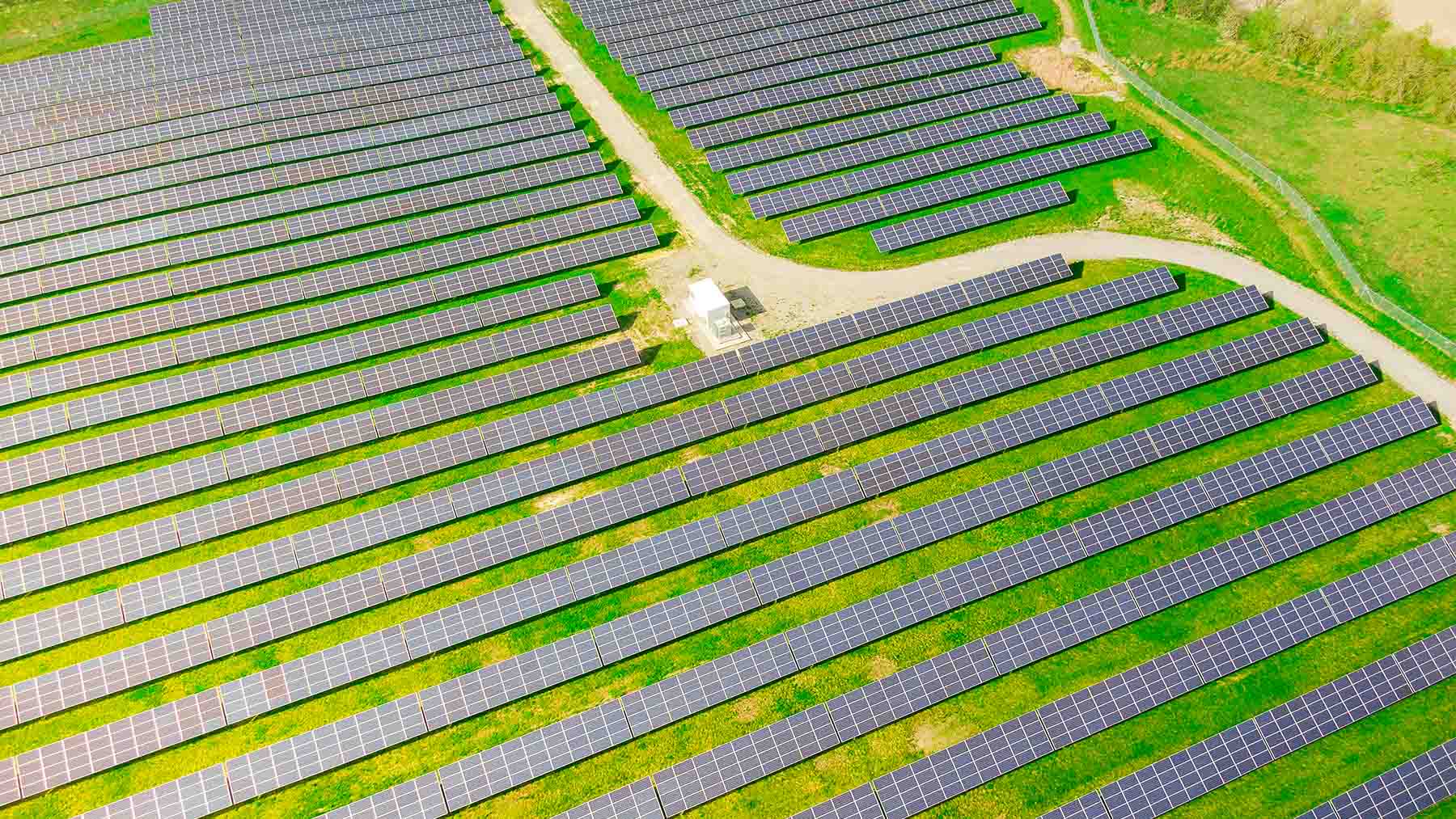
A solar farm typically covers the ground that it needs. But in an area near Venice, one that is currently under construction is doing things differently.
Its panels have been mounted vertically within a cultivated soybean field, with one side exposed to the early morning sun and another to the afternoon sun.
The farm has been set at 1 MW and is among the three Italian farms currently being constructed using the vertical agrivoltaic system of Next2Sun.
The distance that needs to be maintained between rows for agriculture leads to fewer modules per acre in a solar park compared with a compact traditional system.
The unusual thing is not only about where they have been mounted.
Both sides of the panel function
A traditional ground-mounted solar panel is generally oriented in the direction to catch the maximum amount of sunlight at noon. Next2Sun changes this orientation altogether.
Their frameless glass-glass panels are positioned vertically and use bifacial solar cells, which can generate power using the light falling on both sides of the cell.
When it comes to an optimal east-west orientation, one side works well at sunrise, and the other side works at sunset.
Thus, there will be two peaks of power generation. Morning and evening are replacing one midday peak.
Soybeans will cover much of the field
Upright installation modifies what goes on beneath the modules as well.
There is practically no such thing as “beneath” under conventional terms.
According to Next2Sun, row spacing should be no less than 8 meters, which is 26 feet, in order to allow tractors and other agricultural machines to work between rows.
The company claims that their vertical installation physically occupies only 5% of the area, which leaves more than 90% of it free for agriculture or ecological purposes.
According to the same comparison, conventional south-oriented installations may cover over 70% of the area with modules.
The Venice installation will use the space beneath modules in a conventional way.
Soybeans will grow between solar rows.
Noon is not meant to be the key event
Having the generation displaced from noon could be a drawback. But for the grid, that could be the very point.
It just happens that big fleets of standard south-facing solar farms usually generate their peak during such times, when plentiful solar power could drag prices down or take up grid capacity.
The east-west array generates most of its power before and after those hours.
According to Next2Sun, power generation happens mostly in the morning and evening, when conventional south-facing farms are generating little power.
The firm states that its installations could generate 5% to 10% more electricity per kilowatt than conventional ones depending on the module.
It is a performance claim by the company and not an achieved outcome at the incomplete farm in Venice.
Vertical modules alter the arithmetic of land use
The trade-off emerges in terms of power density.
The distance that needs to be maintained between rows for agriculture leads to fewer modules per acre in a solar park compared with a compact traditional system.
Next2Sun says that 2.5-3 hectares of land per MW of capacity would be needed for an average setup.
But, according to Next2Sun, this is the wrong denominator. All but a little of this land is agricultural and is not dedicated solely to the generation of electricity.
This means that the same hectare of land is now expected to generate two outputs. Italy is testing this argument on a larger scale.
In addition to the 1-MW soybean project, there is also a 0.8-MW vertical farm with flowers in Venice and a 0.1-MW project with flowers in Emilia-Romagna.

The field becomes an integral part of the power plant
The Venice soybean array has not provided enough data yet to determine how the crop output or electricity produced by the facility will compare to alternative systems.
For now, the facility is simply a construction project centered on geometry that is well-defined.
Put the modules flat or angled on the field surface, and solar generation covers it, according to Next2Sun Agri-PV FAQ.
Make the modules vertical and space the rows properly so that the machines can operate between the rows.
Rotate the active surfaces towards east and west, and move the electrical output as well.
The soybeans use the bulk of the field’s surface.
The solar farm uses the borders between the fields. Instead of developing into one peak at noon, the vertical rows wait for the sun to come from either direction.
Kelly is an experienced writer with 15 years of experience exploring the big stories that shape our world, from tech breakthroughs and space exploration to climate, energy, and the fascinating quirks of science. She has a talent for turning complex ideas into sharp, memorable insights that stay with readers long after they’ve finished reading.
