
Frankfurt Airport installs 37,000 upright solar panels along a 1.7-mile stretch beside its runway, preserving airfield grass

Frankfurt Airport has set a critical framework for decarbonizing aviation operations using innovative solar designs.
Germany is under pressure to reach climate neutrality by 2045 under its ambitious clean energy regulations.
However, the aviation sector has historically struggled to offset its high direct emissions.
To overcome these challenges, Frankfurt Airport operator Fraport partnered with Next2Sun and created a breakthrough vertical solar layout.
To address this, dual-use engineering strategies, among other things, are being adopted across major airports.
How did Germany’s largest airport transform into a unique photovoltaic powerhouse?
How green energy milestones do not compensate for aviation bottlenecks
Germany has celebrated several achievements in renewable energy capacity growth.
In 2024, roughly 59% of the country’s public net electricity was generated by renewable sources.
This milestone was driven by significant expansions in wind and solar.
Despite continued green capacity growth, the nation still struggles to decarbonize several hard-to-abate economic sectors.
Aviation is especially challenging, accounting for almost 3% of Germany’s total greenhouse gas emissions.
Jet fuel combustion accounts for the majority of these emissions.
However, daily airport ground operations are also extremely carbon-intensive. Frankfurt Airport exemplifies this.
The airport consumes approximately 450 to 500 gigawatt-hours of electricity each year.
This is driven by round-the-clock heating, lighting, and cooling for massive passenger terminals.
Thousands of ground support vehicles, apron buses, and baggage tractors also burn diesel or draw heavy power loads.
Large-scale solar power can directly decarbonize these ground operations.
However, traditional installations face severe bottlenecks at airfields.
Standard solar hits a wall at airfields
Conventional, ground-mounted tilted panels require massive open, contiguous land for installation.
Most major airports lack this acreage near runways, especially in densely populated Germany.
Deploying traditional solar arrays on parking garages and terminal rooftops offers a key solution.
However, rooftop solar alone cannot meet the vast energy demands of major aviation hubs.
Standard tilted panels also present critical hazards to pilots.
Traditional arrays create dangerous optical glare, which blinds pilots during takeoff and landing.
They also create wind turbulence across flat tarmac zones, disrupting aerodynamics.
Furthermore, these flat panels block direct sunlight.
This destroys underlying grassland ecosystems and creates high maintenance burdens regarding weed control.
Airport ground crews must frequently mow or manually clear dense, decaying vegetation.
On sprawling airfields, this necessitates intense labor and specialized mowing equipment that can disrupt active flight schedules.
To overcome these challenges, Frankfurt Airport operator Fraport partnered with Next2Sun and created a breakthrough vertical solar layout.
Using a vertical revolution to power airfield runways
While the agricultural sector has already adopted vertical panels, this is a first for aviation.
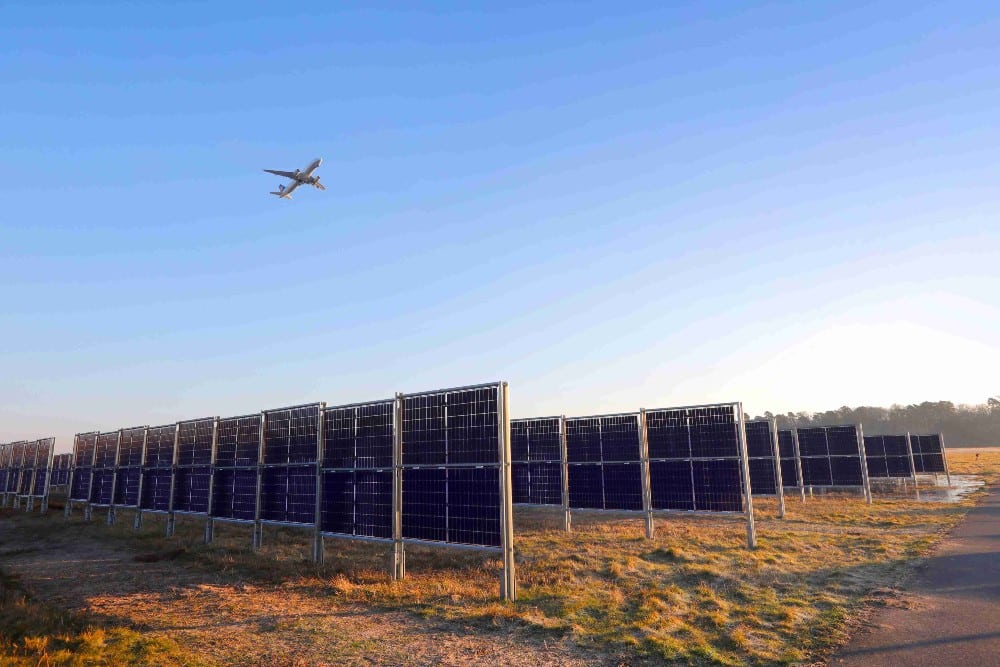
Frankfurt Airport’s new vertical solar system redefines clean energy infrastructure.
The installation features 37,000 bifacial photovoltaic modules aligned in straight rows for 1.7 miles beside Runway West.
It is now fully operational, having gone live in late 2025. At the time, it became the world’s largest vertical solar project.
The benefits of using modules that stand upright
The panels face east and west, absorbing low-angle morning and afternoon sunlight.
This unique orientation enables peak electricity generation outside the midday hours when conventional rooftop solar peaks.
Hence, it serves as an ideal complement, helping to balance the airport’s microgrid.
The vertical system has a peak output of 14.5 megawatts.
Each year, it generates up to 17.4 gigawatt-hours of clean power.
The solar energy directly powers terminal climate control and the airport’s expanding electric vehicle fleet.
Furthermore, the design allows sunlight and rain to reach the soil, conserving grassland ecosystems and biodiversity.
Frankfurt Airport’s success proves that vertical solar can unlock restricted airfield acreage for clean power generation.
This innovation also offers a clear blueprint for other global aviation hubs struggling to decarbonize while meeting heavy energy demand.
Ultimately, integrating vertical solar installations alongside rooftops can transform dormant safety zones into active renewable assets.

Anke Maree is a writer with a clear and engaging editorial style. Her work focuses on making complex topics accessible, informative, and relevant for readers across different areas of interest.
