Norway’s Jostedal hydropower system draws glacier meltwater through a 3,891-foot mountain drop while icebergs float in its reservoir

The mountains of Norway are entering another season of change.
With the fluctuations in temperatures, and snow and ice continuing to reshape the landscape, the relationship between renewable energy and the environment becomes evermore important.
But what happens when these two powerful forces collide?
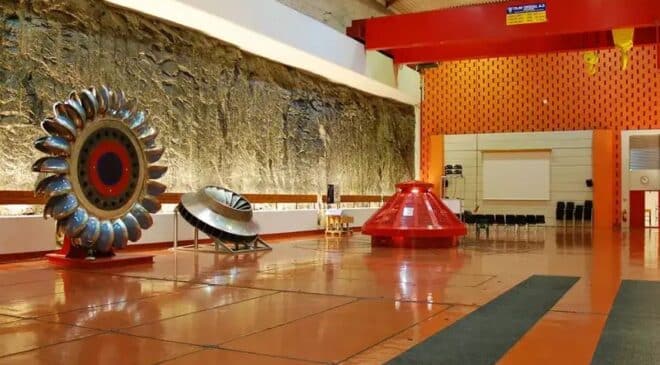
It works like this: water flows through the plant’s infrastructure, spins the turbines and is then discharged through an outlet tunnel towards the Sognefjord.
Living on the edge (of the ice)
Austdalsbreen is an outlet of the Jostedalsbreen ice cap, and chunks of ice are released into the water where the glacier reaches the lake.
It is this process, which is called calving, that makes monitoring this lake is so important.
Scientists are carefully watching the glacier’s hanging front to observe how the ice responds to water levels and seasonal conditions.
The Norwegian Water Resources and Energy Directorate, known as NVE, started to monitor Austdalsbreen in the 1980s, alongside construction of the hydroelectric scheme.
Being a regulated reservoir, its water levels are managed for optimal hydropower production. This means that the glacier, lake and infrastructure are connected in a way that is both natural and engineered.
Mass balance, front position and movement are tracked by NVE to understand how the seasons affect the ice.
Heavy lifting done by gavity
Water from high mountain reservoirs is sent through the system at Jostedal power plant to create electricity.
And it’s the difference in elevation between Lake Styggevatnet and the Jostedalselva River that the plant relies on, with gravity being a main character in this story.
From the lake to the power station, there is a vertical journey measuring 3,890 feet – about the height of a 400-storey building – that gives the water a push before it makes it to the turbines.
The Norwegian Water Resources and Energy Directorate explains that the surrounding glacier-fed reservoirs support the Jostedal hydropower system.
Water from Lake Styggevatnet, Lake Kuppvannet and several stream intakes is channelled towards the plant, where the mountain’s dramatic elevation provides the necessary force to generate power.
Operating since 1989, the power station has an installed capacity of 290 megawatts, with annual production listed at 956.3 gigawatt-hours.
When nature gets plugged in
Jostedal’s power system is intrinsically linked to the surrounding landscape.
The reservoirs sit at the foot of Jostedalsbreen, with Austdalsbreen calving into Austdalsvatnet.
The levels of the reservoir can also influence the conditions near the glacier’s terminus, where water pressure affects how quickly ice slides downhill.
Not exactly frozen in time
According to measurements taken by NVE in 2019, Austdalsbreen covers 3.9 square miles.
The front of it comes in at 3,609 feet wide, with calving accounting for 10% to 15% of its summer mass balance annually.
The lake doesn’t just receive ice but also meltwater.
Since reservoir regulation began in 1988, NVE reports to have retreated around 2,460 feet.
Every snowflake counts
But how much snow builds up on the glacier each winter?
According to NVE, it measures in at an average of 13 to 16 feet.
The amount of water that becomes available is a result of a combination of snowfall, melting, calving and reservoir management.
What goes down, powers up
It works like this: water flows through the plant’s infrastructure, spins the turbines and is then discharged through an outlet tunnel towards the Sognefjord.
Storing the water high above the station and allowing gravity to “carry” it down is an ingenius use of the mountain’s own geography.
The future looks pretty cool
Yes, a glacier calving into a reservoir can look very dramatic.
But is also makes up part of an intricate and changing water system – and it deserves close attention.
By monitoring this phenomenon, changes can be made visible, with hydropower turning the mountain’s elevation into useful energy.
With Norway investing billions in keeping its mountain power stations running for years to come, could its aging hydropower infrastructure hold the key to a bright renewable energy future?


Helen is based in sunny Cape Town, South Africa, and has been writing for over 12 years, covering a wide range of topics. A lover of animals, she cares deeply about recycling, minimizing her impact on the planet and finding new ways to bring old things to life.