
Moving solar panels above a French barley field cut evaporation 20% while preserving 96% of grain yields

France is installing solar panels above agricultural fields to overcome the effects of global warming.
Beyond pressure to decarbonize due to climate mandates, the nation’s farmers must also navigate extreme weather.
As summer temperatures continue to rise, crop yield and quality are declining.
Ultimately, combining unique solar layouts with farm operations is key to fast-tracking the green energy shift while raising food production.
To advance renewable energy targets while protecting harvests, developers are exploring innovative solutions.
Will a demonstration site in central France serve as a vital blueprint for the nation’s energy and agricultural sectors?
How climate pressure in France is worsening
Several nations worldwide have committed to a carbon neutrality goal by 2050.
France is among them and has adopted additional legal targets to fast-track progress toward this goal.
Under the National Low-Carbon Strategy, greenhouse gas emissions must be halved by 2030, while France phases out coal by 2027.
By the end of the decade, 41.3% of renewable energy in final consumption must also be achieved.
To meet these targets, a massive transition to clean power is required.
Households are now replacing gas boilers with heat pumps while transport is becoming electric.
This shift, however, is significantly raising France’s electricity consumption.
Power demand is projected to increase by nearly 30%, or 618 terawatt-hours, by 2035.
This means renewable energy capacity growth must accelerate to bridge the rapidly growing power supply gap more sustainably.
Meanwhile, extreme weather is straining French agriculture.
Farmers are struggling to maintain crop quality and yields, pushing the nation into a major crisis.
Higher temperatures and reduced food production
Climate change has accelerated due to continuously high emissions.
As a result, Earth’s temperatures have increased to record highs in recent years, triggering more frequent severe weather.
In France, the agriculture sector is suffering the consequences in particular.
The nation is facing exceptional summer heatwaves and prolonged droughts.
These conditions are scorching fields across the country, driving soil moisture to its lowest level since 1958.
French grain maize production has dropped by 47%, the lowest level in decades.
Mandatory irrigation restrictions have also struck 79 departments.
Consequently, farmers are facing shrinking harvests and financial strain.
These challenges are why rapid decarbonization is so vital.
Yet spatial limitations have slowed green energy deployment, especially solar.
Ground-mounted photovoltaics require vast expanses of open, flat land.
Viable farmland offers ideal installation conditions, creating direct competition with food production.
However, French solar producer TSE found an innovative way to generate clean power without displacing crops.
Turning to solar canopies to improve harvests
Strict French laws prohibit traditional solar panels on active farmland to conserve national food independence.
TSE’s elevated, rotating solar shading canopy for working farmland was specifically designed to overcome this issue.
The system is being tested across a multi-year trial network in France.
This includes a 1.88-acre demonstration pilot on a 202-acre farm in Chadeleuf, Puy-de-Dôme.
The demonstration elevates 392 solar modules over 16 feet above the ground on wide 88-foot spans.
This enables tractors and harvesters to operate freely underneath.
The panels also rotate throughout the day using smart software.
This balances sunlight for photosynthesis with protective shade during extremely hot weather.
Agricultural and energy benefits of the 2026 Chadeleuf trial
During extreme heatwaves, rotating shade reduced temperatures by up to 7.4°F and lowered water evaporation by 20%.
Barley grown under the panels achieved 96% of open-field control yields. Specific grain weight also increased by 3%.
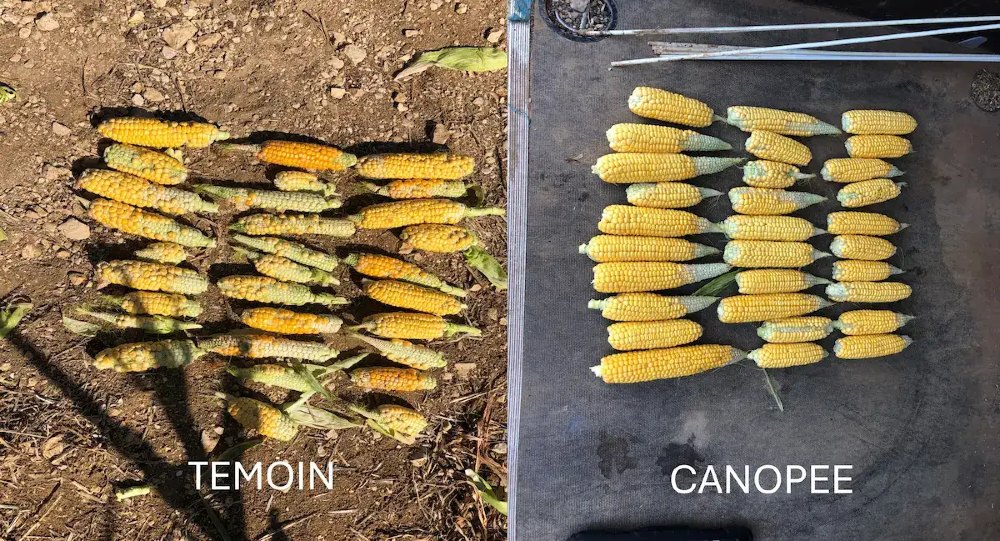
Furthermore, the 278-kilowatt array produces 364 megawatt-hours of clean power annually, offsetting 140 metric tons of carbon dioxide.
The success of the isolated field trials has enabled TSE to move to commercial deployment.
The developer signed major agreements in 2026 with several agricultural cooperatives, including VIVESCIA and Cérèsia.
Not only can solar canopies shield crops from extreme heat and drought, but they also help generate steady farm income.
Ultimately, combining unique solar layouts with farm operations is key to fast-tracking the green energy shift while raising food production.

Anke Maree is a writer with a clear and engaging editorial style. Her work focuses on making complex topics accessible, informative, and relevant for readers across different areas of interest.
