
A 2.65 million dollar cleanup under a Texas church parking lot ran past ten times the largest bond the state asks of an operator, which has not been raised in over thirty years
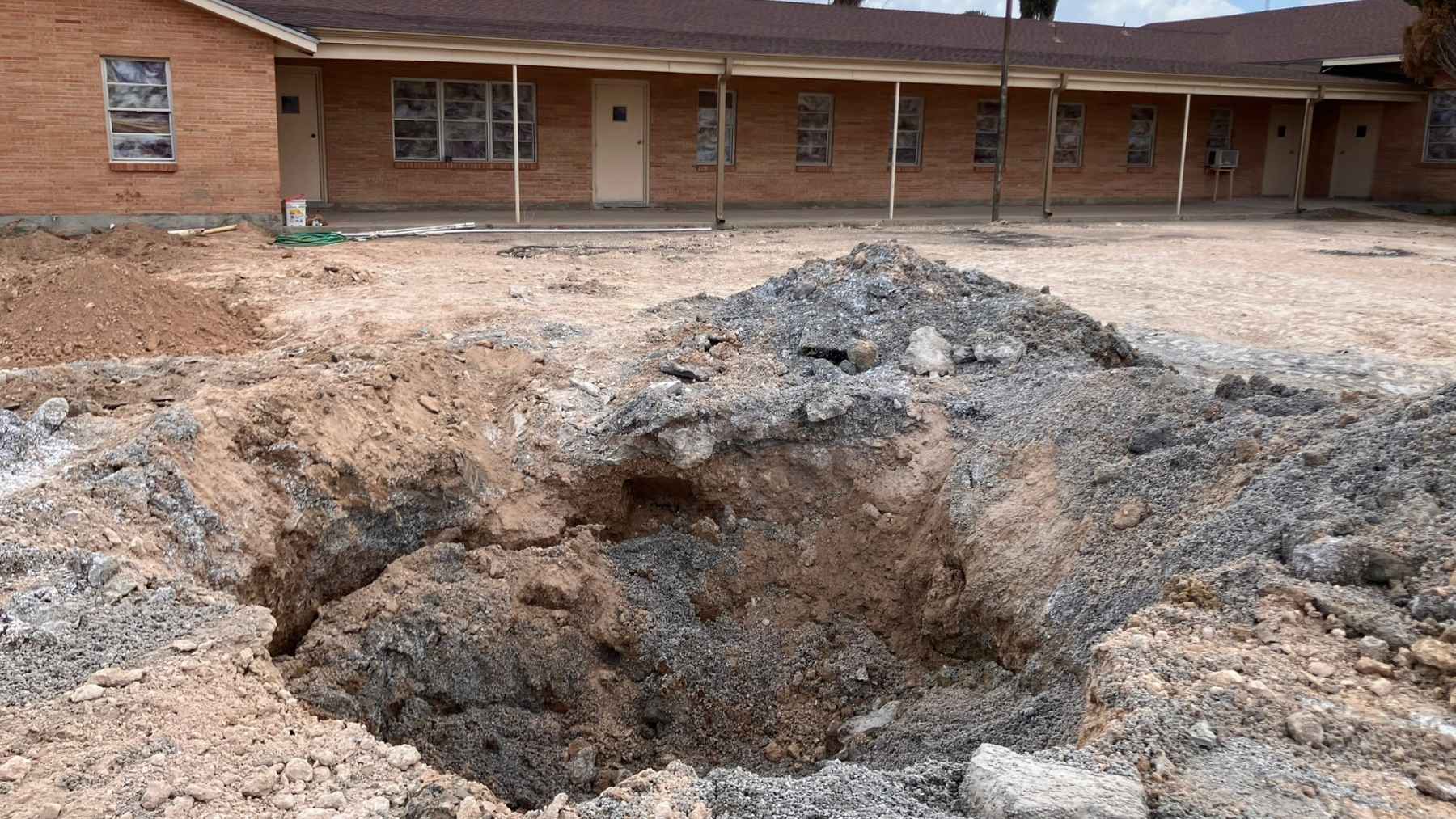
Asphalt lifting in a low dome, early on a Tuesday morning in a West Texas town of 375 people.
Then a split, and salt water weeping out of the crack.
It was April 21, 2026. The water did not stop for eight days.
A laboratory in Midland put total dissolved solids at 138,771 parts per million, roughly four times the salinity of seawater, with chloride and sulfate alongside.
No rig stood nearby. No pipe broke.
It came up through solid rock.
Seven barrels a minute, out of a sealed hole
The water was not leaking. It was being pushed.
A well in the Delaware Basin lifts close to five barrels of salty water for every barrel of oil, and almost all of that water goes back down into deep injection formations.
Those formations have no outlet. Every barrel that goes in adds pressure for the next one, and pressure looks for the shortest way up.
Earthquakes had already forced the state to restrict deep injection in some areas, which leaves the shallower zones to take more.
An old wellbore is the shortest way up. It is a vertical hole through thousands of feet of rock, and the cement poured into it can shrink, channel or corrode across decades.
So the failure is not at the surface and it is not in a pipeline. It is a column of rock with a man made hole in it, and the hole was there first.
Pressure goes in. Pressure comes out somewhere.
Eight days and 21 vacuum trucks
The church was built in 1955 and stands on Avenue D, across the street from the town’s only school.
Water reached the surface of the church parking lot that Tuesday morning and kept coming.
Twenty one vacuum trucks rotated through the site around the clock. The first night took 2,280 barrels off the lot.
The 24 hours from April 22 to April 23 took 6,600 barrels, about 277,000 gallons. Two days later another 24 hour stretch took more than 10,000.
Crews found a wellbore and filled it with concrete on April 29. Salt killed several trees, and during the work the church sewer line was cut by accident.
Trucks around the clock. A congregation meeting across the street.
138,771 parts per million, and a rate check
A laboratory in Midland put total dissolved solids at 138,771 parts per million, roughly four times the salinity of seawater, with chloride and sulfate alongside.
The volume comes from state records. More than 1.5 million gallons over the eight days.
Those two figures allow a check on the flow rate. Spread evenly, 1.5 million gallons over eight days is about 130 gallons a minute.
A state daily report describes 7 barrels a minute at the leak, which is 294 gallons a minute. For a flow that rises and falls over a week, those two sit together comfortably. Nothing in the record describes a constant rate.
A line that has circulated since, describing thousands of gallons a minute, does not. At that rate the entire release would have been over before lunch on the first day.
Four times as salty. Eight days of it.
A 1.49 million dollar plug and a 1.16 million dollar haul
The state paid for this. The commission spent 1.49 million dollars plugging the leak and another 1.16 million disposing of the water back underground.
That is about 2.65 million dollars for one hole under one church parking lot.
Now set it against what an operator posts in advance. A single well bond runs 2 dollars per foot. A blanket bond covering a company’s whole inventory is 25,000, 50,000 or 250,000 dollars.
Those rates have not been raised since 1991. One leak in one small town ran past ten times the largest of them.
There is also nobody to bill, because the commission said in June that it still could not positively identify the well.
Methane keeps rising from forgotten wells that were never mapped either.
The sheer volume going back underground was covered here in a piece on produced water.
One well cost millions. One bond caps at 250,000.
Twelve thousand orphans, up 37 percent in a year
Texas passed 12,000 orphaned wells in April, a 37 percent rise in twelve months and the largest jump in recent record.
The pace of plugging does not match it. The commission plugged 46 priority wells in one program year and 52 in the next.
Federal money moved faster. Texas received 25 million dollars in 2022, which plugged close to 730 wells, and another 80 million in 2024.
The well under this lot appears in none of those counts, because it had already been plugged, reportedly back in the 1930s.
The state map shows at least two dozen plugged wells inside the Grandfalls city limits alone.
The eight days, the lab result and the costs were reported by a newsroom.
The orphan count and the bond rates come from a well tracker.
An orphan list counts what is open, and this one was closed on paper.
Hugo is an engineer with strong technical expertise. Multilingual from an early age, his writing combines technical clarity with a strong interest in science and energy.
