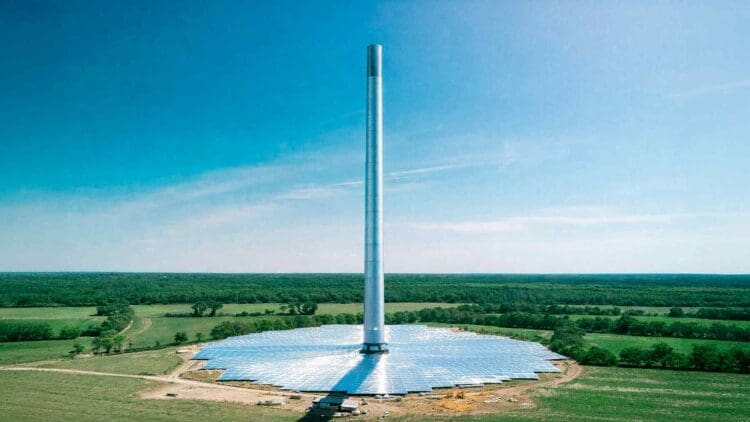

The bitterness of the cold will never have to bother us again.
Through the looking-glass, an “old-world” reliability now breathes with its occupants, powering a futuristic, zero-power climate.
This design serves a dual purpose as an artistic masterpiece and a sophisticated energy reservoir, driving a continuous natural cycle.


Even after sunset, when the night comes to life, could this sculptural piece bring the heat when it counts most?
How the architectural climate is becoming more difficult to regulate sustainably
Change is inevitable, but rapid, unexpected weather change makes for restless moods.
The world is struggling to adapt to new seasonal norms.
First, we are trapped in extreme heat domes, and then suddenly, bitter cold snaps try to break us.
For most, the energy needed to “fight” the exterior environment is nearing breaking point. To add insult to injury, current cooling and heating solutions further strain the very atmosphere we are trying to escape.
As weather patterns become more unpredictable, maintaining a stable interior is becoming more difficult by the day.
As a result, the glass-and-steel boxes from the last century often fail when the grid – or thermometer – reaches its limit.
The need to regulate the interior climate more sustainably has never been greater than it is now.
As the chaos from outside tries to seep in, perhaps we should begin revisiting “old-world” concepts?
When “green” architecture falls short, new ways of thinking become vital
Engineers and designers alike are thinking outside the old “glass-and-steel” box to find more sustainable solutions.
Without doing so, addressing the chaotic shifting climate would be increasingly more difficult. Now, most buildings have become draped in modern renewable technologies.
Skyscrapers are being clad in photovoltaic skins, and rooftops are transforming into lush, living gardens.
These eco-friendly additions are key to lowering structures’ carbon footprints. However, are they not more of a superficial layer rather than a structural solution?
Solar power has been reimagined to more easily coat building walls like a plant vine. Yet, these reimagined designs do not stop buildings from overheating like an oven in July.
This is why engineers are exploring sophisticated, century-old designs.
They discovered that a “forgotten idea” could transform architecture into a life-support system.
The solar chimney: A sculptural life-support system
Modern hydraulic heat capture concepts are great for heating a home. But what happens when occupants can no longer take the heat?
Enter the old-world concept known as the solar chimney. It is featured in the study “A review of the applications of solar chimneys in buildings” published in Science Direct.
It essentially acts as a “thermal engine” for a building. It relies on three principles: solar gain, buoyancy, and the stack effect.
The zero-power HVAC system that never punches out for the night
A transparent glass surface faces the sun, and a dark-colored interior wall. Sunlight passes through the glass, hits the wall, and turns into heat.
The chimney’s interior air heats and quickly rises to the top (buoyancy).
Hot air escapes, and a pressure difference builds at the bottom, pulling stale air out of the building’s rooms. Cooler air is sucked in either through windows or underground vents (stack effect).
Interior walls often consist of phase change materials that act as “thermal batteries.” Heat is absorbed during the day and slowly released at night, continuing the cycle even in darkness.
Combining ancient thermal principles with modern sculptural design is the perfect recipe to outpace the volatility of the changing climate.
The solar chimney transforms the heart of architecture into silent, self-sustaining life-support systems that breathe without a grid.
Existing and new buildings thus no longer have to fight the surrounding environment to provide us with comfort. Thanks to innovative designs, homes become resilient, timeless sanctuaries that embrace sustainability.