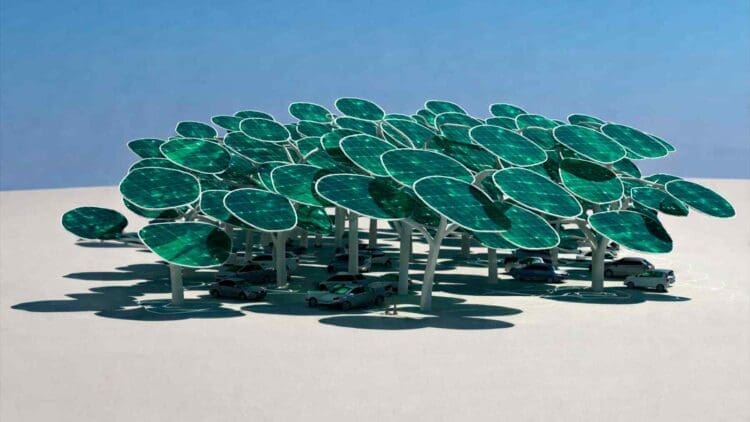

A design that changes perspectives on how to make city life more sustainable.
In the heart of Shanghai’s concrete jungle, despite significant advancements, it is still a matter of urban survival.
It is mankind versus climate change, health and sustainability versus sickness and pollution, and smart technology versus obsolete infrastructure.

Now, a solar grove has taken root with a hidden purpose, but will it help mankind survive the urban jungle?
How a “solar forest” could solve the urban EV charging crisis
Worldwide, global hubs like Shanghai are facing a high-stakes quest for sustainability.
Unfortunately, most have reached an impasse on this quest.
Skylines are rapidly thickening, making the primary barrier to green energy a chronic lack of space.
Adequate survival in major cities necessitates a vast energy demand. Traditional solar arrays cannot meet this demand because every square foot is optimized for high-rise development.
This makes the reliance on a centralized, carbon-heavy grid an ill habit that is not easily broken.
Concrete jungles are also grappling with intensifying air pollution and the “urban heat island” effect.
As millions of cars with internal combustion engines pass through city centers, they trap heat and exhaust. The resulting, increasingly stagnant air then becomes a threat to survival.
Sustainable practices in dense environments are thus vital. But what solutions are there to help humanity become the fittest to survive?
From the electric transition’s friction to integrated additions
Electric vehicles (EVs) have been evolving and have been hailed as a primary weapon against a carbon-heavy future.
However, navigating the smog-filled streets of major cities with EVs is not always easy.
The average urban EV owner must face persistent and physical challenges. This includes hunting for a reliable charging point in crowded city centers.
There is also a lack of integrated solutions in concrete jungles. This means charging often occurs in exposed, sweltering parking lots, exacerbating the “heat island” effect.
Several designers and engineers have realized the need to tip the scales of survival.
This is why urban architecture is not simply being altered, but rather reimagined. Central to this new city concept is the combination of solar with integrated designs.
One such pioneering designer is Neville Mars, who suggested “growing” a unique grove in the heart of Shanghai.
What the “solar forest” reveals about the future of green Shanghai
Planting “living” solar trees in cities may not be a new concept per se. However, Neville Mars’s proposed concept had a secret dual purpose.
Mars is a Dutch architect and the director of the Dynamic City Foundation. He spent decades researching the “hyper-speed urbanization” of Asian hubs.
“Solar Forest” was proposed as a response to the growing friction between EV popularity and the lack of clean energy.
He envisioned Solar Forest to “empathize” with the EV, but the design optimization led to an additional urban benefit.
The hidden power of Mars’s Solar Forest
Initially, towering solar panels were to function as a high-capacity EV charging network in parking lots. As the panels were adapted for maximum energy collection, they became leaf-shaped.
Thus began the rise of the tilting solar canopy. It provides much-needed shade to “overworked” EVs and drivers in a stress-free environment.
The energy load on the EVs themselves is also decreased, thanks to no longer having to blast the AC.
Mars’s Solar Forest indicates that “concrete jungles” do not have to be survival sites, but rather sites of synergy.
Combining urban infrastructure with biomimicry moves cities beyond stagnant grids. These city centers can finally be powered by decentralized, “living” power sources.
The future of urban architecture can be focused on “growing” energy rather than consuming it. If we plant the seeds today, cities of tomorrow will breathe, charge, and finally thrive.