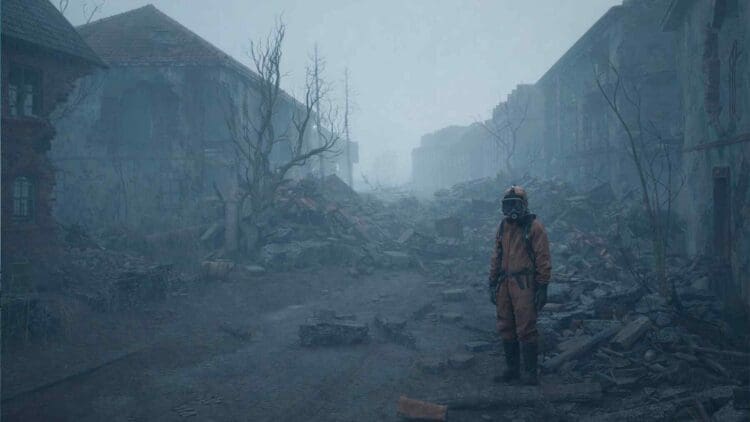

Some fear the unknown, but this woman embraces it to an extreme extent.
The world is filled with unique, mysterious places, as well as researchers and adventurers who love to explore these zones.
While some like to push life’s boundaries in the name of science, others simply do it out of pure curiosity.



Is it a foolish approach to life, or is it the only way we can truly begin to live fully?
There’s a fine line between the pursuit of knowledge and reckless behavior
Sometimes, researchers can be perceived as the “daredevils” of the world.
To them, there is no boundary when it comes to making a scientific discovery. For others, the presence or absence of measurable data in research creates a fine line.
Boundaries are defined by how danger is perceived. Casual observers see hazardous environments as a monolith of risk.
Researchers most likely see complex maps of varying intensities. To the world, this is beneficial, as the pursuit of knowledge requires a daring willingness.
Without this daring, willing behavior, wouldn’t our knowledge of the world have been very limited?
Experts argue that technological and scientific breakthroughs would never have happened if curiosity did not get the best of us.
But exactly when does curiosity end up killing the cat?
The catalysts of scientific discoveries often involve pushing the boundaries
Without curiosity in the world, many laws and mysteries of the world would have remained unraveled.
The most transformative breakthroughs in history have often occurred at the edge of the forbidden.
In a world where climate change looms over our survival, researchers are adamant in finding a final solution.
Nuclear science, particularly its power, has gained renewed interest. This is largely driven by the urgent need to address the global climate crisis.
This low-emission “baseload” source is key to stabilizing renewable networks. Researchers are developing the next generation of nuclear technology, with many eyeing advanced fusion concepts.
However, extreme precision is required for this renewed curiosity. Lest we forget the hazardous environments that were shaped by past atomic events.
Yet, there is a woman who seems to thrive on throwing caution to the wind. Not even one of the most dangerous zones on Earth seems to concern her.
The daredevil woman who willingly embraced the risks of Chernobyl
The dangerous zone in question is none other than the Chernobyl Exclusion Zone.
And the daredevil young woman in question?
She goes by the name “Bionerd23,” and she has become quite the anomaly.
Bionerd23 is famous in the scientific community for her provocative exploration of radioactive sites. Her favorite “living laboratory” is the 1,000-square-mile perimeter of the 1986 nuclear catastrophe.
While this major nuclear accident has rattled public confidence, she became more confident exploring the site. She even dared to eat a lone “Chernobyl apple,” intriguing scientists with her systematic approach.
The effects after the “cat-killing” curiosity got the best of her
Before eating the apple, she used a gamma spectroscope to study its isotopic nature. She discovered the apple contained nearly 39 Bq/kg of Cesium-137.
This was far below the commercial food safety threshold set by the European Union. After she ate it, her biological data indicated a negligible increase in internal radiation.
The conclusion was not so “lethal” as the public expected.
The moral of the story: The Chernobyl apple experiment shows that data-driven perspectives are essential for understanding environmental resilience.
Bionerd23 demonstrated that nature possesses a “stealth” autonomy, filtering the past to produce something unexpectedly life-sustaining. It gives us hope that Earth will eventually restore mankind’s damage.
As AI fast-tracks nuclear fusion breakthroughs to help combat climate change, the complex biological and technical realities must not be ignored. Accidents happen, but healing takes time.