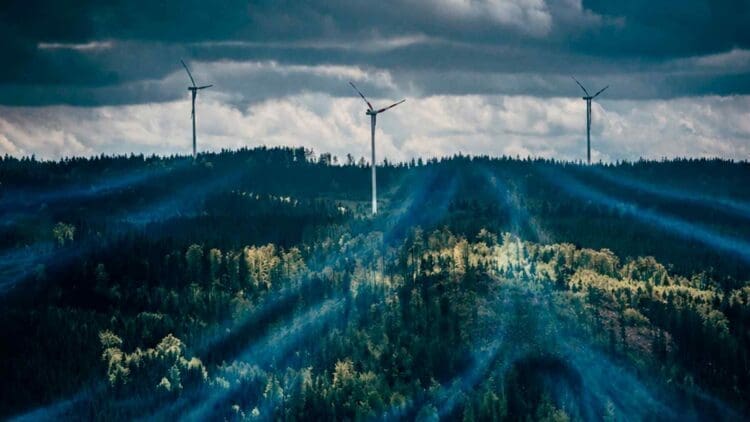

A chain is as strong as its weakest link, and on wind farms, a failure in site reconnaissance proves it.
Renewable energy technology has evolved into sleek, high-tech designs befitting of the digital age.
Yet, even a minor mistake could leave the most advanced operations completely vulnerable to the consequences.


Left to face the irreversible damage, would it not be best for the wind industry to make a tactical retreat?
How wind turbines have transformed to meet modern-day standards
The world has rapidly become digitized to adapt to a new, data-driven, fast-computing society.
But with progress comes greater demands, especially from data centers that keep the digital age operational.
Wind power remains the most cost-effective way to add new renewable capacity to this day. This factor is why it also had to undergo an industrial evolution.
The modern turbine is now a masterwork of digital engineering that can meet the relentless demands of the 21st-century grid.
Advanced sensors provide high-precision capabilities that enable millisecond-level modifications as required to maintain performance.
The aerodynamic form not only boosts efficiency but also the aesthetic appeal of turbines.
Furthermore, wind farms have deployed significantly scaled-up, high-speed installations to meet international climate targets.
It highlights the industry’s ambition, but does this rapid transformation not leave a very small margin for error?
The logistics of the march towards the digital future
Fast-paced computing and AI energy demands are growing exponentially, and they will not stop anytime soon. This is why capacity planning must be efficient while minimizing environmental impact.
However, utility-scale deployment is lagging behind global electricity demand growth.
This can be attributed to the more complicated logistical efforts to move these scaled-up turbines. Not only is it more time-consuming, but specialized transport also increases costs.
Altogether, it creates a velocity gap that is difficult to bridge and slows down meeting fast-approaching climate deadlines.
It has placed the industry under severe pressure to keep up with the digital future.
As it rushes into expansion, the focus is often on turbine efficiency and grid connection, overlooking the immediate environmental impact.
The Viking Energy wind farm on Shetland served as a case study of how a slight oversight could change everything.
The National Wind Watch and EOS provided insights into the site’s incident.
The broken formation of Shetland’s wind farm
Usually, when a wind farm’s operations are halted, it is due to a turbine failure. But this was not the case with the Viking Energy wind farm.
The farm was designed to be a strategic stronghold in the UK’s renewable portfolio. However, in May 2024, the unthinkable happened.
An error occurred, but not due to turbine software or digital modeling, but due to a failure in geotechnical reconnaissance.
The weak link that caused a massive peat slide
Improper mechanical loading of heavy rock onto the sensitive blanket bog led to the peat slide.
EOS noted that the material’s weight exceeded the peat strength. The pressure impacted the acrotelm (the bog’s “living skin”), turning the saturated lower layers into a lubricant.
National Wind Watch classified the consequences as permanent environmental damage.
A ruptured peat bog releases centuries of captured carbon when exposed to oxygen, entirely defeating the purpose of the site.
It proves that when the march to establish a wind army moves too fast, the risk is losing valuable territory.
A minor man-made error jeopardized the integrity of site management and led to an irreversible ecological impact.
How the wind industry handles failure is vital to maintain its place in the renewable world. Wind power remains integral to the global green energy transition, but perhaps it should retreat from high-risk, sensitive terrains.