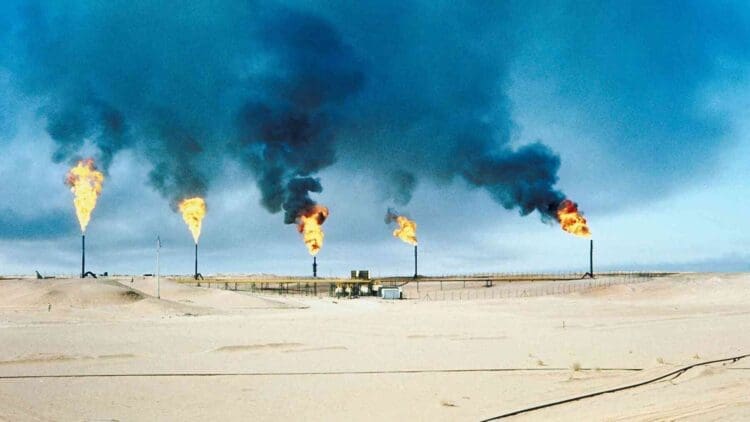

Most people picture fossil fuel pollution at its edges — the drilling rig punching into the earth, the smokestack exhaling above a power plant. But between extraction and combustion lies an enormous, largely invisible network: pipelines threading through suburbs, storage tanks tucked beside city neighborhoods, refineries operating just down the road.
A new nationwide analysis has now put a precise number on how many Americans live inside that hidden geography — and the figure raises serious questions about health risks that science has barely begun to examine.
A hidden network hiding in plain sight
Extraction and combustion attract most of the attention when researchers study fossil fuel pollution. Between those two endpoints, though, lies a chain of additional stages — refining, storage, and transport — that moves oil and gas across the country before it ever reaches a power plant or furnace. These mid-supply-chain facilities can emit volatile organic compounds and other pollutants, yet dedicated health research has rarely focused on them.

The new study, published in Environmental Research Letters, changes that. Led by Boston University researchers Jonathan Buonocore and Mary Willis, it’s the first analysis to map all five stages of the fossil fuel supply chain at a national scale. To make that possible, the team built the EI3 Database for Public Health — consolidating fragmented local, state, and federal data sources, some of which previously required payment or special access, into a single accessible resource.
46.6 million people, one mile away
The headline finding is direct: 46.6 million people, representing 14.1% of the U.S. population, live within 1.6 kilometers — roughly a mile — of at least one fossil fuel infrastructure component.
The breakdown by stage is telling. Nearly 21 million Americans live near end-use facilities such as power plants, and more than 20 million live near extraction sites including oil and gas wells. Around 6 million live near storage facilities — underground gas storage sites and petroleum product terminals. Fewer residents live near refining or transportation infrastructure, though those sites aren’t absent from populated areas. Roughly 9 million people live near more than one type of facility simultaneously, meaning they face layered exposure.
Urban areas and storage sites carry the heaviest burden
Geography shapes who bears the greatest burden. Nearly 90% of people living near end-use, transportation, refining, and storage sites are located in urban areas — a concentration that becomes especially stark when you examine the numbers on a per-facility basis.
A single storage facility has, on average, 2,900 residents living within a mile of it. A typical extraction site has only 17. Extraction sites are numerous but tend to sit in sparsely populated rural regions, while storage facilities are fewer in number yet cluster in densely populated zones. “That means that if a local policymaker in an urban area were to take interest in reducing exposures, they may receive the most impact per piece of infrastructure if they focus on storage,” Buonocore said.
Environmental inequity runs through every stage
The study doesn’t just map proximity — it maps who lives nearby. Communities that are predominantly non-white face higher exposure across all five stages of the supply chain, a pattern that reinforces a substantial body of prior environmental justice research linking fossil fuel infrastructure to racial and socioeconomic disparities.
Previous studies near extraction and end-use sites have documented higher rates of adverse birth outcomes and asthma, and researchers are exploring possible links to conditions including leukemia. For the middle stages of the supply chain — refining, storage, transport — health effects remain largely uncharacterized. The study explicitly flags that gap as one of its most consequential findings.
What comes next: monitoring, policy, and unanswered questions
The EI3 database is a foundation, not a finish line. The research team plans future work that includes detailed monitoring of air, water, noise, and light pollution near specific facilities, alongside efforts to link infrastructure proximity to health outcomes using datasets such as Medicaid records and data on specific populations including pregnancy planners.
One goal stands out as particularly significant: directly comparing health effects across supply chain stages. “We’re really the first group thinking about this as an integrated system,” Willis said. “By quantifying all of these factors at once, we’re potentially able to, down the line, directly compare: what are the health effects of living near an extraction site, compared to living near a storage site?” That comparison was previously impossible without a unified database.
Many states still permit fossil fuel infrastructure to be sited very close to homes and schools, with limited regulation. As the research expands — from mapping proximity to measuring emissions to linking exposure to outcomes — the findings could give policymakers the evidence base they need to act. For the 46.6 million Americans already living inside that hidden geography, the science is only now catching up.
Kelly is an experienced writer with 15 years of experience exploring the big stories that shape our world, from tech breakthroughs and space exploration to climate, energy, and the fascinating quirks of science. She has a talent for turning complex ideas into sharp, memorable insights that stay with readers long after they’ve finished reading.