
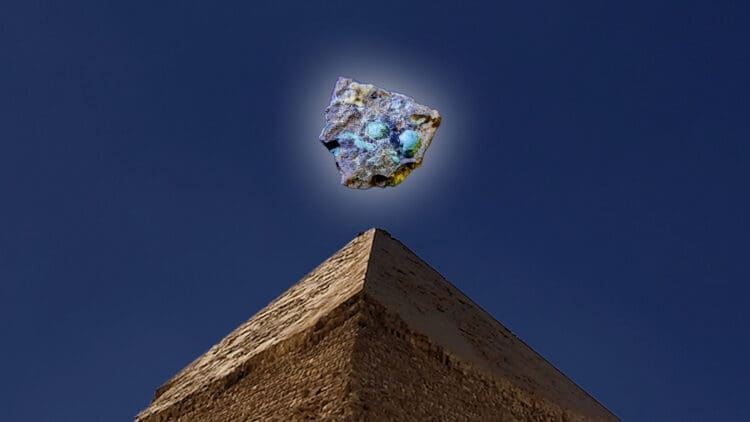
Ancient methods and materials are still relevant in modern times. A substance that the dynastic Egyptians utilized—and in fact believed was spiritual, mystical, and magical—is revealing its uses in the solar energy world. How could something that was uncovered in relics from the times of the Pharaohs and the building of the pyramids be relevant to modern science? This is how it is, even contributing to decarbonization.
How various ancient Egyptian “technologies” impact us in modern times
Ancient Egyptian influences are observed across several aspects of our Modern Age. Scientific and mathematical developments, such as geometry, combined with astronomical insights, aided this pioneering nation’s engineering and architecture. These learnings remain highly influential, and right now, it is solar technology that is set to benefit.
A research team from the University of New South Wales (UNSW) in Sydney, Australia, turned to an old material that was popular long before the reign of King Tutankhamun, with some experts indicating it was used as early as 5,000 years ago. During this time, ancient Egyptians primarily utilised it for:

- Cosmetic purposes, such as eyeliner and mascara.
- Medicinal purposes, for example, to prevent eye infections.
Now, these UNSW researchers have broken a new record in the modern-day solar world, possibly on the way to replacing traditional solar panels altogether. The material that they’re working with is antimony chalcogenide, which the Egyptians used in the form of stibnite, and they’re applying it to tandem solar cells.
No one imagined that Egyptian make-up or medicine would end up transforming solar panel performance
Silicon-based solar cells are the most commonly used in solar panels today. However, several innovative minds have dedicated themselves to creating alternative materials that deliver higher efficiencies, among other benefits. Some have focused on perovskite as a contender material, while others have turned to a mythical green solar cell material that boosts sunlight significantly. However, these materials still present significant obstacles.
This is why the USNW research team is looking to develop antimony chalcogenide. This substance is made up of selenium, antimony, and sulfur, and has been of interest as a tandem top-cell in the past due to its highly favorable characteristics:
- Affordable production at low temperatures
- High sunlight absorption
- Thin-layer application
- High stability
However, this old material has also faced a significant obstacle over the past few years, namely, efficiency. Now, all of that has changed for good, as the UNSW’s research team has made a significant scientific breakthrough.
Setting new solar efficiency records with this “new” ancient material
Antimony chalcogenide’s highest efficiency has never surpassed 10% since 2020. Fortunately, the UNSW researchers discovered why this was the case. It turns out that selenium and sulfur were distributed disproportionately throughout the material after production. As a result, the solar cell had energy barriers that prevented the free movement of electrons and caused energy loss.
The solution to the problem was simpler than one would think. The researchers added a trace of sodium sulfide to enable a controlled reaction, resulting in a more even distribution. The results were significant, as efficiency levels increased to a record 10.7%, which was confirmed by Australia’s Commonwealth Scientific and Industrial Research Organisation (CSIRO).
Beyond the material’s valuable use in tandem cells, which could give perovskite-silicon tandem panels with their new commercial efficiency a run for their money, other commercial applications of the material can also be explored, such as indoor lighting and solar windows.
The flurry of activity in the renewable energy sector has seen innovation and development booming in many different sub-sectors. In the photovoltaics field, Australia has proven its dedication to advancing solar materials by discovering another contender material for perovskite.
Disclaimer: Our coverage of events affecting companies is purely informative and descriptive. Under no circumstances does it seek to promote an opinion or create a trend, nor can it be taken as investment advice or a recommendation of any kind.


