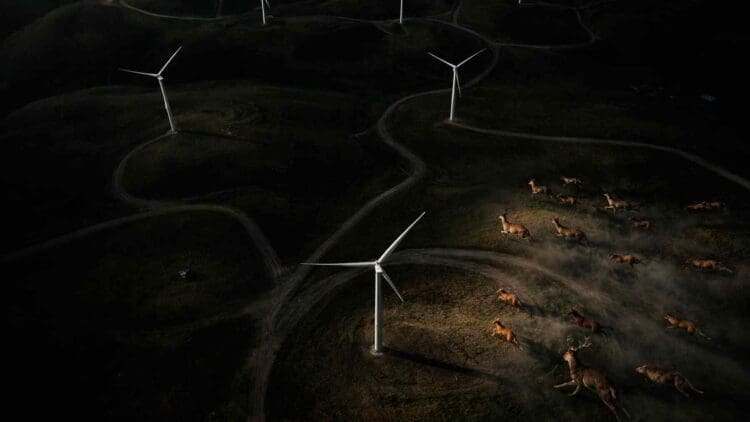

Wind turbines have invisible barriers that keep certain animals away.
Some regions experience higher levels of optimal wind conditions compared to others, making them more favorable for clean wind power.
However, expanding wind energy capacity is not as simple as many would think, as it requires significant in-depth impact studies.


Recent findings have unveiled a harsh truth about turbines, but will it stop the world from investing in such projects?
How the “NIMBY” movement is expanding its membership
For several communities around the world, the answer to achieving net-zero milestones is blowing in the wind.
The expansion of global wind energy capacity has become a non-negotiable priority.
When the sun does not shine, and power grids are under pressure, wind power is the perfect complement.
Now, towering turbines are being deployed from the vast plains of the American Midwest to the ridges of Northern Europe.
However, despite the need for greener power solutions, there are several great obstacles to this particular green expansion.
Protests from the “Not in My Backyard” (NIMBY) movement are the biggest obstacle to wind capacity expansion.
Now, this movement has officially gone wild.
Humans are arguing over property values and obstructed views. Meanwhile, some wildlife simply refuse to interact with the modern “green” landscape.
What exactly is responsible for this systemic shift?
The aerial bias of wind turbines’ environmental impact
Historically, the impact of wind energy on the natural world has mostly been viewed through a vertical lens.
By now, most people worldwide have been made aware of the impacts of turbine blades on bats and birds. Mortality rates are shockingly high, which is why unique, bladeless designs are being explored as alternatives.
While some researchers have been seeking high for potential impact, others have been searching low and deep.
Offshore turbines have also been found to have high potential to alter the critical behaviors of marine mammals. Some research suggests that whale migration routes are mainly affected.
Naturally, aerial and marine impact studies are vital, but they unintentionally create a blind spot regarding terrestrial animals.
Recent studies, including one study on the National Library of Medicine, are shedding new light on the “horizontal” influence.
The wildest neighbors are avoiding an invisible fence
A review by the Natural Resources Institute Finland (Luke) analyzed 84 studies from 22 countries.
The findings confirmed that 67% of terrestrial mammals clearly “avoid” wind turbine areas. This is known as displacement, and the phenomenon extends nearly 3 miles away from spinning blades.
The invisible sensory experience behind this wide displacement is called an “acoustic shield.” This particular shield is keeping some animals at bay.
Humans are commonly annoyed by turbine noise pollution. Most terrestrial animals have better hearing than humans, so imagine how sensitive they must be.
The sensory blackout caused by wind turbines
When it comes to survival, some species, such as the European hare and roe deer, depend on hearing. Without it, they are vulnerable to predators.
The spinning turbine’s continuous, low-frequency hum blacks out their senses. This is why herbivores avoid turbine zones.
In an unexpected turn of events, the National Library of Medicine study indicated the common pheasant did the exact opposite. They feel safer because the hum keeps predators at bay.
Nonetheless, these studies have proven that the biggest obstacle currently to global wind expansion is habitat safety concerns.
It is about time everyone faces the “harsh truth.” Ecologically, a turbine has a much greater impact than expected.
This is why attempts to lower carbon must not compromise the very ecosystems we want to save.
The wild has spoken, and we must begin to listen. This means wind turbine designs must undergo a complete silent makeover.
Disclaimer: Our coverage of events affecting companies is purely informative and descriptive. Under no circumstances does it seek to promote an opinion or create a trend, nor can it be taken as investment advice or a recommendation of any kind.