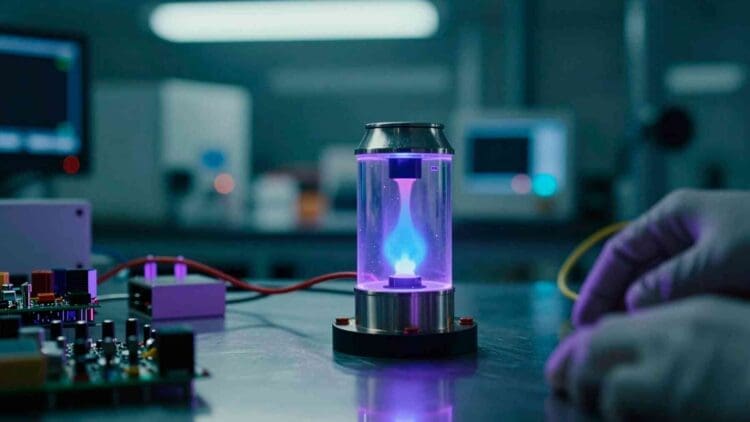

Avalanche Energy just announced that Jyn, its compact fusion plasma device, hit ion energies equivalent to temperatures above 1 keV — that’s roughly 20 million degrees Fahrenheit — during testing. The Seattle-based startup calls it a key plasma performance milestone in its compact fusion program. Oh, and the Jyn device? It’s less than five inches in diameter.
Jyn device records ion temperatures above 1 keV in a compact fusion test
Hitting 1 keV isn’t a minor checkpoint. For any fusion system, crossing that threshold means the plasma is performing at a level where fusion reactions become meaningfully probable. The fact that Jyn pulled this off in a device smaller than a soda can makes the result hard to ignore.
Avalanche Energy frames the result as a concrete step toward building production-ready fusion systems. Jyn isn’t the final product — it’s a demonstration that their compact design can generate plasma conditions relevant to real fusion energy output. That framing matters, because it places the milestone inside a longer development arc rather than treating it as a standalone win.

The 1 keV mark reflects the energy scale at which atomic nuclei can start to overcome their natural electrostatic repulsion. Without sufficient ion temperature, fusion reactions simply don’t happen at useful rates. There’s no shortcut around that physics.
Why Avalanche Energy pursued a compact, iterative development approach
Most fusion projects you’ve heard of depend on large, expensive facilities—the kind that take decades to build and cost billions. Avalanche Energy went a different direction on purpose. Instead of betting everything on one massive machine, they built smaller systems designed to be modified, tested, and rebuilt quickly.
That approach is grounded in a physics concept called the Orbitron, which underpins Jyn’s design. The Orbitron differs fundamentally from the tokamak architecture that dominates mainstream fusion research, and it lets Avalanche Energy pursue a much more compact form factor without abandoning the core physics requirements of plasma confinement.
CEO Robin Langtry highlighted the contrast between Jyn’s size and its performance. The device is compact enough to fit on a truck, yet it reached ion temperatures comparable to those found in the sun’s core. That juxtaposition is basically the company’s whole argument: big results don’t require big machines.
The strategy also prioritizes learning. Each hardware iteration feeds lessons into the next build cycle, compressing the time between experiments, which, in theory, accelerates progress while keeping costs well below those of traditional fusion programs.
What the plasma milestone means for fusion energy development
Fusion works by forcing atomic nuclei close enough together that they merge and release energy. The catch is that nuclei carry positive charges and naturally push each other away. Overcoming that repulsion takes enormous energy, which is exactly why ion temperature is such a critical variable. As temperatures climb, the probability of successful fusion collisions goes up.
Reaching 1 keV in a sub-five-inch device validates more than just a number. It confirms that Avalanche Energy’s compact plasma design can sustain the conditions necessary for fusion-relevant performance — a meaningful distinction, since it’s not enough to build something small if the physics fall apart under real conditions.
The milestone also supports the company’s longer-term goal of scaling power output from kilowatts to megawatts. Jyn isn’t producing megawatts yet. Demonstrating plasma performance at this level is a prerequisite for getting there, though. You can’t scale what you haven’t proven.
Compact fusion systems, if they keep maturing, could shift the economics of fusion energy development considerably. Conventional large-scale projects carry enormous upfront costs and long timelines — a modular, iterative approach could reduce both, though that still needs to be demonstrated at higher power levels.
Avalanche Energy’s background and target applications
Avalanche Energy was founded in 2018 and is based in Seattle. The company’s stated mission from day one has been to develop hand-held, portable fusion power units — an ambition that now has at least one verified plasma performance result behind it.
The company specializes in modular micro-fusion reactor development, targeting applications where compact, high-density power sources offer clear advantages. Their primary markets are space, defense, and industrial sectors — areas where portability, reliability, and energy density often matter far more than raw scale.
Space applications make a particularly compelling case. Power generation in deep space is a persistent challenge, and a compact fusion source could address it in ways that solar panels or conventional nuclear systems can’t. Defense and industrial contexts follow similar logic: situations where reliable power is needed in remote or constrained environments.
For Avalanche Energy, the Jyn milestone also validates their iterative hardware strategy. The company ran numerous development cycles before arriving at this result, and each previous machine contributed to the design choices that made the 1 keV achievement possible.
Modular micro-fusion systems
Avalanche Energy’s Jyn device achieved ion energies equivalent to temperatures exceeding 1 keV — roughly 11 million degrees Celsius — in a plasma device under five inches in diameter. The 1 keV threshold is a recognized performance benchmark in fusion development, since higher ion temperatures directly increase the likelihood of fusion reactions occurring.
The result validates the plasma performance of Avalanche Energy’s compact Orbitron-based design and supports the company’s goal of scaling from kilowatts to megawatts. Founded in 2018 in Seattle, the company is targeting space, defense, and industrial markets with modular micro-fusion systems. The Jyn milestone reflects multiple iterative hardware development cycles and marks a measurable step in the company’s path toward production-ready fusion technology.
Kelly is an experienced writer with 15 years of experience exploring the big stories that shape our world, from tech breakthroughs and space exploration to climate, energy, and the fascinating quirks of science. She has a talent for turning complex ideas into sharp, memorable insights that stay with readers long after they’ve finished reading.