
The “Land Down Under” is taking renewable energy potential to a whole other level.
Known for its vast, bright, and sunny landscapes, this backdrop has become the perfect canvas for unique green infrastructure.
Solar power may be central to the technology, but how the energy is focused paints a different picture entirely.



Will this “eccentric” technique change how solar could be focused in the future, and possibly reshape carbon-heavy industries?
How some are struggling to let go of fossil fuels
Renewable energy capacity has skyrocketed over the past few years, with solar energy topping the charts.
Globally, giant solar panel installations have become a given in most sunny regions, such as Australia.
Many households and businesses have embraced this power source, but for many, it still does not make the cut.
Nearly 75% of industries still rely on fossil fuel-based energy sources. This includes sectors such as iron and steel production and alumina refining, which depend on extremely high temperatures.
For these massive sectors, commercial solar farms and standard batteries fall short of providing the desired thermal energy levels.
Even if an adequate temperature can be reached, conventional batteries are less beneficial for energy storage. Their hidden footprint makes them non-ideal, which is why alternative sources are gaining traction.
Today, one of the most sought-after sources is hydrogen, but since the natural form is scarce, it must be produced.
Harnessing the power of a thousand suns
In the U.S., green hydrogen production infrastructure is expanding fast nationwide.
Its popularity stems from its ability to serve as a direct replacement for fossil fuels in high-heat furnaces. The best part is that it only emits water vapor as a byproduct.
Unfortunately, using conventional solar energy (photovoltaics) is not efficient in this case.
Producing hydrogen that way would result in significant power losses due to multistep energy conversions. Also, to make water electrolysis most efficient, direct thermal heat surpassing 1,800°F is required.
This is where thousands of sun-tracking mirrors and concentrated solar power come in.
This effectively eliminates the middleman, as this highly concentrated energy is directed onto a tower in the middle’s receiver. Extreme temperatures are then achieved to split water molecules directly.
Unfortunately, this technique is not easily scalable for heavy industry. But now, CSIRO may have found the ideal solution.
Taking concentrated solar to another level for efficient green hydrogen production
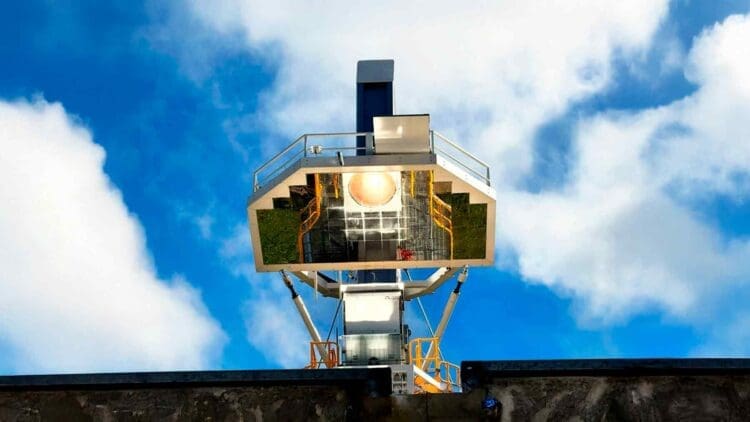
Conventional concentrated solar reactor designs beam energy upwards. To overcome scalability obstacles, CSIRO flipped the switch on efficiency by engineering a “beam-down” solar reactor.
This approach places a secondary mirror at the top of the tower. The mirror then reflects the concentrated solar energy back to a ground-based reactor.
However, the real magic happens on the inside.
Unveiling the magical process inside ground-based reactors
Together with Japan’s Niigata University, a specialized catalyst called “doped ceria” was created. It is a modified metal oxide that can “inhale” and “exhale” oxygen at certain temperatures.
When solar energy is “beamed down” and heats doped ceria, oxygen is released. When steam is added, oxygen is removed directly from water vapor, producing pure green hydrogen.
The green hydrogen can then be captured and stored for heavy industry, providing a number of benefits.
Now, heavier reactors can be used due to higher stability, and maintenance for industrial operations becomes much simpler.
Amazingly, the “beam-down” solar reactor has achieved efficiency over 20%, making it highly competitive with conventional approaches. It also skips the high expenses of electrical conversions.
CSIRO’s “beam-down” breakthrough in Newcastle proves that natural resources and a green industrial future can be bridged. But only time will tell if and when it becomes the new norm.