
Beyond the Logs: Turning LWD Azimuthal Resistivity into Actionable Insight
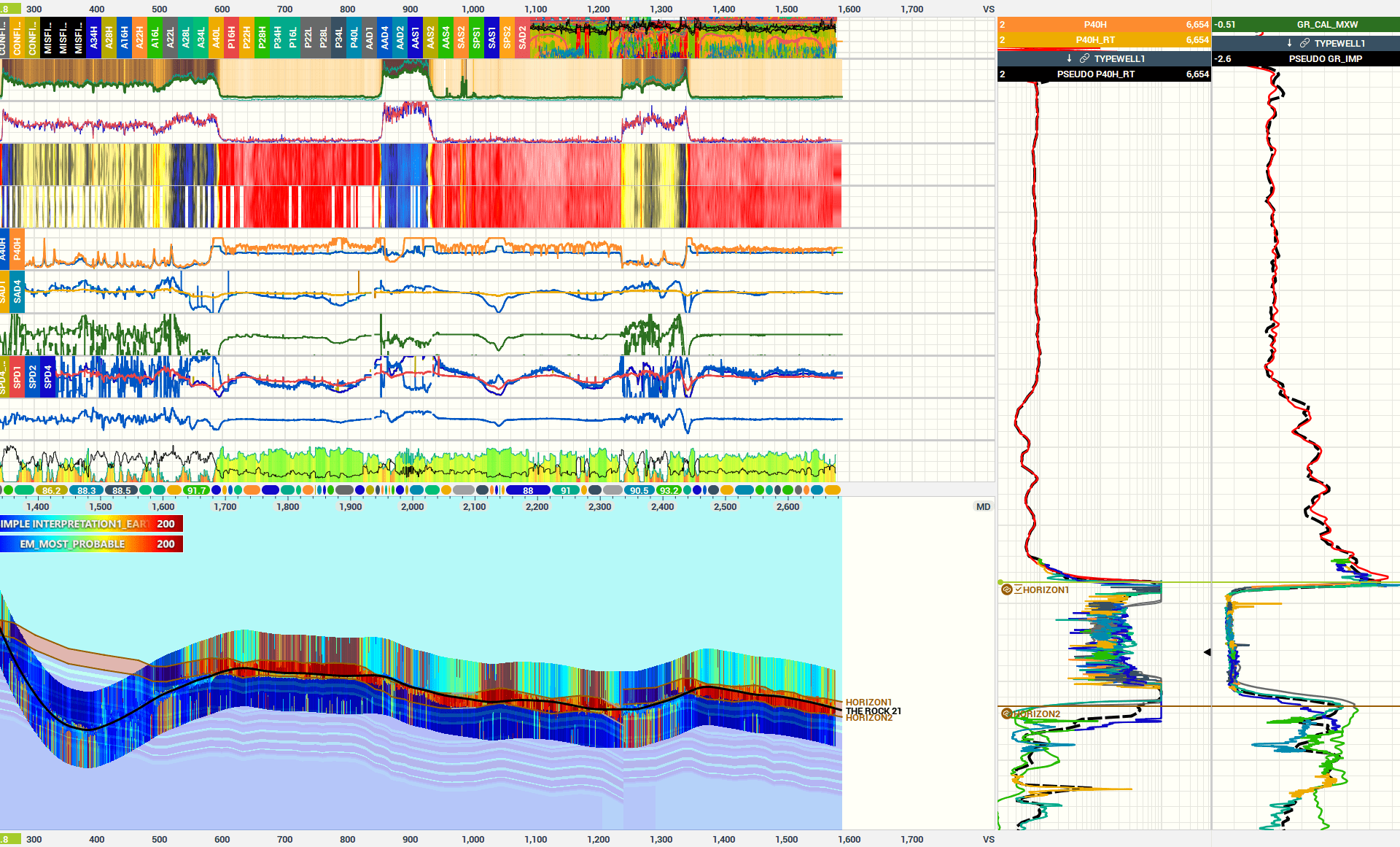
The industry-standard LWD azimuthal resistivity tool operates on the principle of electromagnetic wave propagation. It measures the attenuation and phase shift of electromagnetic waves across several components and frequencies in response to the formation surrounding the tool. Thanks to its azimuthal capabilities, the tool can detect geological features and continuity radially several meters away from its position, which allows for projections to the drill bit and informed decisions to steer the wellpath effectively. Visual mapping of boundaries is accomplished by employing advanced inversion techniques, resulting in high resolution and performance.
Why traditional workflows fall short
In many reservoirs, standard geosteering with GR and bulk resistivity is not enough:
- Muted GR contrast – Clean carbonates, homogeneous sands, or heavy oil reservoirs show little GR separation between target and non‑target.
- Thin or subtle boundaries – Water contacts, attic oil, or subtle facies shifts may not be that clear on GR/DEN/NEU.
- Complex structures – Anticlines, faults, or lateral facies changes are hard to resolve when only compared to a single type well.
- Lateral Reservoir Exposure. Target early production.
- Maximize life production. Enhance long-term production volume
The result: Under the user’s hands, Azimuthal Resistivity logs often remain raw curves on a screen instead of becoming quantitative, real‑time insights. High-performance inversion software can assist oil field operators in enhancing their comprehension of full-scale reservoir structures during drilling operations. This software facilitates the delineation of pay zones with greater accuracy, leading to enhanced production outcomes through more informed geosteering decisions.
Previously, he spent over 14 years at Baker Hughes, leading geoscience teams, delivering real-time geosteering, and drilling optimization across multiple countries.
From raw logs to Earth models: log squaring in StarSteer
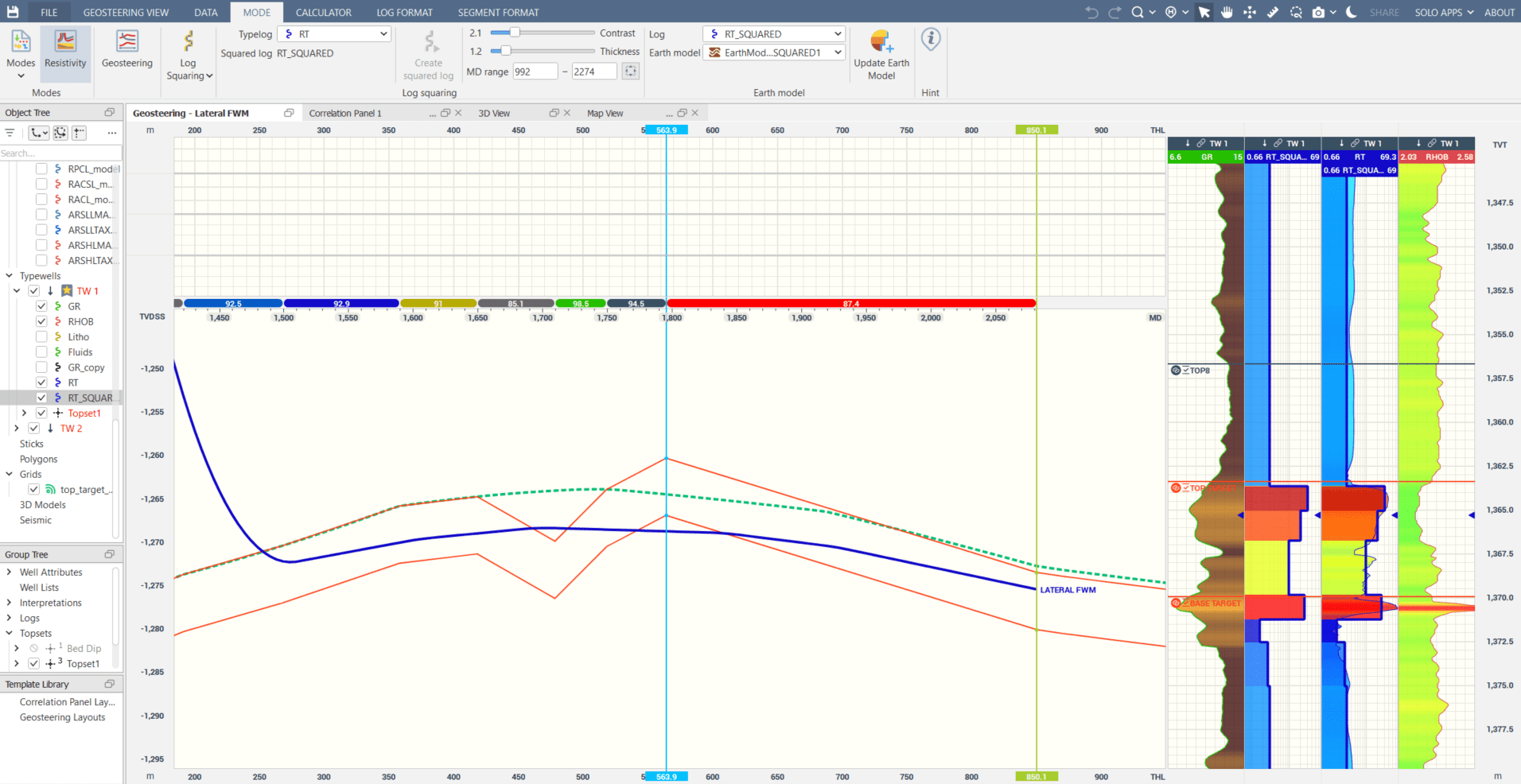
The StarSteer resistivity module is built to turn those curves into a usable Earth model.
- Select a type‑well resistivity log
Start from an offset well with high‑quality resistivity, plus GR and other supporting curves. - Create a log square
In Log Squaring mode, the offset resistivity curve is converted into discrete layers with:
- Individual thicknesses
- Resistivity contrasts
- The interpreter interactively adjusts these so the synthetic “log square” realistically matches the original log.
- Propagate the Squarelog profile along the structural scenario to update the Earth model.
The finished log square populates the cross‑section with layered resistivity properties that:
- Honor the thickness and contrast of the type well
- Follow structural trends from seismic or 3D models
- Allow local edits along the lateral (faults, thickening/thinning, changing resistivity)
Now you have a geologically consistent resistivity model tied to structure—rather than just a single offset curve.
Seeing before you drill: forward resistivity modeling
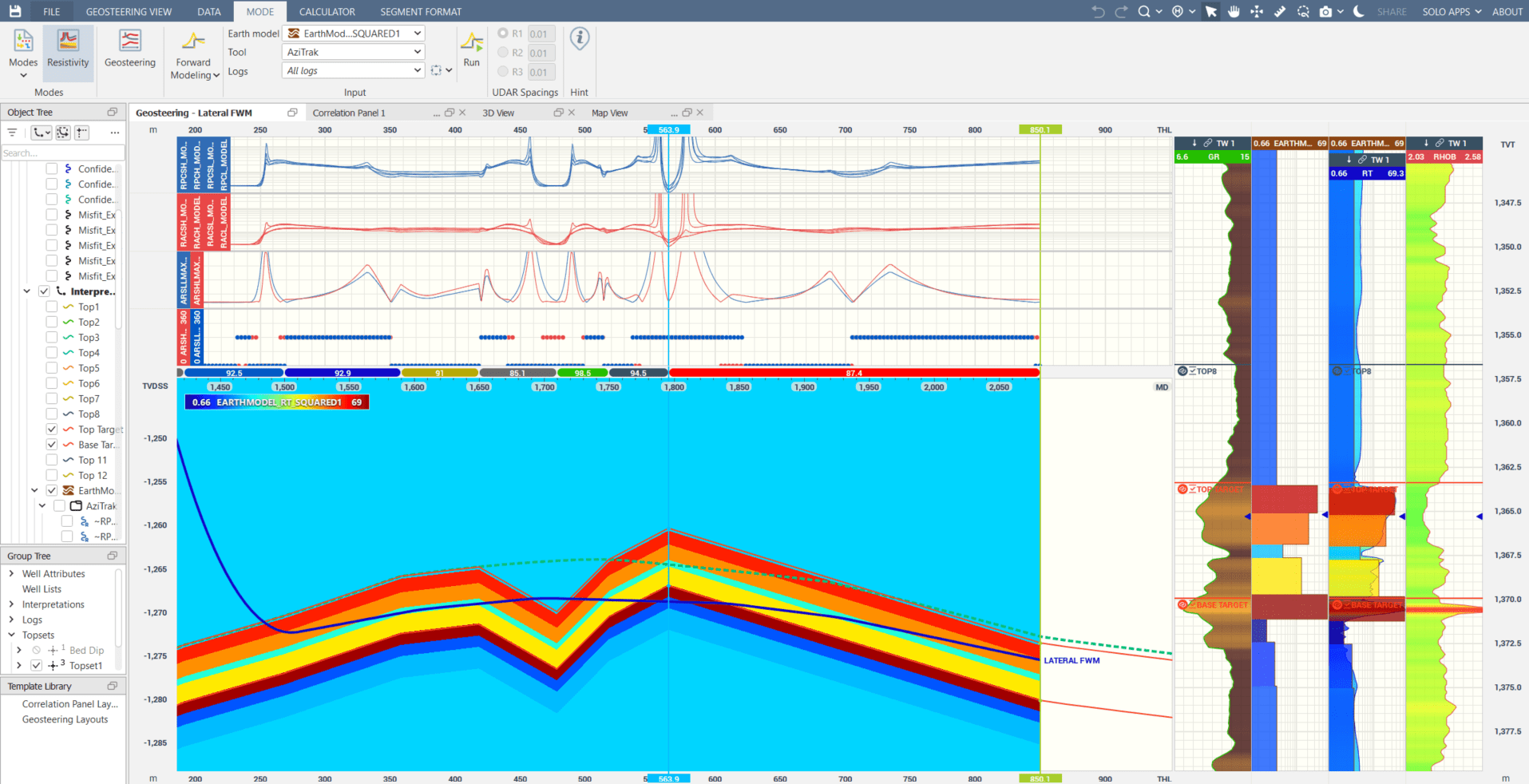
With the Earth model in place, StarSteer’s Resistivity mode uses forward modeling to predict the logs’ responses for different Azimuthal Resistivity measurement instruments along a wellpath.
Key capabilities:
- Vendor‑independent support
The Resistivity Module in StarSteer software supports most deep and ultra‑deep azimuthal resistivity tools with a flexible platform to incorporate new tools. - Fast, parallel computation
Wellpath, Structural or Resistivity property changes update synthetic forward model logs almost instantly, supporting interactive “what‑if” analysis. - Forward model assessment
The resistivity module allows visualization of:- Shoulder effects near boundaries
- Polarization horns at sharp contrasts
- Anisotropy and depth‑of‑investigation differences
- Distance to boundaries based on tool response
Geoscientists can test different scenarios (e.g., higher anticline, subtle fault, resistivity changes, well plan) and understand how different log channels react as the tool position changes under the different scenarios along a well path.
From modeling to reality: Data Driven Deterministic and Stochastic inversion
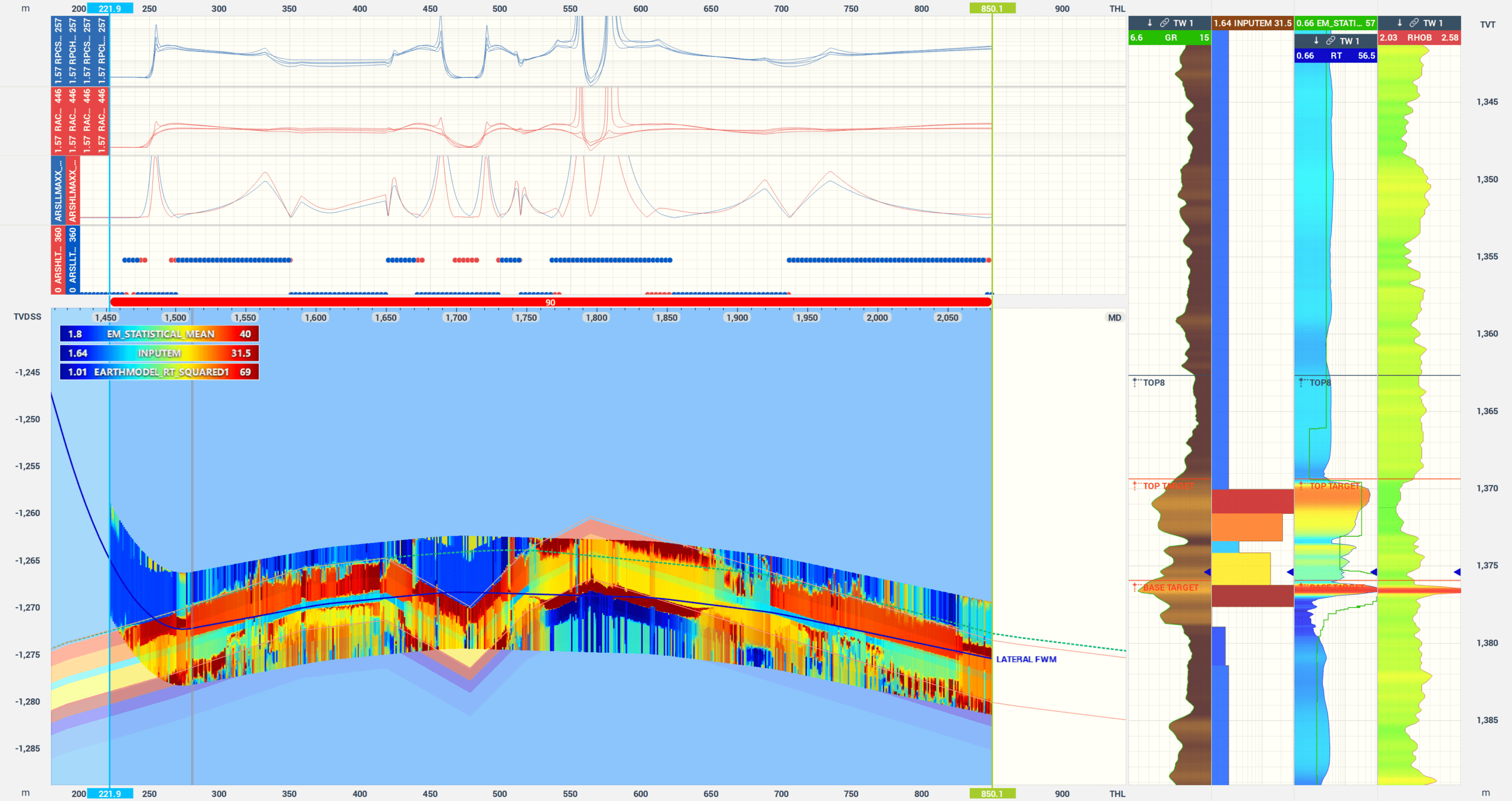
During drilling, real‑time Azimuthal Resistivity logs feed into StarSteer’s inversion workflows.
Multi‑layer inversion
- Stochastic algorithms driven by resistivity logs and wellpath geometry. Deterministic relies on an Earth Model guidance as initial input, but is still data-driven.
- Statistical approach to estimate uncertainty, providing predefined P10/P50/P90 percentiles and Most Probable models describing probable resistivity/anisotropy distribution and smoothing model visualization, under a unified format independent from tool logs input.
- Express-mode implementations for faster computations under simple expected geological scenarios.
- Inversion CPU parallelization so computational workload is distributed evenly, and an HPC cloud computing cluster is supported.
- Implements a unified uncertainty‑aware view of resistivity/anisotropy distribution.
StarSteer resistivity module Quality Control:
- Inversion model logs output a direct visual comparison to input data logs (from Prejob model, Real Time, or Memory).
- Generates a misfit curve as a QC metric.
- Highlights intervals where inversion struggles, guiding model edits.
Inversion models explaining Azimuthal Resistivity Logs responses are correlated to different geological events and structural trends.
Real‑time geosteering with integrated resistivity
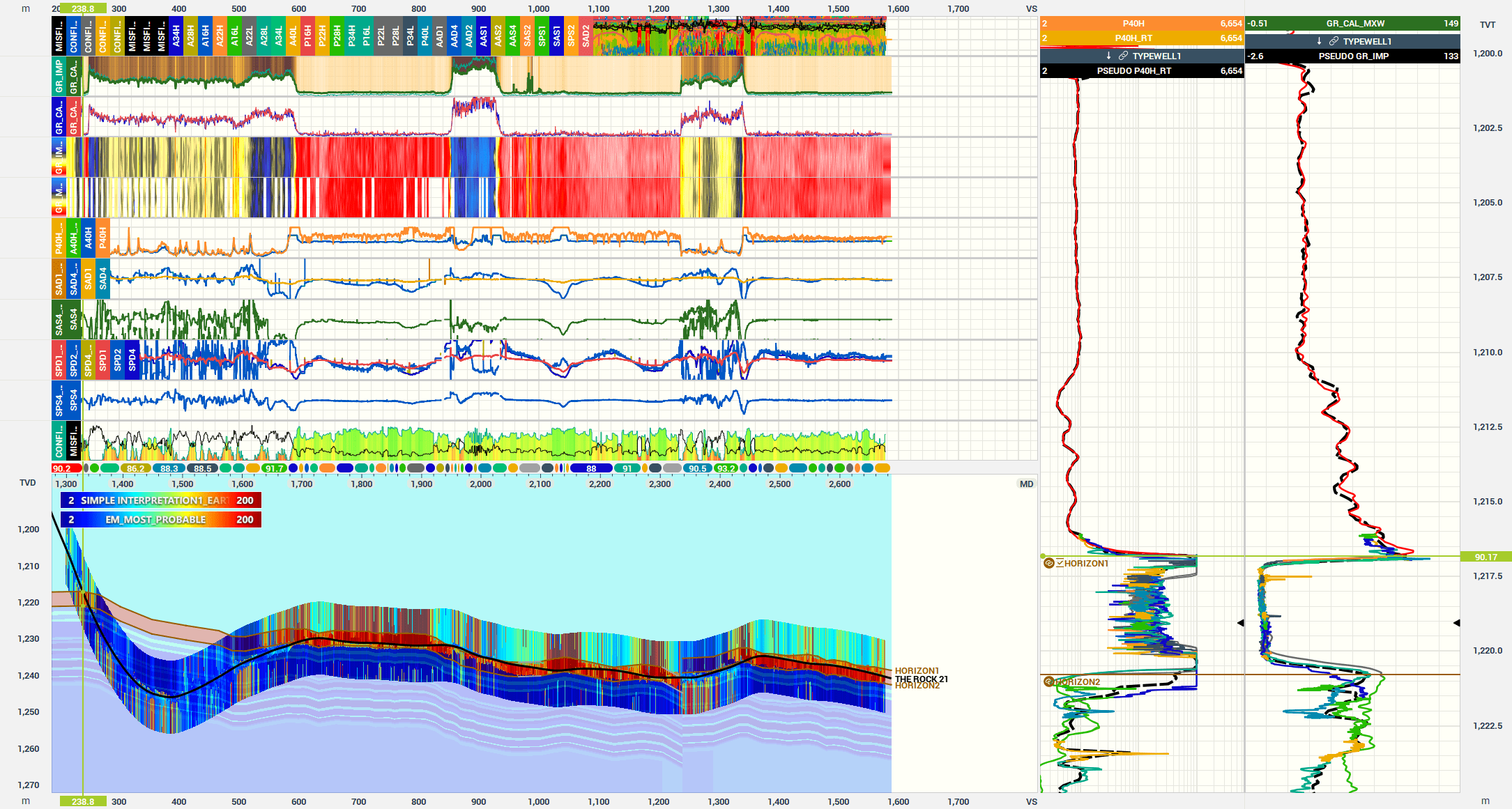
In real time, the StarSteer resistivity module enhances geosteering by:
- Landing and staying in zone
Inversion volumes indicate whether the bit is above or below a boundary and how far away it is, enabling pre‑emptive steering rather than reactive corrections. - Integrating multiple data types and workflows
StarSteer modes are fully integrated while drilling:- Azimuthal resistivity inversion
- Azimuthal gamma ray images feature sinusoid interpretation
- Seismic cross‑sections and structural grids visualization
- Correlation Panel and stratigraphic context based on the Strat-Based Horizons model
- Updating structure on the fly
When inversion shows the real structure diverging from the pre‑job grid, horizons and surfaces can be updated around the wellpath, tightening the Earth model–data loop. - Handling diverse environments
The same workflow applies from onshore conventional to offshore complex carbonates, including:- Low‑contrast GR environments
- Active aquifers and moving contacts
- Attic targets with tight structural tolerances
- Deep and ultra‑deep detection, depending on the tool and contrast scenario
How the StarSteer resistivity module helps operators
For operators, the benefits include:
- One vendor‑independent platform
Multiple resistivity, deep azimuthal, and ultra‑deep tools are supported in a unified workflow, keeping operations flexible. - End‑to‑end resistivity workflow
A dedicated Resistivity mode with sub‑modes, fully integrated to all other StarSteer workflows:- Log Squaring
- Forward Modelling
- Two‑Layer Inversion
- Multi‑Layer Inversion
- Pre‑job design, real‑time steering, and post‑job analysis all live in the same environment.
- Proactive decision‑making
Parallelized modeling and configurable inversion allow resistivity interpretation to keep pace with realistic ROP and telemetry limits, enabling proactive rather than corrective steering. - Quantified uncertainty and robust QC
P10/P50/P90/most probable models describing probable resistivity/anisotropy distribution and misfit curves provide means to reduce decision-making risks, improve understanding of inversion boundaries to correlate with geological events, and fulfill drilling objectives. - Cross‑discipline alignment
By tying resistivity inversion to seismic, petrophysics, and geosteering, StarSteer keeps geoscientists, reservoir engineers, and drilling teams working from a single, continuously updated project.
Graphs credit: ROGII
Rómulo Cuevas Hernández is a Geological Engineer with over 10 years of experience in the Oil & Gas industry, specializing in geosteering and well placement. He graduated from The University of Los Andes in Mérida, Venezuela, and has since built a robust career through positions at leading service companies such as Schlumberger and ROGII. Currently based in Europe, Hernández works as a Senior Technical Manager for ROGII, where he supports real-time well placement and analysis across conventional and unconventional reservoirs globally.
Jair Sarmiento is a geologist with 18+ years in the oil and gas industry, specializing in resistivity-based geosteering. He currently works at ROGII Inc. as a Technical Advisor and Azimuthal Resistivity Geosteering Specialist, supporting clients in the USA, Canada, Brazil, Argentina, and Australia, among other regions. Previously, he spent over 14 years at Baker Hughes, leading geoscience teams, delivering real-time geosteering, and drilling optimization across multiple countries. He is recognized for his expertise in resistivity tools, image logs, and data quality control, as well as for his collaborative and advisory approach.