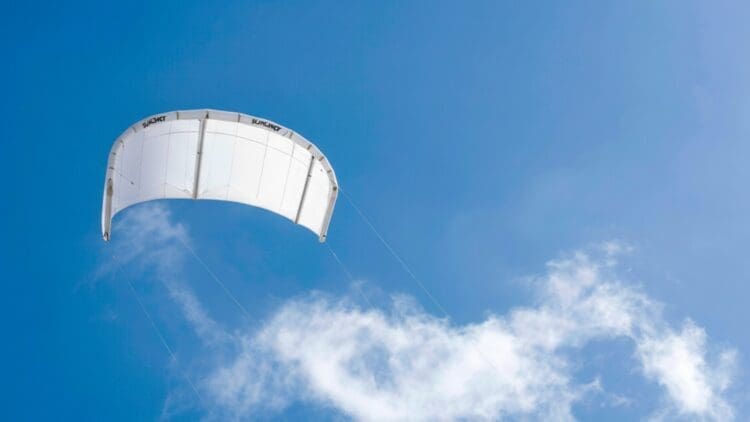

China has proven that you do not have to be Superman to fly high with power. The country is reaching new heights in sustainability by seeking power beyond wind turbines and investing in giant wind kites instead. These kites are flown at 16,000 feet and can reportedly power nearly 10,000 homes. This unconventional approach to harnessing wind power could open new doors to producing sustainable electricity, proving that not even the sky is the limit when it comes to China.
China is reaching new heights beyond turbines
When it comes to installed renewable capacity, it truly comes as no surprise that China is the global leader in wind power capacity. Near the end of 2024, China achieved a remarkable wind capacity of 521 GW. The country stunned the world again by increasing this already remarkable capacity to 580 GW by the end of 2025.
According to the Sixth Tone, despite being significantly ahead of the rest of the world when it comes to wind power capacity, China is not quite finished yet. China has long-term goals of achieving a minimum of 2 TW by 2035 and 5 TW by 2060. While this may seem impossible to some, the country is fortunate to enjoy substantial national funding and supportive mechanisms to support capacity expansion.

However, a very unconventional approach is being taken to potentially increase its capacity, as China is seeking options beyond wind turbines. In fact, they are testing the power of high-altitude winds by flying giant wind kites at 16,000 feet.
Flying giant wind kites at 16,000 feet
China has confirmed its interest in harnessing wind at higher altitudes to generate power, and has even completed the trial tests of its first national R&D project’s technology to harness wind from these higher altitudes. The China Energy Engineering Corporation created this key technology, which is a giant wind kite that measures 53,820 square feet.
The China Energy Engineering Corporation is not the first to use flying kites to harness wind power, as seen by KiteKRAFT’s flying wind turbine kite. However, China’s specific kite operates slightly differently, as it comprises a ground-based system, as was indicated by the trial tests in Inner Mongolia Autonomous Region’s Alxa Left Banner.
A helium balloon was utilized to launch the giant kite 984 feet into the sky, after which the kite unfolded. Traction cables, which were connected to a ground-based generator, were pulled by the unfolded kite, which created energy. This energy was then converted into power. The kite’s design allows it to harness more stable and stronger winds at significantly higher altitudes.
They power 10,000 homes and more
Smaller kites that measure 12,900 square feet were also studied during the trial tests. Altogether, successful deployment and retraction were achieved, and the results indicated stable energy conversion. According to Interesting Engineering, China’s giant wind kites hold tremendous potential, giving promise to the following benefits:
- Saving up to 95% of valuable land space
- 90% reduction of steel utilisation
- Decreased environmental impact
- 30% decrease in power production costs
Furthermore, a 10 MW system has the potential to produce nearly 20 million kWh of power annually, which is enough to provide power to almost 10,000 homes.
According to Huo Shaolei, China Power Engineering Consulting Group Limited’s senior technical expert:
“We will conduct multi-kite flight tests and plan to launch power generation trials at the end of next year.”
It is an exciting time for China, as this technology could be key to achieving its long-term wind capacity goals, perhaps much sooner than initially anticipated. Not only that, but the technology can unlock increased access to clean electricity in nations with limited land space, increasing energy independence. China is also focused on boosting its offshore capacity, as plans have been revealed to roll out 50 MW of wind turbines by 2026 in a substantial technology push.