
California’s $20 million canal solar pilot generates electricity and cuts water evaporation in dual-benefit test
 AI-made
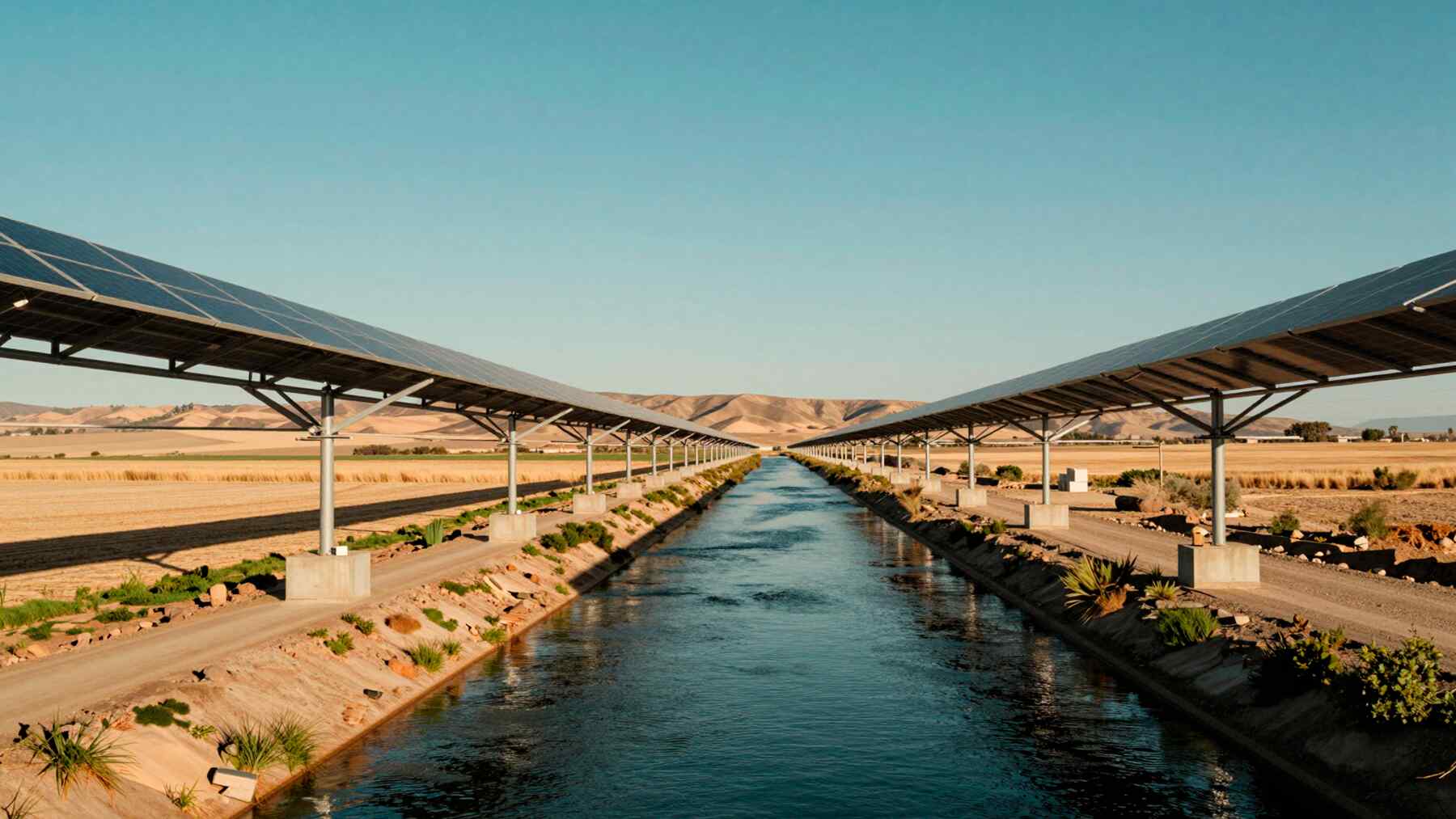
California has spent $20 million placing solar panel canopies directly over irrigation canals — and the results go beyond clean energy. Project Nexus, a public-private-academic pilot, fully commissioned its final solar array sections in late 2025 and formally launched its long-term operational monitoring phase in Spring 2026. The program is designed to generate 1.6 MW of electricity while evaluating projections that it can significantly reduce water evaporation and cut canal maintenance costs — outcomes that suggest the approach may offer more than a creative workaround to land scarcity.
Project Nexus delivers results across two canal sites
Project Nexus brought together public agencies, private partners, and academic researchers under a single $20 million mandate: prove that solar canopies over irrigation canals can work at scale. Large panel structures were engineered and installed directly over existing public irrigation canals, bypassing the need to break new ground or acquire additional land. Construction wrapped, and panels were commissioned across both sites by late 2025, moving into a multi-year data-collection phase formally marked by state officials in Spring 2026.
Combined output across the two locations reaches 1.6 MW of clean electricity. Modest by utility-scale standards, but the pilot was never designed to power a city — it was designed to demonstrate operational feasibility. On that measure, the field testing is now underway.
Shading the water is also expected to interrupt photosynthesis, curbing the aquatic weed and algae growth that costs canal operators millions annually to clear.
Why California pursued a canal-based solar solution
California’s energy challenge is not simply about generating more power. It is about finding space to do so. Population growth and the rapid expansion of energy-intensive industries have pushed land availability to a breaking point for conventional solar development.
Data centers represent the sharpest pressure point. Facilities across California consume nearly 5,580 GWh of electricity annually — roughly 2.6% of the state’s total electrical demand — and experts forecast that figure could double or triple by 2028, driven largely by generative AI workloads. Without new generation capacity, grid instability becomes a real risk. Climate change compounds the problem from a different angle, as higher average temperatures have accelerated evaporation rates across California’s open water systems, tightening an already strained water supply during prolonged drought periods.
Covering canals with solar panels addressed both pressures simultaneously — generating power while protecting water — without requiring planners to identify, acquire, or develop a single new parcel of land.
Multiple operational benefits recorded beyond electricity output
The electricity output is the immediate headline number, but the anticipated operational benefits extend well beyond grid contribution. Initial modeling indicates that panel shadows blocking sunlight and wind across the water surface will significantly reduce evaporation rates during drought conditions. In a state where water scarcity is a chronic concern, confirming that reduction carries real value.
Shading the water is also expected to interrupt photosynthesis, curbing the aquatic weed and algae growth that costs canal operators millions annually to clear. If real-world metrics match projections, reduced algae presence will translate directly into lower maintenance costs — a practical financial benefit that strengthens the economic case for wider adoption. There was an efficiency feedback loop as well: the cooler water beneath the panels created a natural cooling effect on the panel structures themselves, and since solar panels convert electricity less efficiently as their temperature rises, cooler operating conditions improved power conversion output. The canal, in effect, made the solar installation perform better.
Broader context: global solar expansion pressures drive unconventional siting
California’s canal experiment does not exist in isolation. Around the world, the push to expand solar capacity is running into the same obstacle: suitable land is running out. Global green energy capacity has reached 5,149 GW, with solar accounting for 2,392 GW of that total. Experts estimate that nearly 735 GW of new solar capacity must be added every year to meet the targets embedded in tightened international climate frameworks.
That pace of expansion is forcing developers into territory previously considered off-limits — rural communities, undeveloped natural areas, agricultural land. Conflicts with local residents, farmers, and conservation groups have followed. The displacement of large tracts of natural habitat has drawn particular concern from environmental organizations, who argue that the ecological cost of some installations undermines the very climate goal they are meant to serve.
Canal-covering approaches represent one practical response to this tension. Several countries dealing with drought and land scarcity have explored similar concepts, recognizing that existing water infrastructure offers a ready-made footprint that does not require displacing communities or ecosystems.
What the Project Nexus results mean going forward
Project Nexus has successfully transitioned from a laboratory concept to live proof-of-concept testing clean electricity generation, reduced water evaporation, lower algae-driven maintenance costs, and improved panel efficiency through natural cooling. The $20 million pilot provides the critical real-world testing ground needed to confirm these co-benefits under true operating conditions.
The scale remains small. Larger installations would need to address engineering, cost, and regulatory questions that a pilot program does not fully resolve. Still, as live data streams in, the project gives planners in California — and in other drought-affected regions watching closely — a concrete evidence base to work from as pressure to expand solar capacity continues to grow.
Kelly is an experienced writer with 15 years of experience exploring the big stories that shape our world, from tech breakthroughs and space exploration to climate, energy, and the fascinating quirks of science. She has a talent for turning complex ideas into sharp, memorable insights that stay with readers long after they’ve finished reading.
