
Canada’s refined petroleum product imports climbed 3% in 2025 to 485,000 barrels per day, with the U.S. supplying nearly 80% of total volume
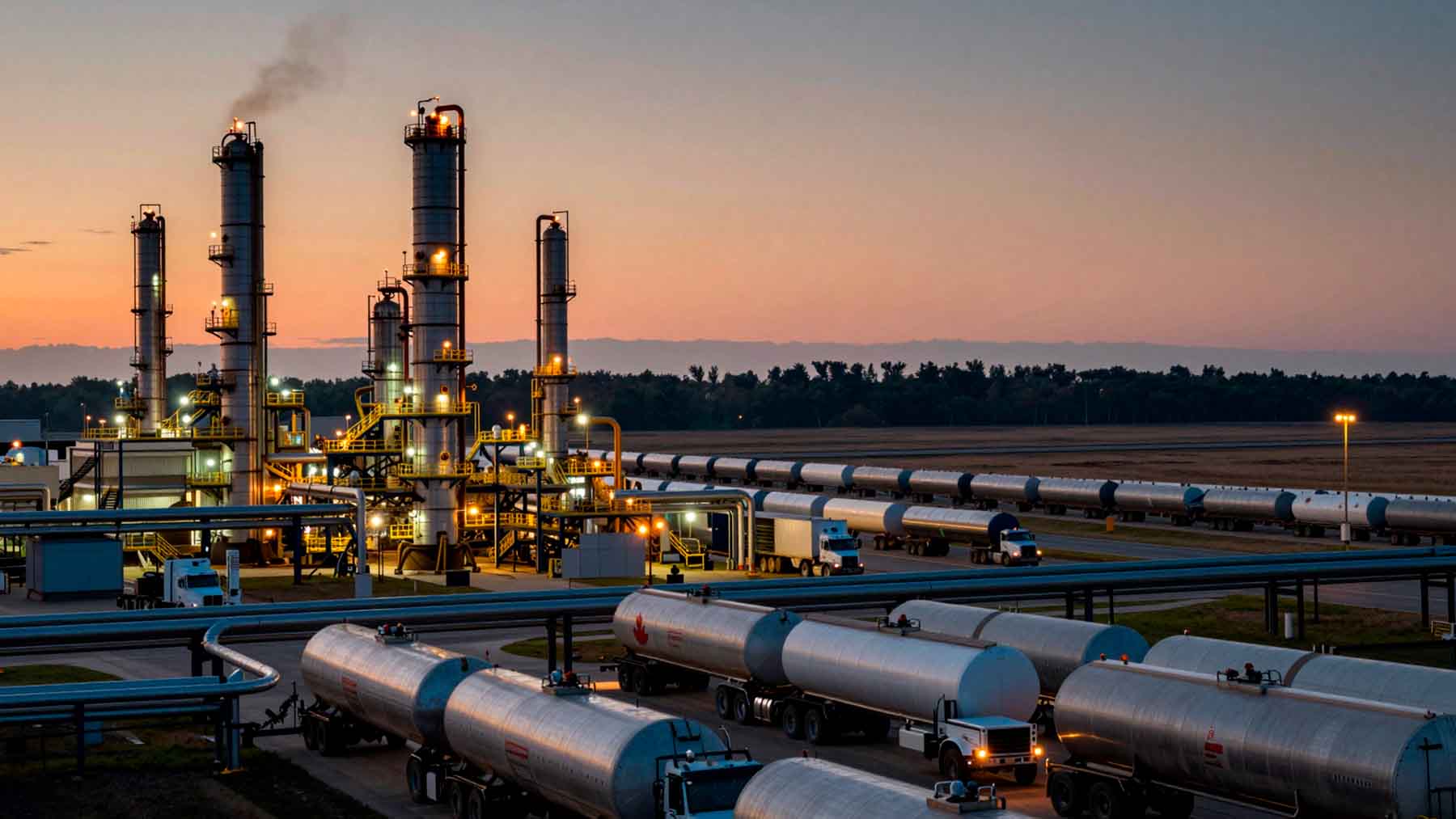 Image generated with artificial intelligence
Canada imported 485,000 barrels per day of refined petroleum products in 2025 — a 3% jump from the year before, according to data the Canada Energy Regulator released on July 29. Here’s the part that might surprise you: even though volume went up, the total import bill actually dropped 1.2%, landing at C$21.4 billion (approx. $15.7 billion USD). The U.S. supplied 386,000 b/d of that — nearly 80% of everything Canada brought in — continuing its role as the country’s go-to source for refined fuels.
Canada’s RPP imports reach 485,000 b/d in 2025
The 3% volume increase fits into a bigger pattern. RPP imports have been climbing steadily since 2020, though they haven’t fully bounced back to pre-pandemic levels yet. Total costs dipping to C$21.4 billion ($15.7 billion USD) tells you something useful: per-barrel prices were lower in 2025 than in 2024, even as Canada pulled in more product overall.
The CER published this data on July 29, 2026, drawing from Canada’s International Merchandise Trade database. The figures cover refined products under HS codes 2710.12, 2710.19, and 2710.20 — gasoline, diesel, jet fuel, and other processed petroleum goods.
Its import trajectory has been uneven: volumes rose steadily from 2010 to 2018, dropped sharply in 2020, then recovered without climbing back to pre-pandemic peaks.
Rising volumes plus falling costs isn’t a combination you see all the time. It points to a market where supply availability and pricing both moved in Canada’s favor, even as demand kept growing.
The U.S. accounts for nearly 80% of Canadian RPP imports
The U.S. isn’t just Canada’s largest supplier — it’s in a different league entirely. At 386,000 b/d, it accounted for 79.6% of all refined petroleum products Canada imported in 2025. That share has stayed pretty stable since 2020, reflecting just how deep and durable the trade relationship between the two countries actually is.
No other supplier gets close. The Netherlands held second place — as it has for roughly a decade — at 24,000 b/d, or just 4.9% of the total. After that, the numbers fall off fast: the U.K. at 3.0%, Belgium at 2.9%, Norway at 2.2%, China at 1.8%, and Germany at 0.6%. A broader “other” category — including South Korea, Japan, France, and India — made up the remaining 4.8%. All non-U.S. sources combined still don’t come close to what the U.S. delivers on its own.
Alberta leads provincial imports, driven by oil sands condensate demand
When you look at where imported RPPs actually land in Canada, Alberta stands out immediately. The province received 200,000 b/d in 2025 — 41% of the national total, more than Quebec, Ontario, and British Columbia combined.
What makes Alberta’s situation different is what it’s importing. Most of those barrels aren’t transportation fuels. They’re condensate — a light hydrocarbon liquid piped in from the U.S. via two CER-regulated pipelines, Southern Lights and Cochin. Condensate gets blended with bitumen from oil sands projects, thinning it enough to flow through pipelines. Without it, moving oil sands production to market would be considerably harder.
Alberta’s condensate imports have doubled since 2012, tracking the growth of oil sands output. The province’s share of national imports did slip, though — from roughly half of Canada’s total between 2020 and 2024, down to 41% in 2025 — as other provinces pulled in more volume than before.
Quebec, Ontario, and BC import transportation fuels to meet population demand
Beyond Alberta, Canada’s most populous provinces drive the next tier of imports. These aren’t industrial inputs — they’re the fuels that fill gas tanks, power aircraft, and move freight.
Quebec was the second-largest importing province in 2025, taking in 103,000 b/d, or 21% of Canada’s total. Its import trajectory has been uneven: volumes rose steadily from 2010 to 2018, dropped sharply in 2020, then recovered without climbing back to pre-pandemic peaks. Ontario imported 36,000 b/d (8% of the national total), and British Columbia brought in 34,000 b/d (7%), both leaning heavily on U.S.-sourced product given their geography and existing supply infrastructure.
Quebec’s situation has one key difference: tidewater access. Provinces with coastlines — Quebec, Nova Scotia, and Newfoundland and Labrador — can receive tanker deliveries from overseas suppliers, which is why they source a larger share of RPPs from European countries compared to landlocked provinces, according to the Canada Energy Regulator.
Sourcing decisions reflect commercial and logistical factors
Canada doesn’t import refined petroleum products through any centralized system. Individual distributors and resellers in each province make their own calls, weighing product specs, pricing, local supply availability, and transportation costs — which explains why the supplier mix varies so much from province to province.
The long-term upward trend in imports since 2020 comes from two parallel forces: continued expansion of oil sands production in Alberta and the condensate needed to support it, alongside population-driven demand for transportation fuels in Quebec, Ontario, and BC.
The 2025 data also sends a clear pricing signal. Volume went up, but total costs went down, meaning Canada paid less per barrel on average than it did in 2024. That’s a meaningful shift for anyone managing fuel supply costs.
Key highlights from Canada’s 2025 RPP import data
Canada’s refined petroleum product imports rose to 485,000 b/d in 2025, up 3% from 2024, while total import costs fell 1.2% to C$21.4 billion ($15.7 billion USD). The U.S. stayed the dominant supplier by a wide margin, providing 79.6% of all imports. Alberta led all provinces at 200,000 b/d, mostly for oil sands condensate, while Quebec, Ontario, and BC imported mainly transportation fuels. Imports have trended upward since 2020 but haven’t returned to pre-pandemic levels, according to the Canada Energy Regulator’s July 2026 report.
Kelly is an experienced writer with 15 years of experience exploring the big stories that shape our world, from tech breakthroughs and space exploration to climate, energy, and the fascinating quirks of science. She has a talent for turning complex ideas into sharp, memorable insights that stay with readers long after they’ve finished reading.
