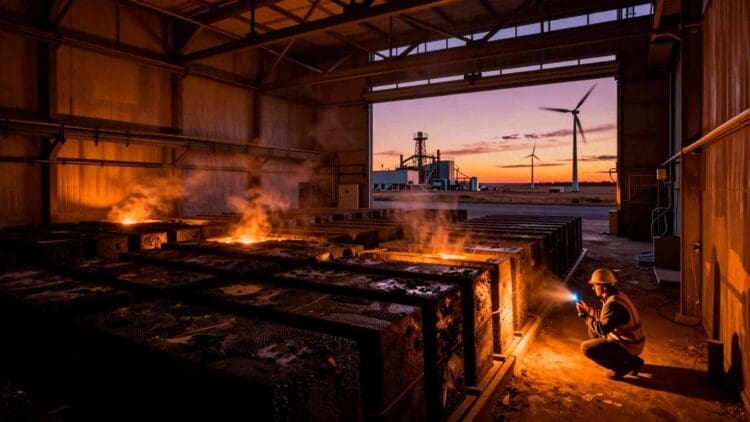

Rows of solid carbon blocks sit inside an insulated facility in Big Stone City, South Dakota — quietly holding heat that, hours earlier, was surplus electricity from regional wind turbines. There are no spinning turbines here, no flowing water, no chemical reactions. Just stored warmth, waiting to work.
That warmth is now flowing into POET’s bioprocessing plant next door. The system delivering it — a 5 GWh thermal battery developed by Antora Energy — ranks among the largest energy storage projects operating anywhere in the world. What it means for a biofuels plant to run on captured wind heat, around the clock, is a question the industry is only beginning to answer.
A battery made of carbon blocks
Antora Energy’s thermal battery looks nothing like what most people picture when they hear the word “battery.” No electrodes, no electrolyte, no lithium. The system uses resistive heating elements to convert surplus electricity — drawn from nearby wind turbines — into intense heat, which dense, insulated blocks of solid carbon absorb and hold.


Carbon’s heat-retention properties allow the system to store energy across multiple days. That multi-day capability sets it apart from conventional lithium-ion storage, which handles short-duration grid balancing well but struggles to deliver energy continuously over longer stretches. The difference is not minor — it is the whole point.
Once stored, the heat can serve industrial facilities in two ways: driving thermal processes directly, or converting back into electricity. For a bioprocessing plant like POET’s, direct heat delivery carries particular value. Industrial heating is one of the most energy-intensive parts of biofuel production, and having a reliable thermal source changes the economics considerably.
From construction site to live energy delivery in 12 months
One of the more notable details about this project is its pace. From the start of construction to the first live energy delivery, the timeline ran under 12 months — an unusual speed for energy infrastructure at this scale.
The system is not fully operational yet. Full commissioning is expected later in 2026, at which point the 5 GWh installation will rank among the world’s largest energy storage projects by capacity. Energy is already being delivered, just not at its complete designed output.
Deployment speed matters well beyond the logistics of a single project. When a storage system of this size can go from breaking ground to powering an industrial facility in under a year, it suggests that thermal storage technology has reached an engineering maturity that makes rapid scaling plausible — a meaningful signal for an industry still working to establish its commercial footing.
What it means for POET’s biofuel operations
The commercial structure behind the project is as consequential as the technology itself. POET and Antora entered a long-term heat offtake agreement — a contract in which POET commits to purchasing thermal energy over an extended period. That agreement gives Antora the revenue certainty needed to justify the investment, while providing POET with a stable, around-the-clock energy supply.
Continuous thermal energy access translates directly into production capacity. The facility can now increase its bioethanol output without depending on the variability of grid electricity or fluctuating fuel prices.
The arrangement also required careful regulatory work. Antora partnered with Otter Tail Power, a utility serving customers across South Dakota, North Dakota, and Minnesota, to design an electric rate that allows the storage system to charge rapidly during periods of surplus local energy production. The South Dakota Public Utilities Commission approved that rate last year — and the structure was designed so that other utility customers in the region would not see their costs increase as a result.
A model for American industrial energy reinvention
The Big Stone City project arrives at a moment when the United States is actively working to expand domestic energy production in response to rising demand. Industrial facilities that can absorb surplus renewable energy and store it for continuous use fit directly into that goal, reducing reliance on imported fuels and making local energy resources go further.
Antora CEO Andrew Ponec has framed the project in explicitly industrial terms. In his words, it represents “reindustrialization” — American innovation supporting domestic supply chains that span a dozen states, creating jobs from factory floors to construction sites. That framing connects a single energy storage deployment to a much broader economic argument.
Senator Mike Rounds echoed that view, pointing to the project’s expected economic impact in South Dakota and its contribution to domestic energy production. His comments reflect the bipartisan appeal of energy projects that can simultaneously deliver jobs, local investment, and greater energy independence.
If a 5 GWh thermal battery can be deployed at this speed and scale — without raising costs for surrounding communities — it becomes a template. Other industrial facilities with high heat demand and access to surplus renewable electricity could follow the same path. The question is no longer whether thermal storage can work at industrial scale. In South Dakota, it already does.