
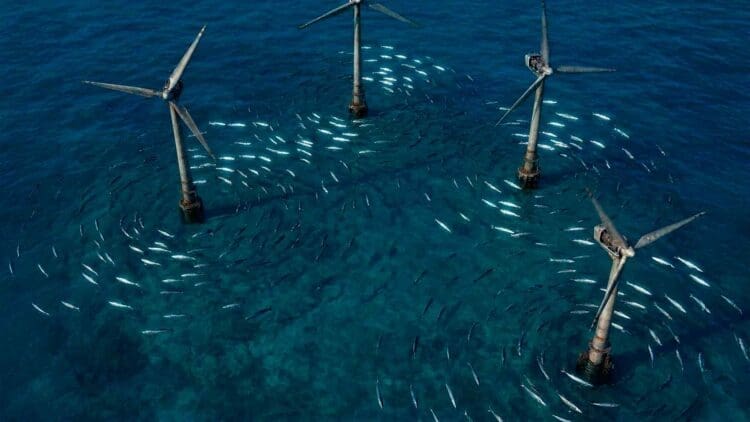

When it comes to offshore turbines, there is more beneath the surface than meets the eye.
The significant capacity growth of wind energy over the ocean should have been a green victory.
But now, it seems the ambition toward a net-zero future is harming the environment we vowed to protect.


The supposed thriving sanctuaries are now becoming ghost towns, which raises the question: Where have the fish gone and why?
How the stakes of the offshore energy rush are becoming higher
In a desperate attempt to meet the rapidly approaching climate targets, renewable energy capacity has exploded on land.
So much so that Earth is not only running out of time, but also out of terrestrial room.
The limited suitable space for large-scale projects often faces scrutiny, especially by the “Not In My Backyard” (NIMBY) movement.
This is where the endless, deep waters of the ocean come in. Not only is the wind of this vast frontier much stronger, but it is also more consistent.
These factors are all key to providing high-capacity, baseload power to complement existing infrastructure.
It will help generate clean electricity to feed the growing hunger of data centers and AI. It can also help accelerate transport electrification.
However, few people could have predicted the environmental impact that this supposed offshore “green victory” would truly have.
One man’s victory is another’s complete loss
Across the world, record volumes of newly contracted offshore wind capacity are being delivered.
This may be quite the environmental triumph, but ecologically speaking, the physical footprint is a major loss.
Offshore wind turbines use giant steel or concrete foundations for installation into the ocean floor. The entire process shifts the marine environment.
The seafloor, or “benthic zone,” itself is disrupted during offshore capacity expansion. As a result, current patterns change, which alters the distribution of nutrients and sediment.
With the sudden presence of darkwaves detected near two American regions, these alterations are the last thing the world needs.
However, beyond the physical impact on the ocean environment, there are also changes in fish behavior.
PhD candidate and marine biologist Fien Demuynck elaborated on these behavioral changes. Her findings are in the study “Noise at sea: Research on how wind farms affect fish,” published in Phys.org.
The cost of a constant noise rising from the sea
If the NIMBY movement thinks that the pollutive noise caused by onshore turbines is annoying, imagine how marine animals feel.
Across the biological map of the North Sea, underwater “ghost towns” were suddenly increasing. In the March 2026 study, this strange “disappearance” was analyzed along the Dutch-Belgian coast.
The acoustic shield surrounding offshore turbines
Demuynck discovered that turbines have an operational hum that causes low-frequency vibration. This hum shields the natural underwater sounds that fish rely on for communication and navigation.
This is why some species, specifically pelagic fish, disappeared from these regions completely. This includes mackerel and herring.
However, some species remained, but projected highly defensive behavior known as “tight shoaling.” This is commonly used to survive predators, suggesting the constant mechanical hum is perceived as a threat.
The altered current patterns can also reduce plankton production, which is essential to the whole marine food chain.
Demuynck’s study made it clear that we should no longer turn a blind eye to the ocean depths.
The green transition is not a silent victory, and should not be treated as such.
Increasing insights into the acoustic footprint of offshore projects could help innovators engineer quieter installations.
The impact not only affects small fish, but also the mass movement of our whales. This way, we may be able to protect these species from endangerment.



