
Decades of drought and overuse pushed the Colorado River toward a breaking point, and Washington is now forcing seven states to confront who gets less water
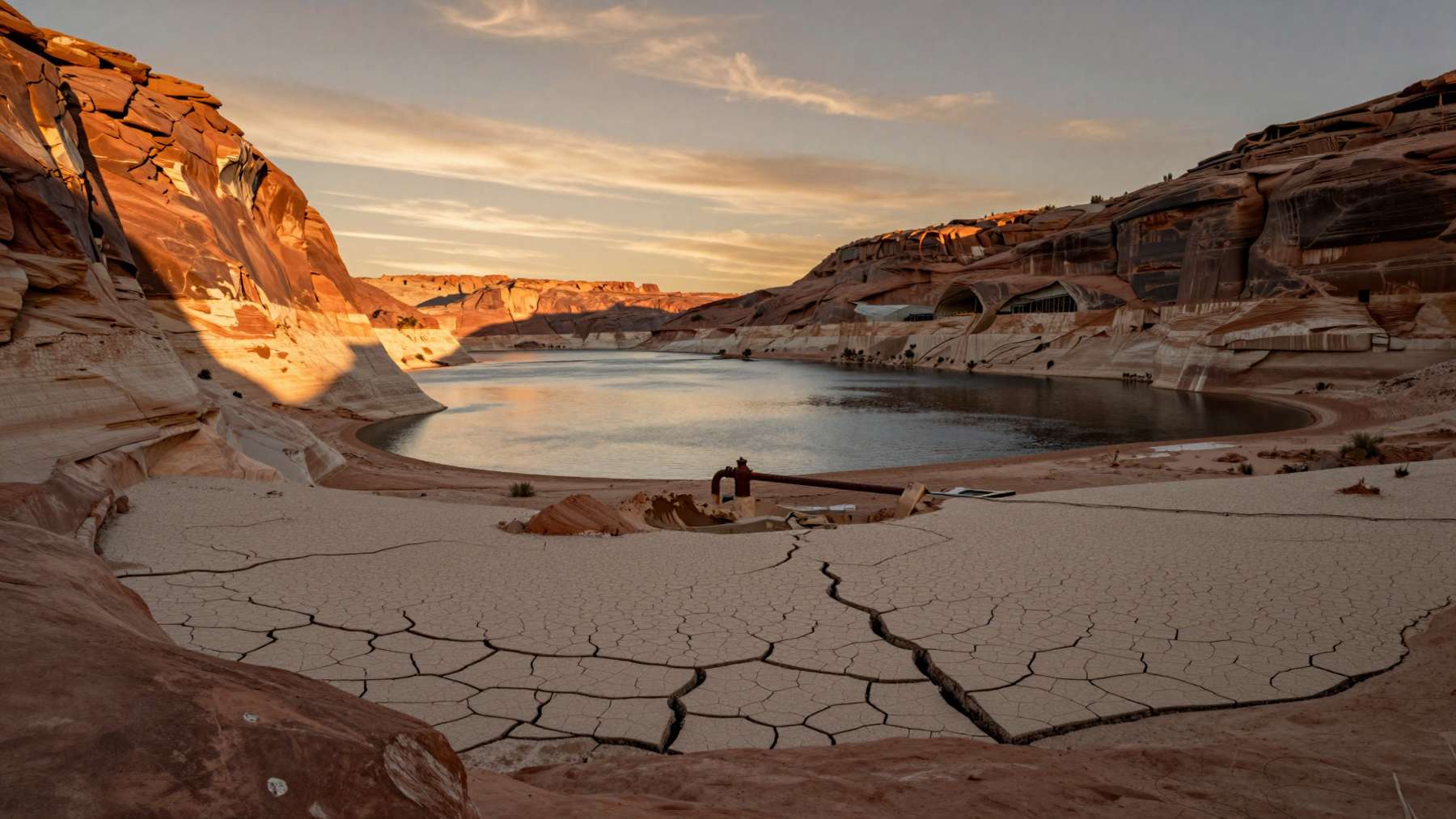 Image generated with artificial intelligence
Decades of drought and overuse pushed the Colorado River toward a breaking point, and Washington is now forcing seven states to confront who gets less water.
For more than a century, the Colorado River has been dammed, diverted, and drained to sustain the American West. Today, over 40 million people across seven states, 30 tribal nations, and Mexico rely on its flow. Yet prolonged megadrought, rising temperatures, and systemic overuse have pushed the system past its breaking point, forcing federal intervention.
A river running low on promises
The river’s management framework dates to the 1922 Colorado River Compact, when states allocated water based on hyper-optimistic flow estimates. That fundamental math error created millions of acre-feet of “paper water” that never actually existed.
Meanwhile, Upper Basin states—Colorado, New Mexico, Utah, and Wyoming—face only voluntary targets, igniting fierce regional friction.
Today, Lake Mead and Lake Powell—the nation’s two largest reservoirs—have dropped toward historic lows. Both risk reaching “dead pool,” the dangerous threshold where water levels fall below dam intakes, halting hydroelectric generation for millions and escalating a regional energy emergency alongside the water crisis.
Why the federal government stepped in
Washington intervened only after years of bitter stalemate among basin states made self-regulation impossible. With existing operating guidelines expiring at the end of 2026, a regulatory vacuum loomed. Record-dry winters accelerated the emergency, forcing the U.S. Bureau of Reclamation to issue a sweeping proposal.
Designed to mandate adaptability, the federal plan enforces deeper consumption cuts during drought while pressuring state leaders to finalize a unified management agreement before time and water run out.
What the proposal actually demands
The proposal imposes the heaviest burden on the Lower Basin: Arizona, California, and Nevada. These states could be forced to slash water use by up to 3 million acre-feet annually through 2036—a volume nearly equal to Arizona and Nevada’s entire combined annual allocation, capable of supplying 25 million households.
Instead of fixed quotas, reductions would adjust every two years based on basin-wide storage. Meanwhile, Upper Basin states—Colorado, New Mexico, Utah, and Wyoming—face only voluntary targets, igniting fierce regional friction.
How the states are pushing back
Lower Basin leaders reacted aggressively. Arizona officials condemned the plan, arguing that forced reductions unfairly penalize users with lower-priority legal rights. Nevada called the cuts unrealistic, while California took a more measured tone, viewing the proposal as a negotiation baseline.
Lower Basin states demand that all seven states share mandatory reductions. Upper Basin governors countered that mandatory cuts violate the original 1922 Compact, arguing they should not be penalized for natural hydrological fluctuations beyond their control.
Real costs for farms, cities, and water bills
The practical consequences are immediate and far-reaching. Farmers in California’s Imperial Valley and Yuma, Arizona, produce 90% of North America’s winter leafy greens; reduced deliveries mean leaving fields unplanted and driving up national produce prices.
Beyond agriculture, the crisis threatens the West’s booming tech economy.
Major industrial centers—including Phoenix’s multibillion-dollar semiconductor manufacturing plants—depend on guaranteed water allocations, elevating regional river management into a high-stakes issue of national economic and technological security.
Urban residents face steep utility increases rather than dry taps. Gilbert, Arizona, raised residential water rates by up to 50% to fund alternative supplies. As ASU water law professor Rhett Larson noted, “We are not running out of water. We are running out of cheap water.”
What comes next
The Bureau of Reclamation’s plan is a starting point, setting up intense legal brinkmanship ahead of the 2026 deadline. Yet the ultimate hook driving this entire crisis isn’t just shrinking reservoirs—it is that federal law grants the Secretary of the Interior sole authority to unilaterally decide who gets water if states fail to agree, placing the future of the West entirely in federal hands.
Kelly is an experienced writer with 15 years of experience exploring the big stories that shape our world, from tech breakthroughs and space exploration to climate, energy, and the fascinating quirks of science. She has a talent for turning complex ideas into sharp, memorable insights that stay with readers long after they’ve finished reading.
