
In Cortlandville, New York, a 120 acre flooded stone quarry begins hosting floating solar panels on its surface, and the mining company turns into the grid’s newest power supplier
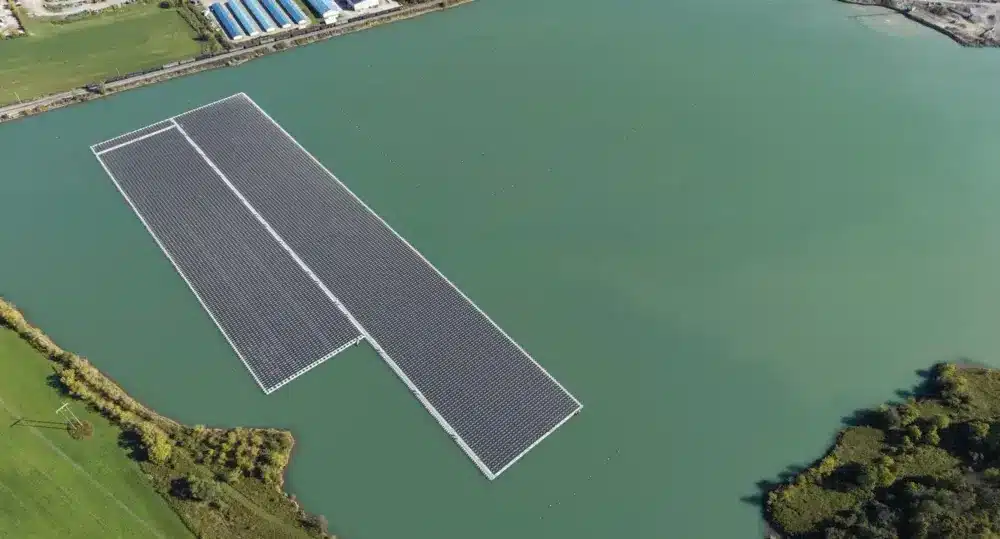
A gravel hauler idles at the edge of a lake that was never supposed to exist.
Beneath the surface sits a pit dug for crushed stone, not water.
For decades the machines dug until the hole dropped below the water table.
For Cortlandville, the project arrives at a moment when central New York winters make every kilowatt of local generation matter for grid resilience.
Then the water simply arrived and stayed.
Now that accidental lake is about to carry something nobody who worked this quarry ever expected to float past the loading docks.
So how does a working mine end up anchoring solar panels to its own water?
Why put panels on a lake that was never meant to hold anything
A flooded quarry behaves nothing like a reservoir built for drinking water or flood control. The walls are steep rock, the floor is uneven stone left behind by decades of blasting, and the depth can change sharply within a few dozen feet. That geometry matters because floating solar structures need stable anchoring, and anchoring into broken quarry rock is a different engineering problem than anchoring into soft reservoir mud.
So the appeal is not the water itself but what sits beside it. A working quarry already has a substation, access roads built for heavy trucks, and an owner who buys enormous amounts of electricity to run crushers, conveyors and asphalt kettles.
Floating the panels means the power generation shares the same footprint as the power demand, with almost no new land cleared. That pairing is the whole logic behind Crown City Solar, now moving into construction at Suit-Kote Corporation’s Polkville Crushed Stone Facility in Cortlandville, Cortland County.
A developer identified the roughly 120 acre flooded mine pit as an ideal host in early 2024, treating the quarry’s idle water as the asset nobody else was using.
A sand and gravel operation that keeps running underneath the array
Picture the scene from the shoreline. Excavators and conveyor belts keep moving crushed stone and asphalt material on one side of the property, while out on the water a grid of dark floating panels grows row by row.
Every quarry and reservoir already has a job to do, and the project shows those sites can take on a second one, powering their neighbors at community scale on a working industrial site. Suit-Kote itself is a subsidiary of a larger paving group that completed its acquisition in October 2026, and the asphalt operation at Polkville has run for years independent of any renewable ambitions.
The solar array does not replace that business. It floats above a corner of it, feeding power into the local distribution system while the stone keeps moving on the banks. Because the mining operation never pauses, the installation has to work around trucks, dust and vibration rather than the other way around, the tradeoff of building on an active industrial site instead of a retired one.
What makes this the first of its kind in North America
The developer frames Crown City Solar as North America’s first floating community solar project, a claim that rests on combining two things that have mostly stayed apart until now. Floating solar has grown on reservoirs and retention ponds in the United States for several years, but community solar, the model that lets nearby households and businesses subscribe to a share of a project’s output without installing their own rooftop panels, has almost always sat on land.
Putting that subscriber model on open water inside a working quarry is the combination that has not been tried before on this continent, according to the developer’s own announcement of construction.
Thanks to the collaborative efforts of Suit-Kote, the Town of Cortlandville and Cortland County, the project team reached construction less than two years after securing site control and applying for interconnection, a fast pace for any shared industrial site. The developer’s broader business runs on exactly this kind of overlap, specializing in floating solar alongside brownfield solar, energy storage and grid infrastructure for commercial and industrial customers.
The engineering problem hiding under the water
Floating an array on a flooded quarry means designing for conditions no standard reservoir array has to survive. Quarry walls can be unstable, water levels can shift as pumping continues nearby, and the floor itself is often jagged stone rather than silt. That changes how anchor lines and mooring points get engineered and maintained over the life of the project.
There is also the matter of access. A community solar subscriber base depends on the array actually generating and billing reliably, and that means maintenance crews need a way to reach panels sitting on water inside an active mine.
Quarry companies already run boats and barges for some operations, so the infrastructure overlap helps, but it is still a longer maintenance call than walking out to a ground mounted row. Floating solar on former mine pits has been tested elsewhere, including in Europe, where some projects have faced their own anchoring and weather surprises on newly flooded ground. What is new at Polkville is doing it as a subscriber owned asset rather than a private power deal for the mine operator alone.
What the quarry’s second job means for the water underneath it
For Cortlandville, the project arrives at a moment when central New York winters make every kilowatt of local generation matter for grid resilience. A community solar array that answers to subscribers rather than a single industrial customer spreads the benefit of that generation across households who never see the quarry but still buy into its output.
For the quarry itself, the arrangement turns a liability, the flooded pit nobody planned for, into a second revenue stream sitting beside the primary business of crushed stone.
The caveat is scale. A single quarry lake, however large at 120 acres, will not reshape a regional grid, and community solar depends on steady subscriber enrollment over decades, not just a successful interconnection. Smaller projects elsewhere, like the PowerBank project that recently cleared its own final operating hurdle, show how much of this market still depends on steady local uptake rather than headline megawatts.
Floating arrays on working industrial water, much like the growing push toward distributed battery storage feeding homes rather than utilities, point toward a grid built from many small, odd shaped pieces rather than a few enormous ones. The quarry at Polkville just happens to be one of the odder pieces, and likely not the last.
Hugo is an engineer with strong technical expertise. Multilingual from an early age, his writing combines technical clarity with a strong interest in science and energy.
