

Discerning between the spectral realities of antimatter wide and far.
General civilian opinion is that when something can be seen, it must be there, but this is not entirely true.
Just like the stars are evidence from the past, the future of energy cannot be seen with the naked eye.


If scientific belief can be turned into sight, what innovative device could help the world make this fundamental mind shift?
How antimatter became the new poster child of science
Have you ever noticed how the image staring back at you in a mirror is not your true reflection?
Raising the right hand is reflected as left and vice versa. In reality, these reflections are actually flipped front-to-back, but our brains interpret them left-to-right.
Now, in physics, the entire world we perceive also exists in such a “mirrored reality.”
In this realm, the poster child of science was born. Physicists named it antimatter.
Essentially, this suggests that each particle of stars, planets, and bodies has a corresponding “anti-particle.” They also have opposite charges from the correspondents.
We may not be able to perceive it with the naked eye, but scientists discovered that it has untapped power.
This substantial amount of energy is far greater and more efficient than that of nuclear fusion.
But would the world truly benefit from that much power?
The breakdown of the global energy gap
This “mirrored reality” is not just about satisfying physicists’ curiosity.
Worldwide, nations are running out of sustainable options to meet the rising energy demands of the digital era.
From data centers and AI to a shift toward electric vehicles (EVs), one thing is clear: Consumption is outpacing production.
This energy crisis is preventing the world from letting go of fossil fuels once and for all. In the U.S., an $80 billion investment in a nuclear buildout project is attempting to set that straight.
Unfortunately, no matter how much money you throw into the pile, the “energy gap” obstacle is not going anywhere.
Conventional nuclear fission promises zero-carbon baseload power, but its efficiency is non-remarkable by current standards. Only approximately 0.1% can be used for energy.
Now, scientists believe the answer to this obstacle lies within the invisible reality surrounding us. When matter collides with antimatter, total annihilation occurs, releasing concentrated power.
But how can the invisible be made visible?
A device to peek through the looking glass
For decades, antimatter remained a ghost to the world. Now, the study “Remote reactor ranging via antineutrino oscillations” published in AIP Advances, finally caught a phantom messenger.
This messenger is called an antineutrino and could initiate the start of another new chapter in nuclear energy.
These particular anti-particles are entirely unshieldable, passing through steel and concrete like true ghosts.
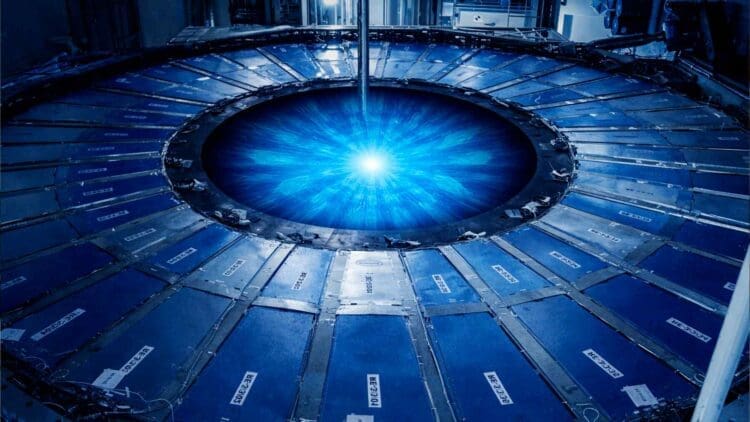
The best part is that these eerie movements can now be seen thanks to a newly developed device.
A specialized detector to decode the secrets of antineutrinos
Oscillation enables antineutrinos to transform their types as they move. The device measures these transformations, detecting the precise distance to hidden nuclear reactors miles away.
When the antineutrinos move through liquid, they emit blue light called “Cherenkov radiation.”
The device also distinguishes between civilian power production plants and plants manufacturing weapons. This is because each reactor’s varying fuel emits unique signals.
Now that the world invisible to the naked eye can finally be made visible, the applications are profound.
The energy gap can be closed with unmatched efficiency, and nuclear secrets can no longer be hidden behind lead walls.
Now that the global nuclear map can be made transparent, what will the open looking glass truly reveal?
We will either finally gain control over antimatter, or we could end up ripping the universe apart.



