
Sky-high power bills have us feeling the heat.
Everyone deserves a second chance, especially unused energy, and two innovative professors have shown how effectively it can be done.
Heavy industry operated on a “burn and vent” mode for generations, letting valuable energy and capital vanish into the atmosphere.



Instead of just feeling the heat of lost power, could this become the silent, powerful engine for future economic resilience?
How modern industry became a billion-dollar chimney
The modern world is filled with significantly advanced technology.
Yet, modern industry still faces a fundamental flaw, and it is not a lack of power.
The problem lies with retaining unused and wasted power.
Various sectors rely on furnaces that must reach temperatures far beyond 1,832°F to process raw materials.
This requires a significant amount of fuel, and an even greater portion never even contributes to the final product. Little by little, this “waste” is channeled through giant exhaust systems and eventually lost to the sky.
This is known as the “burn and vent” model, and it becomes a dual burden on heavy industry.
It is costly to produce this heat and to power the giant cooling systems needed for safety. The facilities also remain chained to centralized power grids, as sole operation cannot be done efficiently.
Heavy industry becomes vulnerable to price surges and grid instability as a result.
Perhaps it is time to stop overlooking wasted opportunities and seize the day, or at least the heat.
When traditional storage systems fail the industrial test
When at first you do not succeed, try and try again.
Renewable energy systems have been perceived as the next best thing for high-temperature industrial plants.
Several nations have significantly invested in expanding solar and wind energy. Even Spain’s industrial demand could now be satisfied by a 100 MW green hydrogen plant.
However, it is one thing to add renewables, but it is another to make them available on demand.
Usually, on-demand clean power requires “geographic luck” to support expensive pumped-hydroelectric systems. Additionally, it is also highly dependent on lithium-ion batteries.
This not only adds to the burden of additional expenses but also increases the risk of toxic material waste production. Not to mention the environmental impact from mining the critical mineral lithium.
Industry thus needs an entirely different system.
A startup founded by two professors from the University of Michigan may have just the device.
Bridging the gap between heat and electricity
Professor Stephen Forrest and Professor Andrej Lenert cofounded the startup called “Heat2Power.”
The goal of their startup is to provide affordable, efficient energy from stored heat. The key to this goal is thermophotovoltaic (TPV) technology.
Unlike traditional solar panel designs that convert solar energy into electricity, TPV devices convert heat into electricity.
The heat, or intense infrared radiation, emitted from white-hot industrial materials, is harvested by Heat2Power’s patented technology, “air-bridge thermophotovoltaics.”
Microscopic technology that delivers a powerful punch
Unused energy gets a second chance thanks to a microscopic air layer and a gold reflector.
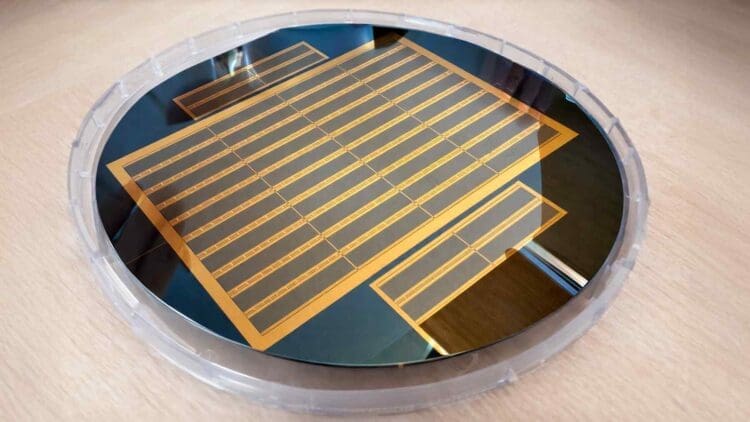
The thin air-bridge between the semiconductor and a gold mirror prevents thermal energy from overheating the cell. High-energy photons move through the bridge and are converted into electricity.
The gold mirror reflects low-energy photons to the heat source.
The technology achieved efficiency levels of 44%.
This shows that the smallest gap can become a bridge to solving a massive industrial waste problem.
Transitioning from “burn and vent” models to “bottling and recycling” could be a turning point for heavy industry. Facilities can become self-contained ecosystems that thrive on their thermal output.
Pushing boundaries is what the industry is all about, and this new technology could even generate power at night. A whole other world of clean, efficient power awaits us.