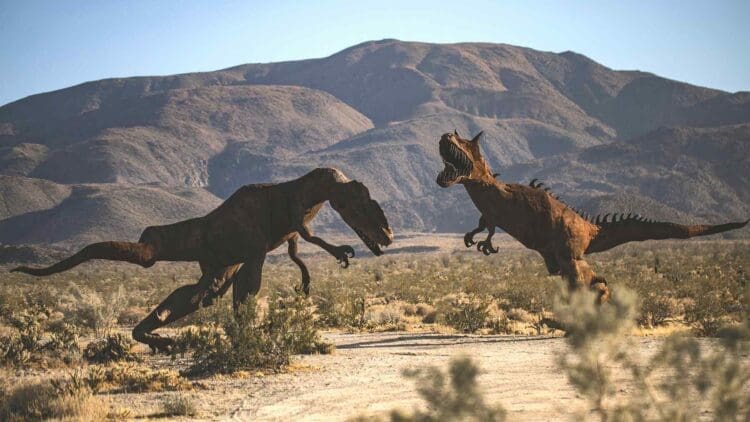

From evolved species to evolved insights, changing perspectives. Fans of the Jurassic Park movies will be glad to know that those creatures are not mere fiction today. Dinosaurs do still walk the Earth – some even fly! The latest research has shown that initial insights into dinosaurs were not as black-and-white as once thought. The existence of some species can be traced back to the dinosaur age, but are they also facing mass extinction?
A completely changed understanding of dinosaurs
Long before humans walked the Earth, there were dinosaurs. As with all other living species, they evolved to adapt to their changing environments. If we thought Earth was hot now, we would most likely not have survived the Triassic Period’s arid, hot climate. Carbon dioxide levels were extreme, making the period’s dinosaur species highly unique.
Fast-forward a few million years to the tropical Jurassic period. This period saw a rise in the variety of species, ranging from giant herbivores to predators. Another few million years later, the species reached maximum diversity during the Cretaceous Period. Earth was generally warm with minimal ice caps.


The term “dinosaur“ means “terrible lizard,” as they were widely accepted as scaly lizard-like creatures. However, this perception has evolved in recent years. The latest evidence points out that they are more closely related to a modern-day species. This may explain how they survived mass extinction.
The modern-day progeny of dinosaurs
Not all dinosaurs were extinct after the asteroid impact. Palaeobiology professor Roger Benson from the University of Oxford has studied the mass evolutionary patterns of dinosaurs. He particularly focused on those with a strong relation to bird origin. For years, it has been debated whether birds are dinosaurs. Evidence such as fossilized bone and soft tissue has ended the debate.
Just like the first female fossil hunter, Mary Anning, imagined dinosaurs either swimming or crawling, so did several others in the early nineteenth century. However, some could also fly, albeit with varying evolutionary techniques. Palaeontologist Paul Barrett from the Natural History Museum said that the discovery of the 115-million-year-old Deinonychus reshaped our perception of dinosaurs.
This predatory dinosaur had significant likeness to birds. Several discoveries highlighted the similarities that prove that birds are living dinosaurs. But the line between fossil birds and bird-like dinosaurs is a fine one.
Birds of a feather flock together
Not all feathered dinosaurs could fly. This makes the judgment call quite difficult, but Professor Benson has made a few things clear. Bird-like dinosaurs, such as the small Mei long, slept in positions similar to modern-day birds’ roosting. Fossil discoveries have also proven that bird-like dinosaurs gradually evolved, as did feathers.
Evolution varied from the 150-million-year-old Archaeopteryx in the late Jurassic to the Velociraptor from the late Cretaceous, 66 to 100 million years ago. Some could glide due to feather arrays on their legs, eventually evolving to the latest species with flight. Bones’ growth rate also indicates that bird-like dinosaurs were warm-blooded.
Fossil birds were distinct due to their wing-feather-arrangement-likeness to that of birds. However, birds’ origin traces back to bird-like dinosaurs due to:
- Warm-bloodedness
- Egg-laying
- Feathers
- Walking on two legs
Despite the belief of some, due to fear-based climate change propaganda, we are still far from another mass extinction. But we must start taking action.
As technology advances and more fossils are unearthed, it seems dinosaurs were more complex and unique than initially thought. There is still much to discover regarding these creatures of the past, but we must not forget about present-day species. Birds may be living dinosaurs, but as we attempt to conserve the Earth with renewable technologies, their existence, among others, is threatened. Are we truly doing all we can to save them?