
Egypt to award seven oil and gas exploration blocks in Upper Egypt and Red Sea with up to $70 million in planned investment
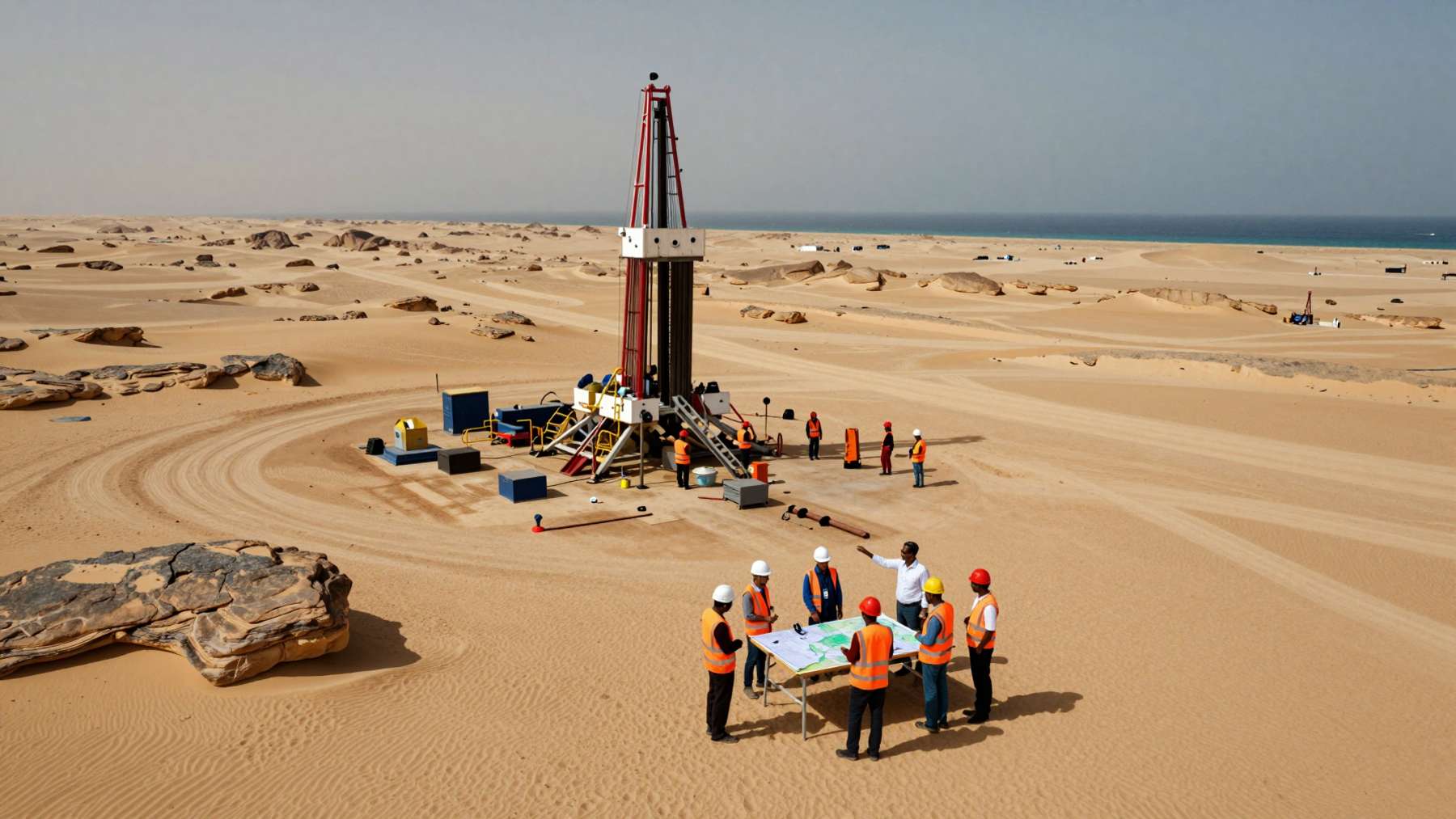 Image generated with artificial intelligence
Egypt’s South Valley Egyptian Petroleum Holding Company is preparing to award seven new oil and gas exploration blocks—six in southern Egypt and one in the Red Sea—with total planned investment somewhere between $60 million and $70 million. Petroleum Minister Karim Badawi announced an inspection of the Al-Baraka field in Aswan. The companies lined up to receive blocks include Canada’s Mediterra, the General Petroleum Company, and BP.
Seven blocks to be awarded to Mediterra, GPC, and BP
The six southern blocks cover the South Al-Baraka, North Al-Baraka, and Khart areas, heading to Canada’s Mediterra and the General Petroleum Company. Block seven sits in the Red Sea and is expected to go to BP.
South Valley chairman Samir Raslan described the target locations as offering solid exploration prospects at relatively low development costs. That combination—upside potential without heavy upfront spending—makes these areas more attractive than the mature, capital-heavy basins elsewhere in Egypt. Planned investment across all seven blocks runs between $60 million and $70 million, which isn’t a large number by global standards, but for underexplored southern Egypt it represents a meaningful injection of activity into a region that hasn’t seen much petroleum development in years.
She has a talent for turning complex ideas into sharp, memorable insights that stay with readers long after they’ve finished reading.
Concession consolidation and large-scale seismic survey underway
To improve commercial viability, South Valley has merged the Al-Baraka and West Al-Baraka concessions into a single unit—essentially making the numbers work for companies thinking about getting in. Better project economics create more stable conditions for sustained investment.
Running parallel to that, a major seismic survey is underway across nearly 100,000 square kilometers (62,100 square miles) of southern Egypt—roughly 10% of the country’s total land area. Once complete, the survey should deliver updated geological data and push the number of investment-ready areas past 10, opening a fresh pipeline of upstream opportunities. Results will go to investors after evaluations wrap up.
Taken together, concession restructuring and new seismic data form a deliberate play: improved economics plus better geology lowers the barrier for international companies to commit capital.
Drilling resumes at the Al-Baraka field after a three-year suspension
One of the clearest signs of renewed momentum is what’s happening at the Al-Baraka field in Kom Ombo, Aswan. Drilling and production had been on hold since 2022—a three-year pause tied to financial and operational challenges. That work has now restarted.
Mediterra has placed the first drilling rig on site and begun investing in a structured restoration program covering maintenance of seven existing wells, drilling of two new ones, and evaluation of five more. It’s a phased approach that balances near-term output recovery with longer-term appraisal work. The company is also working with the Egypt Upstream Gateway to identify the best spots for further drilling, taking the guesswork out of site selection before committing to new wells.
Restarting Al-Baraka matters beyond the field itself. It’s a visible proof point that activity in southern Egypt is moving from planning into actual execution.
Government strategy targets underexplored Upper Egypt with investment incentives
Minister Badawi was direct about where Upper Egypt fits in the ministry’s priorities—describing it as central to the exploration and production strategy, with the region’s largely untapped petroleum potential as the main driver.
Concrete incentives are on the table to back that up. These include the R-Factor mechanism, a fiscal tool that adjusts terms based on how much an investor has recovered relative to their costs, alongside the concession consolidation already underway. Both measures are designed to reduce financial risk for companies operating in less-developed areas. Badawi also pointed to the settlement of outstanding payments owed to foreign partners as a key factor in bringing Mediterra back—clearing those arrears helped rebuild confidence and gave the company a genuine reason to restart investment.
He framed the broader payoff across several dimensions: production growth, job creation, development of local petroleum expertise, and a boost to related industries across the region. Upper Egypt has historically lagged behind the Nile Delta and Western Desert in petroleum activity, so the government sees this push as both an energy strategy and a regional development tool. Mediterra’s success, Badawi noted, could have a multiplier effect—strengthening investor confidence and drawing more international energy companies into southern Egypt’s upstream sector.
New geological data for the region
Egypt is moving to award seven oil and gas exploration blocks across Upper Egypt and the Red Sea, with $60–70 million in planned investment split among Mediterra, the General Petroleum Company, and BP. South Valley has consolidated the Al-Baraka concessions to improve project economics, and a seismic survey covering nearly 100,000 square kilometers (62,100 square miles) is generating new geological data for the region. Drilling has restarted at Al-Baraka after a three-year suspension. The government is backing the push with fiscal incentives, debt settlements with foreign partners, and a broader strategy to develop Upper Egypt’s underexplored petroleum resources.
Kelly is an experienced writer with 15 years of experience exploring the big stories that shape our world, from tech breakthroughs and space exploration to climate, energy, and the fascinating quirks of science. She has a talent for turning complex ideas into sharp, memorable insights that stay with readers long after they’ve finished reading.
