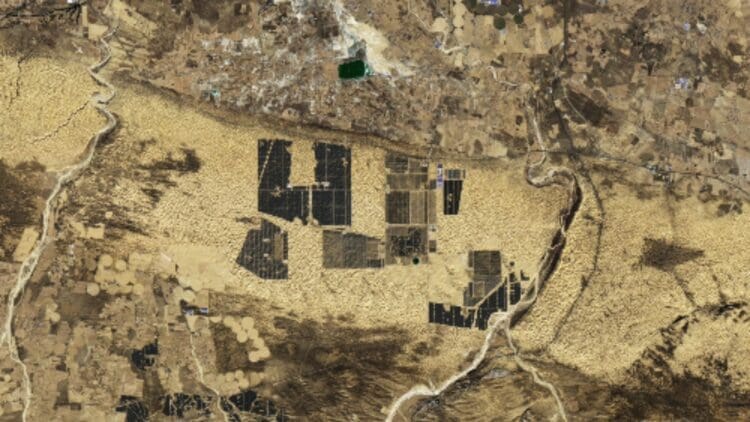

China is breaking significant barriers in the world’s installed renewable capacity, especially with solar. The country has proven that slow and steady wins the race, and is now well on its way to ascending the ladder to renewable dominium. The assembly of the ‘Great Wall of Energy’ has commenced in the desert, which will consist of a mind-boggling eight million panels and 100 GW. The country’s entire energy landscape has been transformed, setting global benchmarks that some can only dream of.
Ascending the ladder to renewable dominium
In 1983, the first civil 10 kW solar power station began operations in Ganzu. Since then, the Chinese have proven that they deserve the title of being a global leader in the solar industry. This was evident in the latest data from the Global Energy Monitor, which indicated that the country’s solar capacity increased significantly. According to this data, China achieved the following:
- 278 GW solar addition in 2024
- Adding almost 200 GW in the first five months of 2025
- Surpassing 1 TW installed solar capacity by mid-2025
However, it seems as if these milestones are only the beginning, as even more mega-projects lie ahead, with renewable dominium within reach. One of these mega-projects will enable China to continue ascending that ladder to dominium, as the assembly of its Great Wall of Energy has commenced in the desert.
China starts assembling its ‘Great Wall of Energy’ in the desert
From one Great Wall to another, there is no stopping the Chinese. While the first one took approximately four centuries to complete and focused on the security of the nation, the second one may take less time to complete and is more concerned with the nation’s energy security. The assembly of the “Solar Great Wall” has commenced in the Kubuqi Desert in Northern China.
According to Popular Mechanics, this wall will be nearly 133 km (82.6 miles) long and 25 km (15.5 miles) wide. This is not China’s first solar desert project, as 455 GW of solar power is also stretched across the dunes in the Shagehuang Desert. However, according to Ordos Energy, the project developer, this project stands out, as it generates “more than enough” power to meet Beijing’s energy demands.
Sounds too good to be true? Well, with eight million solar panels, you best believe it!
Boasting so much more than scale
The goal of the Solar Great Wall is to generate 180 billion kWh annually by 2030. With the wall’s assembly, a new transmission line will also be added to convey 48 billion kWh of power from the installation to the Beijing-Tianjin-Hebei area annually, as per Popular Mechanics. Beyond boosting the region’s energy security, there are other benefits as well. According to Dalad Bannar’s official Li Kai:
“In total, approximately 50,000 job opportunities will be generated by 2030.”
But wait, there’s more. One of the key challenges faced by desert regions is a process called “desertification,” which is the gradual transition of a river’s ecological basin into desert-like conditions. This is presently occurring at the Yellow River near the installation. The Solar Great Wall will:
- Provide shade and decrease evaporation at 27 million hectares (66 million acres) of the region
- Provide windbreaks to prevent soil erosion
2,400 hectares (988 acres) of crops will also be planted in the “most desertous regions” near the wall. This will help advance the economy while fostering ecological preservation. What is commonly referred to as the “Sea of Death” will thus become a significant energy hub in the country. The assembly of the Solar Great Wall will thus not only add to China’s already impressive solar portfolio but also serve as inspiration to breathe new life into desert regions. Another Chinese 7,000 MW mega-project is going live in 2026, lighting up the desert even further.