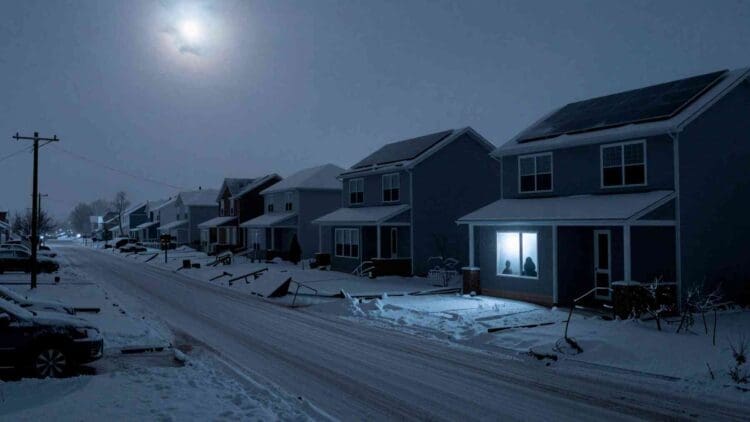

More than a quarter of U.S. homes already run entirely on electricity, and solar installations are on track to triple within five years. The push to clean up America’s energy supply is accelerating — and so is the pressure that extreme weather places on the grids powering those homes.
What emergency planners have been slower to map is the risk hiding inside that transition. As millions of households go fully electric, researchers are only beginning to ask what happens to them when the power goes out — and whether the homes built to be cleaner are also built to survive the storms getting worse around them.
A nation going electric — faster than its grid can handle
The numbers behind America’s energy shift are substantial. More than a quarter of U.S. homes already run entirely on electricity, and solar installations are projected to triple within five years. The infrastructure carrying all that power, though, is aging — and extreme weather events are arriving more frequently, stressing grids that were never designed for this combination.



Emergency planners are caught in the middle. They need to know which households face the greatest risk during a blackout, but efficient tools to answer that question have largely been absent. Philip Odonkor, a Stevens Institute of Technology professor who led the new research, framed the problem directly: electrification is accelerating, while our understanding of the vulnerability it creates has not kept pace.
Mining 129,000 homes for hidden energy signatures
To close that gap, Odonkor’s team turned to data. Working with Department of Energy building-stock records, the researchers analyzed energy patterns from 129,000 single-family homes across eight states. The central goal was identifying what they called energy “signatures” — distinctive consumption patterns that separate fully electrified homes from those still drawing on mixed energy sources. They also worked to determine which specific appliances within mixed-energy homes had already switched to electricity.
The models relied entirely on consumption data. No physical inspections, no door-to-door surveys — just the patterns that homes leave behind in their energy use.
Summer resilience, winter fragility: a stark divide
The findings revealed a clear seasonal split.
Solar-powered homes performed well during summer heat waves. With the sun available, they could generate their own power and absorb some of the stress that extreme heat places on the broader grid. That resilience is real, and it carries practical weight for emergency planning.
Winter tells a different story. Fully electrified homes were found to be nearly three times more vulnerable to winter outages compared to homes using mixed energy sources. Solar panels, however effective in summer, cannot meet the intense heating demands that emerge when temperatures drop, and the grid fails at the same time. Odonkor pointed to the 2021 Texas winter storm as a preview of what broader electrification could mean in cold-weather emergencies — millions lost power during that event, and as more homes go fully electric, preparing for that kind of scenario becomes essential.
95% accuracy — without knocking on a single door
The method the team developed may prove as significant as the findings themselves.
Their machine-learning models can identify a home’s energy systems and assess its vulnerability profile with over 95% accuracy, using only energy-consumption data. No resident contact required, no inspection. Privacy is protected while utilities and emergency responders still get the information they need to act.
“Until now, we actually had to go door-to-door to determine if a home was fully electric,” Odonkor noted. That is no longer the case. The tool can scan entire neighborhoods and flag at-risk households at a scale manual methods could never match. The research was published in the Journal of Smart Cities and Society.
From research tool to community resilience strategy
The practical applications extend well beyond individual homeowners.
Community emergency-service units could use vulnerability maps to prioritize outreach before a storm arrives, directing resources toward the households most likely to struggle when the grid fails. Urban planners could fold the same data into long-term housing decisions — building resilience into neighborhoods before problems emerge rather than scrambling after the fact. Both uses point toward a fundamentally different way of thinking about grid risk: anticipatory rather than reactive.
The broader implication is difficult to set aside. A green energy transition that leaves fully electrified homes dangerously exposed during winter blackouts is an incomplete transition. Odonkor’s message was direct: sustainable cities must be both clean and resilient, and those two goals cannot be treated as separate ambitions.
As electrification continues to expand, the next test will be whether utilities, planners, and policymakers adopt tools like this one quickly enough to matter — before the next major winter storm forces the question.