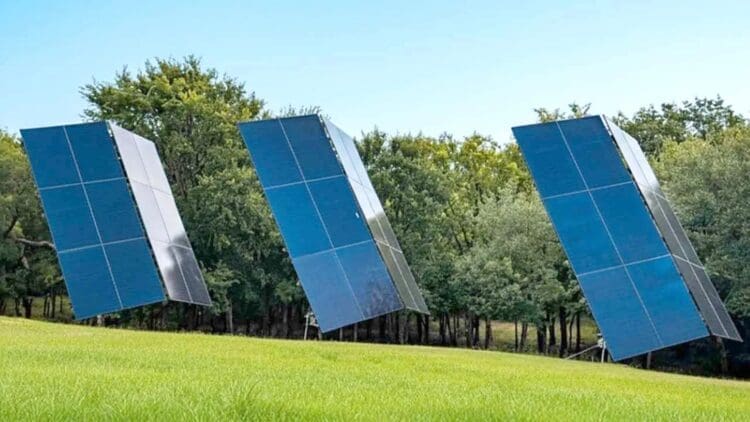

It is like a miniature Tower of Pisa meets skyscrapers, but its role is bigger than a mere aesthetic pivot.
When in Rome, do as the Romans do, but when in The Gambia, survival requires rising to the occasion.
That is precisely what a particular engineer did after reimagining solar power in the U.S.

Rome may not have been built in a day, but will these towers rise much quicker worldwide?
How the cost of flat thinking is keeping us from efficient solar energy
After years of staggered breathing due to the choking air caused by fossil fuels, it is time for a change.
The survival of habitats and ecosystems is being threatened, and our own vital resources are running dry.
Only renewable energy can help the world break free from the soot-staining shackles of fossil fuels.
For a long time, solar power has been the ultimate savior of renewables. It has proven to be a clean, silent, and infinite alternative.
However, this “perfect” hero turned out to have a giant, 2D skeleton in the closet.
Peak performance is achieved when solar panels are carpeted across thousands of acres. The technology’s giant footprint thus replaces vast and valuable agricultural land and wilderness.
And it is taxing on both land and pockets. Production, preparation, installation, and miles of wiring cost a pretty penny.
That is why innovators are beginning to think outside the flat box.
2D designs are lacking in creativity and efficiency
For many people, these acres of glass reflecting at what feels like the ends of the Earth are not aesthetic. Then, there is the pilot safety issue stemming from intense solar reflection.
This means that the entire design and layout of solar panels are due for a major revamp. But it is not just about looks, as it is also about efficiency.
Experts in the field are certain that solar energy and panels are nearing their theoretical limit. However, this does not change the fact that traditional designs only convert approximately 33.7% of sunlight.
This static design thus leaves a large portion of the market underserved. This is especially true during peak demand in the early morning and late afternoon.
A Gambian man named Mohammad Njie knows what it feels like to live without reliable electricity.
He knew that an unreliable grid needed something more than the usual solar solution.
The rise of a sleek, solar tower dynasty
Most innovators focus on improving solar material to boost efficiency. However, Mohammad Njie and his company, Janta Power, focused on the structural layout itself.
The Dallas-based startup used both nature and manmade architecture as inspiration to reimagine solar power.
The one thing that trees and skyscrapers have in common is that both extend upwards. This led to the creation of a unique, 3D solar tower.
When a 3D tower leans into both efficiency and aesthetics
These 17-foot steel towers save on space, reclaiming the millions lost to flat designs.
They also generate three times more output per acre, and pivot on a single axis towards sunlight. This results in a “dual-peak production curve,” with maximum power production from early morning to late afternoon.
The vertical layout naturally lowers intense glares, boosting safety for pilots. The towers can also withstand winds up to 140 mph.
Munich International and Dallas-Fort Worth Airport are already investing in Janta Tower pilot programs. With target costs of $0.03/kWh to $0.04/kWh, the returns will certainly rise to the occasion, too.
However, for Njie, the true success behind these solar towers is powering a Gambian school that was used to darkness.
In addition, this sleek design will also fit in nicely with concrete jungles. In the end, the best way to “save millions” is by thinking vertically.