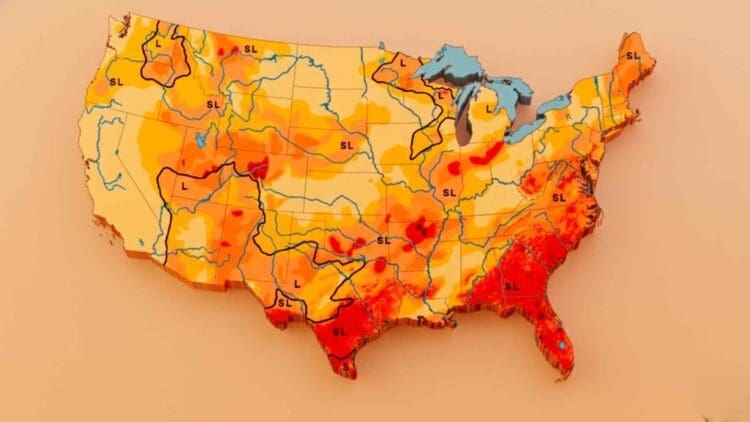

Most people consider the beginning of early spring to be a welcome relief from the stresses of winter and the weather conditions associated with it. However, forecasters noticed a subtle yet persistent trend during their seasonal shift assessments that was both notable and worthy of consideration, and not panic. According to the National Interagency Fire Center’s Seasonal Outlook, almost 43% of the United States is currently experiencing some form of drought.
A number that says more than you think
This percentage of the total U.S. land mass represents not a sudden catastrophic event nor a brand new environmental emergency. Instead, it simply represents the area of the nation that is experiencing abnormally dry conditions at this particular time in the season.
What makes the 43% figure so significant is not the size of the number itself, but rather the geographical distribution of the drought conditions. While many regions in the western U.S. continue to be affected by drought conditions, the drought situation is improving along coastal areas, specifically in California.

Simultaneously, drought conditions have worsened in various sections of the southwestern U.S. as well as parts of the central Rocky Mountains, the southern Plains, and the southeast U.S. Additionally, dry zone conditions have developed in other areas in the upper Midwestern states.
Drought patterns as a backdrop for the March forecast
To the experts, the current drought patterns represent the context for what they believe will occur in March. March is typically a month characterized by changing jet stream patterns, temperature anomalies, and varying precipitation patterns.
Regional areas where conditions are expected to be increasingly stressed
According to the official statement from the National Interagency Fire Center, in terms of the March forecast, the focus is on the climatic phenomena that are consistent with the seasonal patterns of temperature and precipitation. According to the National Oceanic and Atmospheric Administration (NOAA) and Predictive Services, above-normal temperatures are predicted to dominate the southern half of the U.S., including the Appalachian Mountains, extending northward to the east coast of the United States as March approaches.
Conversely, near-to-below normal temperatures are predicted to exist in the northern tier of the U.S., from Washington state to northern Minnesota, affecting the northern part of the U.S. through early spring.
The precipitation forecasts show a similar dichotomy
Below normal precipitation is predicted for the southern tier, primarily the southwest U.S. and the Gulf Coast region, potentially exacerbating drought conditions in those areas.
Conversely, above normal precipitation is predicted for the northwestern U.S., the Great Lakes, and the Ohio Valley region, potentially influencing soil moisture and fire potential through March.
While neither of these forecasts indicates extreme or alarming conditions, they do illustrate areas that may experience worsening or improvement in conditions as the season progresses. Therefore, the 43% drought factor is significant because it provides the starting point from which regional conditions may either remain stable or become increasingly stressful.
Understanding the pattern is important now
To the professionals, March is far more than just a high-risk month; it is also a turning point for the season, where historical drought will be influenced by short-term weather trends. The climate forecast for March indicates that the southern Plains, the Northern Gulf Coast, and parts of the Carolinas and Virginia are likely to have above-average fire potential at the beginning of March due to warm and dry conditions.
Conversely, the wetter conditions predicted in the Midwest and Great Lakes regions could temporarily ease drought conditions in those regions.
Instead of an overall disaster, we see a wide range of regionally contrasting impacts on fire danger. With the approaching March providing a glimpse into the interplay of temperature and moisture and reshaping the national landscape as spring arrives. Experts agree that an appreciation for the regional nuances will be essential for navigating the months ahead.
Disclaimer: Our coverage of events affecting companies is purely informative and descriptive. Under no circumstances does it seek to promote an opinion or create a trend, nor can it be taken as investment advice or a recommendation of any kind.