
Floodwater keeps rising around homes in Georgia, and residents fear it is carrying toxic chemicals from nearby Superfund sites
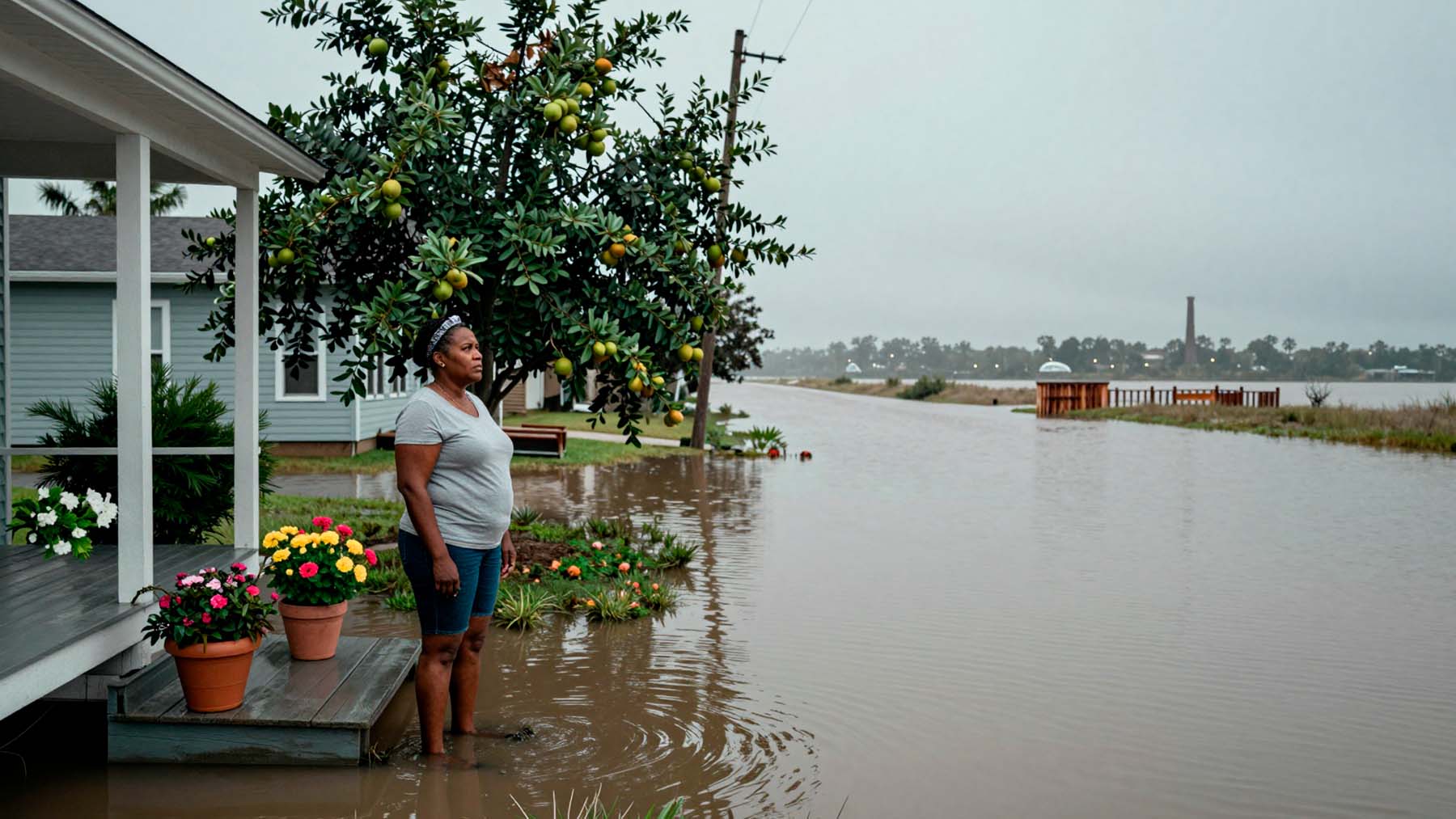
Semona Holmes has fruit trees in her yard, potted flowers on her porch, and a fish pond out back. She also has floodwater — rising to her knees when the tide runs high or the rain falls hard enough, occasionally turning her street in Brunswick, Georgia, into something closer to a river.
Her neighborhood floods regularly. It also sits about half a mile from a former pesticide plant, now a federal Superfund site. For Holmes, the water that pools around her home isn’t just an inconvenience. It’s something she fears is carrying more than mud and rainwater with it.
A neighborhood caught between the tides and a toxic legacy
Brunswick sits along Georgia’s Atlantic coast, where land meets water in ways that are beautiful and, for some residents, deeply unsettling. Holmes’s street floods regularly — not just after major storms, but when the tide climbs high enough. After one hurricane, her neighbor paddled a canoe down the block. Improvements to the stormwater system have helped somewhat in recent years, but the underlying anxiety hasn’t gone anywhere.
Science shaped by community input is more likely to answer the questions people are actually living with, rather than the ones that happen to be easiest to measure.
That anxiety has a specific address. Roughly half a mile away, a former pesticide plant now operates as a federally designated Superfund site. Holmes worries that the water rising around her home doesn’t stay clean as it moves through the landscape. “Everything from that chemical plant has flowed into our community,” she said.
Glynn County carries an unusually heavy burden for its size — four Superfund sites within its boundaries, concentrating decades of industrial-era contamination in a relatively compact coastal area. For Holmes, the concern isn’t abstract. Several of her six grandchildren attend an elementary school just blocks from the nearest toxic site. She thinks about them on the playground and wonders about the soil beneath their feet.
Why climate change turns old contamination into a new crisis
Superfund sites aren’t simply abandoned lots. They’re actively managed — capped, contained, monitored — under the assumption that keeping pollutants locked in place protects nearby communities. But those containment structures were designed for a world with more predictable weather and more stable coastlines. Both assumptions are now being tested.
Floodwater doesn’t respect engineered barriers. When contaminated soil and sediment get inundated, the chemicals stored within them can mobilize — spreading into streets, drainage systems, waterways, and ultimately into people’s bodies. The caps and containment measures meant to prevent exposure may not hold under conditions more extreme than their designers ever anticipated.
Glynn County isn’t an outlier. Thousands of contaminated former industrial sites identified by the EPA face similar climate-driven risks across the United States. Coastal and low-lying locations are especially vulnerable, and the communities living nearest to them — often lower-income, often with less political leverage — tend to bear the greatest burden.
Holmes’s household has already drawn its own conclusions. Her family avoids tap water and steers clear of seafood caught in local waterways — a grassroots precaution made without formal risk assessments or official guidance. That gap between what residents fear and what science has formally documented is exactly what researchers now hope to close.
Georgia’s first Superfund research center takes aim at both past harm and future risk
A $15 million, five-year research initiative funded by the National Institute of Environmental Health Sciences will soon launch what is described as Georgia’s first Superfund research center. Six institutions are partnering on the effort: Emory University, the University of Georgia, Georgia Tech, Morehouse School of Medicine, Spelman College, and Texas Tech University. Glynn County’s four toxic sites, including the former pesticide plant near Holmes’s home, are the focus.
Emory public health professor Noah Scovronick describes two core goals. “One is to understand the health effects of past chemical exposures,” he said, “and the other is to try and reduce people’s future exposures.” Both matter — and they require very different methods.
The team plans to conduct environmental sampling to trace how and where people may have encountered toxic substances, then analyze potential links between those exposures and health outcomes. They’ll also model the effects of climate change on existing remediation infrastructure. “We want to be sure that the remediation that is ongoing at those sites is resilient to extreme weather moving forward,” Scovronick said. That last piece — stress-testing containment against future storms and sea-level rise — may prove the most consequential part of the work.
Community voices shaped the research agenda
Before the researchers finalized their study design, they met with Glynn County residents. That step matters. Science shaped by community input is more likely to answer the questions people are actually living with, rather than the ones that happen to be easiest to measure.
Holmes knows exactly what she needs to understand: which chemicals her family has been exposed to over the years, and what the long-term health consequences might be. The answers may not be reassuring. But she believes documentation has value regardless of what it reveals.
If the research uncovers damage that can’t be reversed, that record still creates accountability — it names what happened and who was responsible. “It shows that you care about humanity,” Holmes said, “and that you are able to acknowledge that, ‘Yeah, by our actions, we have possibly contaminated an entire county.'”
Acknowledgment, though, is only a starting point. Holmes is clear about what comes after: “There has to be continued action.” As sea levels keep rising and storm seasons grow less predictable, the findings from this research center could help determine whether communities like hers get ahead of the next wave — or are left to wade through it.

Carlos is an engineer with strong expertise in technical and industrial topics. He previously worked at international companies such as Siemens and is multilingual.
