
German renters are turning their balconies into tiny power plants, and half a million of them are already “off the grid” in their own small way
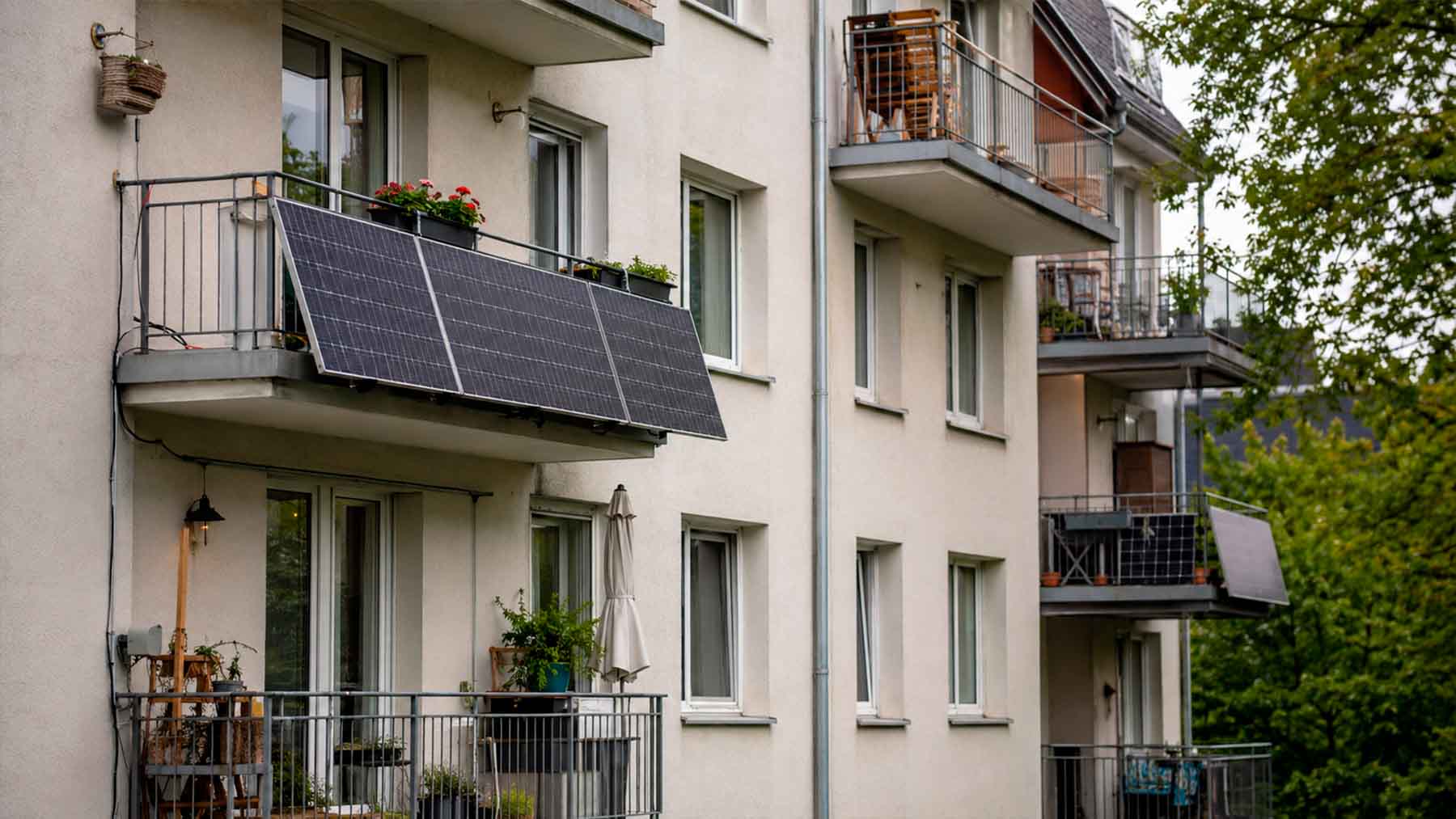 Image generated with artificial intelligence
On Matthias Weyland’s balcony in Kiel, Germany, two dark-blue solar panels hang quietly from the railing of his red-brick apartment building. They connect directly to a microinverter plugged into a standard wall outlet. No expensive contractor, no municipal permits, and no rooftop access required. He bought the complete setup online for roughly $550.
It is a modest system, but on a clear day, it generates enough solar power to meet half his family’s daily electricity needs.
A plug-in revolution hiding in plain sight
The device driving this grassroots energy movement is deliberately simple. Two solar panels clip onto a balcony railing, connect to a compact microinverter, and plug into an ordinary household wall outlet. Clean electricity flows straight into the apartment, offsetting whatever power the municipal grid would otherwise deliver. No electrician, rewiring, or homeownership needed.
Yet advocates like Helena Holenweger of Deutsche Umwelthilfe stress that the movement makes the clean energy transition feel concrete rather than abstract.
That last detail is huge in Germany, where over half the population rents. Rooftop solar has historically been an exclusive privilege reserved for property owners. Balcony solar hands energy independence directly to tenants. If you can plug in a toaster, you can install one.
Most setups cost around $550. Regulations cap output at 800 watts—enough to run a compact refrigerator or keep laptops powered all workday.
From niche curiosity to half a million units
Balcony solar, or balkonkraftwerk, spent years on the fringes as a hobby for DIY tech enthusiasts. Widespread adoption surged four years ago, fueled by regulatory shifts and global economic shocks.
Policy changes provided the initial spark. Years of advocacy led to Germany’s 2019 technical standards, which formally authorized plug-in solar devices to feed power into home electrical circuits.
Then came sudden accelerants. The COVID-19 pandemic gave housebound residents time for home projects, while skyrocketing energy prices made balcony solar a fast, practical defense against rising utility bills. “People did whatever they could to lower their bills,” explained Wolfgang Gründinger of clean energy firm Enpal.
Policy tailwinds that made it happen
Government momentum kept building. In April 2024, federal authorities streamlined registration, slashing bureaucratic red tape. By July 2024, lawmakers passed landmark tenant protection rules preventing landlords from arbitrarily blocking solar installations.
Cities backed the effort directly. Berlin and Kiel launched multi-million-dollar subsidy programs, providing cash incentives to lower upfront costs for hesitant residents.
Safety concerns—a common landlord objection—have proven unfounded. Experts at the German Solar Industry Association verified that standardized microinverters feature automated shutoff mechanisms that seamlessly integrate with standard home wiring without overloading the electrical grid.
Modest savings, outsized meaning
The financial payoff is real but measured. A typical setup saves users roughly $100 annually on electricity, achieving full payback in about five years. Under optimal conditions, a south-facing system can supply up to 15% of an apartment’s power needs.
Nationally, the total capacity remains small. Analysts at the German Federal Network Agency note that even if every suitable balcony nationwide installed panels, total generation would cover 1% or less of Germany’s energy demand.
Yet the psychological impact is profound. Without expensive battery storage, power must be consumed instantly. This turns daily energy use into a game—running dishwashers and charging electric bikes when the sun peaks. Users track live output on smartphone apps and proudly share daily stats in family group chats.
Hurdles ahead and what Germany’s experiment means elsewhere
Landlord friction persists, though courts back tenants. Weyland successfully sued his property manager in October 2023 over unreasonable installation demands.
Expanding internationally presents technical hurdles. While balcony solar grows across Austria, France, and the Netherlands, it faces resistance in the United States. US National Electrical Code rules restrict backfeeding into standard outlets, and American 120-volt circuits differ from Europe’s 230-volt standard, requiring costly electrical modifications.
Yet advocates like Helena Holenweger of Deutsche Umwelthilfe stress that the movement makes the clean energy transition feel concrete rather than abstract.
Which reveals the true story behind this quiet movement: German renters are turning their balconies into tiny power plants, and half a million of them are already “off the grid” in their own small way.
Kelly is an experienced writer with 15 years of experience exploring the big stories that shape our world, from tech breakthroughs and space exploration to climate, energy, and the fascinating quirks of science. She has a talent for turning complex ideas into sharp, memorable insights that stay with readers long after they’ve finished reading.
