
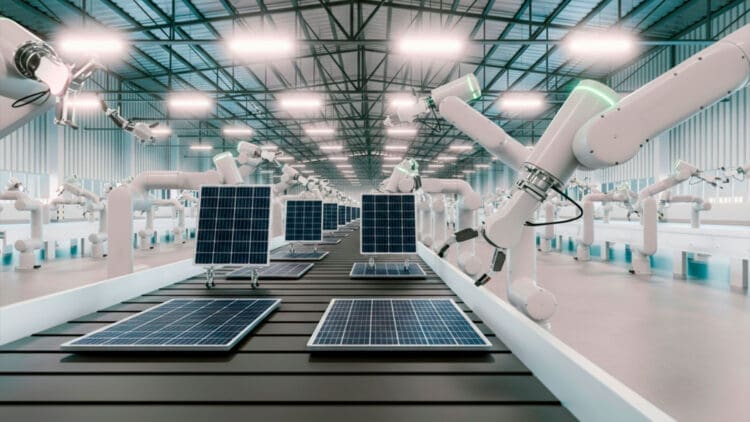
Solar cells are now very close to perfection.
For many years, solar technology has been deemed too expensive to make solar energy a primary alternative energy resource. Now, solar panels have become relatively affordable.
The next step was advancing solar cell production while maintaining key characteristics. German scientists created an ingenious production method, and years later, it is more advanced than ever.


Will this production method reshape the entire industry?
Solar power: The key to zero-carbon energy production
The world is experiencing significant urbanization due to rapid population growth. Important industries are becoming digitalized as technology continues to evolve.
Throw that all together, and it is no wonder that global energy demands are at an all-time high.
While fossil fuels still significantly contribute to the energy sector, the world is actively investing in renewable energy sources.
Among the most important of these sources is solar energy.
This alternative source is critical in achieving global net-zero targets. Global capacity has significantly expanded in recent years.
This can be attributed to its long-term savings on electricity bills and more affordable upfront costs. Unfortunately, solar power continues to face significant challenges despite its growing popularity.
One of the greatest challenges lies within the production of solar cells. This is why scientists have been exploring new production methods.
Fortunately, Chemnitz University of Technology made a discovery that could be the breakthrough the world has been waiting for.
The need for new solar cell production methods
The production of conventional solar cells is extremely energy-intensive and not as cost-effective as initially believed.
Furthermore, the silicon wafer material is highly fragile and non-flexible. This, in turn, results in heavy solar panels that consist of glass and metal to protect the cells.
This makes installation more difficult and limits applications. While these cells have high efficiency levels, maximum output is only achieved in direct sunlight.
Considering all of this as a whole, it makes sense why scientists from Chemnitz University of Technology’s Institute of Print and Media Technology sought better methods.
While tandem solar cells are seen as the new “solar craze,” the German scientists opted for another material for their alternative production method.
The method was tried and tested 15 years ago. While it was successful, it took years of refinement to make it a more feasible approach.
Will it become the new norm?
The method that could change it all
A scientific team led by Dr. Arved Hübler made history in 2011 after creating the first solar cell printed on paper. At the time, the efficiency was a mere 1.7%, but the accomplishment opened the door to further development.
Since then, the latest solar cells have advanced to higher efficiencies and long-term stability.
While the Chinese have invented an adhesive solar film as thin as paper, this technology is different. The German scientists used PM6:Y12, a polymer blend, and incorporated it into five extra layers to print the solar cells.
Organic semiconductors are in the central layers for light conversion.
A roll-to-roll press is utilized, and liquid functional inks with electrical properties are applied.
Fast, efficient, and “cheap” production with great yield
Production is fast, cost-effective, and energy-efficient. Its production yield is also higher than 88%.
The breakthrough can be attributed to the German Research Foundation (DFG)’s funding of the research group “Printed & Stable Organic Photovoltaics with Non-Fullerene Acceptors,” or POPULAR.
The next step for this technology is assessing its durability under high-stress conditions.
Scientists from various German universities will be conducting the tests. This research will increase insights into solar cell degradation. It also plays a key role in the production methods and materials used for next-generation solar technology.
However, Australia is convinced that another material is a great contender to be the solar game-changer. What do you think the future of solar looks like?

