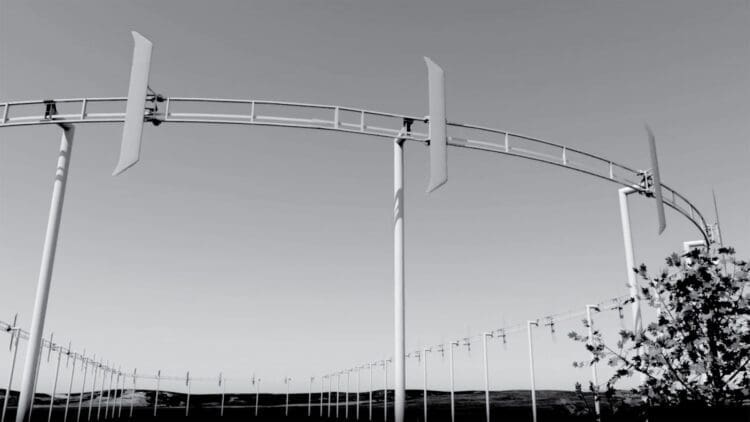
In the “Intelligent Era,” artificial intelligence (AI) has become a common feature in our daily lives, but just like all living things require energy to stay alive, so does AI, metaphorically speaking. AI is extremely energy-intensive, and traditional renewable technologies, such as wind turbines, fall short in supplying this demand. This is why we must rethink clean power, and a wind specialist company may have the solution, namely a “roller coaster” system that could produce up to 2.5 MW of clean power.
Goodbye to wind turbines: Rethinking clean power
Globally, data centers are consuming substantial amounts of power to keep AI “alive.” According to the International Energy Agency (IEA), some data have predicted that AI will consume more than 1,000 TWh by 2030, a scale that has people concerned, and rightfully so. The IEA, along with the World Economic Forum, indicates that fossil fuels are, unfortunately, still primarily supplying this substantial demand.
In the U.S., power grids are under tremendous pressure, especially considering the aging infrastructure. While renewable energy capacity for solar and wind is rapidly expanding, some experts are concerned that it will not be enough to sustain power-hungry data centers. Furthermore, utilities believe that the urge to build new data centers can negatively impact local regions, potentially increasing electricity bills.
This is why innovative renewable power sources are needed, not only to power AI, but also to simultaneously keep our carbon footprints as low as possible. A Wyoming-based startup company has been rethinking clean power, and its latest innovation may have us say goodbye to traditional wind turbines for good.
“Roller coaster” system testing begins in Wyoming
The wind specialist startup, Airloom Energy, has introduced its pioneering wind energy “roller coaster” system to the world, and as a result, the Consumer Electronics Show (CES) has named Airloom Energy a “2026 Honoree in Sustainability & Energy Transition.” This next-generation wind turbine design could potentially reform the entire wind industry.
The startup created a prototype in 2023, and in 2025, its 150 kW pilot operation testing began in Wyoming. The specifications of Airloom’s turbine design are unique, as it is a vertical-axis system that resembles a roller coaster and features modifiable wings on an oval track. What makes this design valuable in the U.S. is that it requires fewer rare components, which is vital as wind power is facing material shortages.
It could produce up to 2.5 MW soon
According to CES, when comparing Airloom’s system to a typical 3MW horizontal-axis wind turbine (HAWT), it presents the following benefits:
- It is 40.3% lighter
- It is made from 42.3% fewer components
- It requires 96.1% less unique components
- It is 50.5% more cost-effective per square meter
- Easier mass production, transport, and installation
- Operates in areas with low wind speeds
- Only 20 to 30 meters high
- Increased access to clean and reliable power
Airloom is working hard on a commercial version, which could potentially produce 2.5 MW of wind energy. The commercial version’s prototype is set to be completed by 2027. Feedback has been positive so far, including from Breakthrough Energy Ventures’ Phil Larochelle, who stated:
“We spend a ton of time in the hardware, enegry, and industrial spaces and my sense is that Airloom can not only serve as a catalyst for low-cost utility-scale energy, but also lead to a rapid, mass manufacturable source of resilient energy.”
In conclusion, this pioneering “roller coaster” system could revolutionise the wind industry by offering consumers a more affordable and versatile wind power solution. Should Airloom scale its design to a commercial scale, it could potentially bridge the gap between renewable energy capacity and data center energy demands. For now, if you have noticed that your electricity bill has indeed increased, why not consider a clean power solution for your home, such as the vertical-axis “Pegasus” 4 kW wind turbine for home-use.
Disclaimer: Our coverage of events affecting companies is purely informative and descriptive. Under no circumstances does it seek to promote an opinion or create a trend, nor can it be taken as investment advice or a recommendation of any kind.