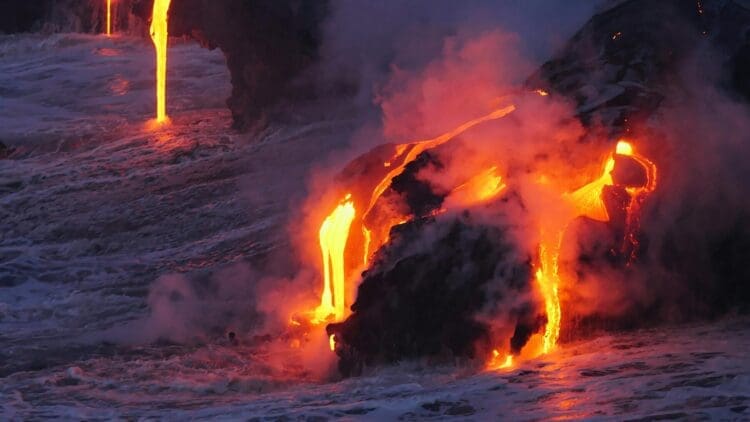

While some people will be focused on their newly made New Year’s resolutions, nations worldwide continue to actively work towards achieving their respective climate goals. The state of Hawaii is among the nations trying to achieve carbon-neutrality. It had geothermal, but hydrogen was missing, until now. Plans are under development where up to 1,000 tons could be mined at a new facility. Should the project receive approval, it could reform Hawaii’s energy infrastructure.
Hawaii had geothermal, but hydrogen was missing
Hawaii is one of the states that faces challenges with its carbon footprint, with transportation playing a significant role in the state’s overall carbon emissions. According to 2022 greenhouse gas emissions data from the Hawaii State Department of Health, ground transport and aviation accounted for nearly 50% of the state’s total greenhouse gas emissions.
This comes as no surprise, as the island state heavily relies on its transportation for tourism and imports. Unfortunately, the 2022 data also revealed that Hawaii’s power production contributed 36.6% of greenhouse gas emissions. The state has set a climate goal to achieve carbon neutrality by 2045. While its geothermal energy may help lower the state’s dependency on imported fossil fuels, it is not enough to decarbonize its carbon-heavy industry.

Hydrogen, which is key to decarbonizing carbon-heavy industry, is the one thing missing from the island state, but this could change soon.
Now up to 1,000 tons could be mined at this new facility
Eurus Energy America, an energy company based in Delaware, has its sights set on Hawaii’s Kapolei to become a hydrogen hub. Eurus has sent in an application to the Hawai’i Board of Land and Natural Resources to construct a new facility at Campbell Industrial Park, Kapolei. The main purpose of the facility would be to use recycled water to produce clean hydrogen.
Seeing as the IEA indicated the clean hydrogen outlook for 2030 has been trimmed, a new facility may not be such a terrible idea. 100 acres of Campbell Industrial Park would be for the project, of which nearly 90 acres will be set aside for a 20 MW solar array that would power the facility. The recycled water will be transported via an existing pipeline of the Board of Water Supply.
According to the Department of Energy, the facility will have the capability to generate between 500,000 and 800,000 kg (551 and 881 tons) of clean hydrogen annually. This is reportedly enough to enable a semi-truck to drive 7 million miles. While the possibility of a hydrogen facility holds tremendous potential for Hawaii, there is still a long way to go.
The latest update on the project’s progress
Eurus is not the only company interested in Kapolei, as the Honolulu Board of Water Supply also sent in an application to the Hawai’i Board of Land and Natural Resources, proposing the construction of a desalination plant adjacent to the area Eurus is interested in. Eurus’s application states that it aims to start the facility’s operations near the end of 2027.
However, before one can become hopeful for a more carbon-neutral Hawaii, Eurus is yet to receive approval for the hydrogen project’s use of Kapolei’s land from the Hawai’i Board of Land and Natural Resources. According to Fuel Cell Works, the board held a meeting on January 9, 2026, regarding the planned facility at Campbell Industrial Park.
There will most likely be public meetings in the near future where Eurus’s representative will have the opportunity to present additional information regarding its planned facility. Local hydrogen production not only aligns with Hawaii’s climate goals but would also significantly help boost the island state’s energy independence and security. Hopefully, Hawaii will not suffer the same fate as California, which had to stop its hydrogen hub activities due to decreased federal support.