
Hunga Tonga’s eruption accidentally “vacuumed up” methane from the sky in a way scientists had never witnessed before, and the culprit was a chemical chain reaction triggered by ash, seawater, and sunlight that tracked across an entire ocean for ten days
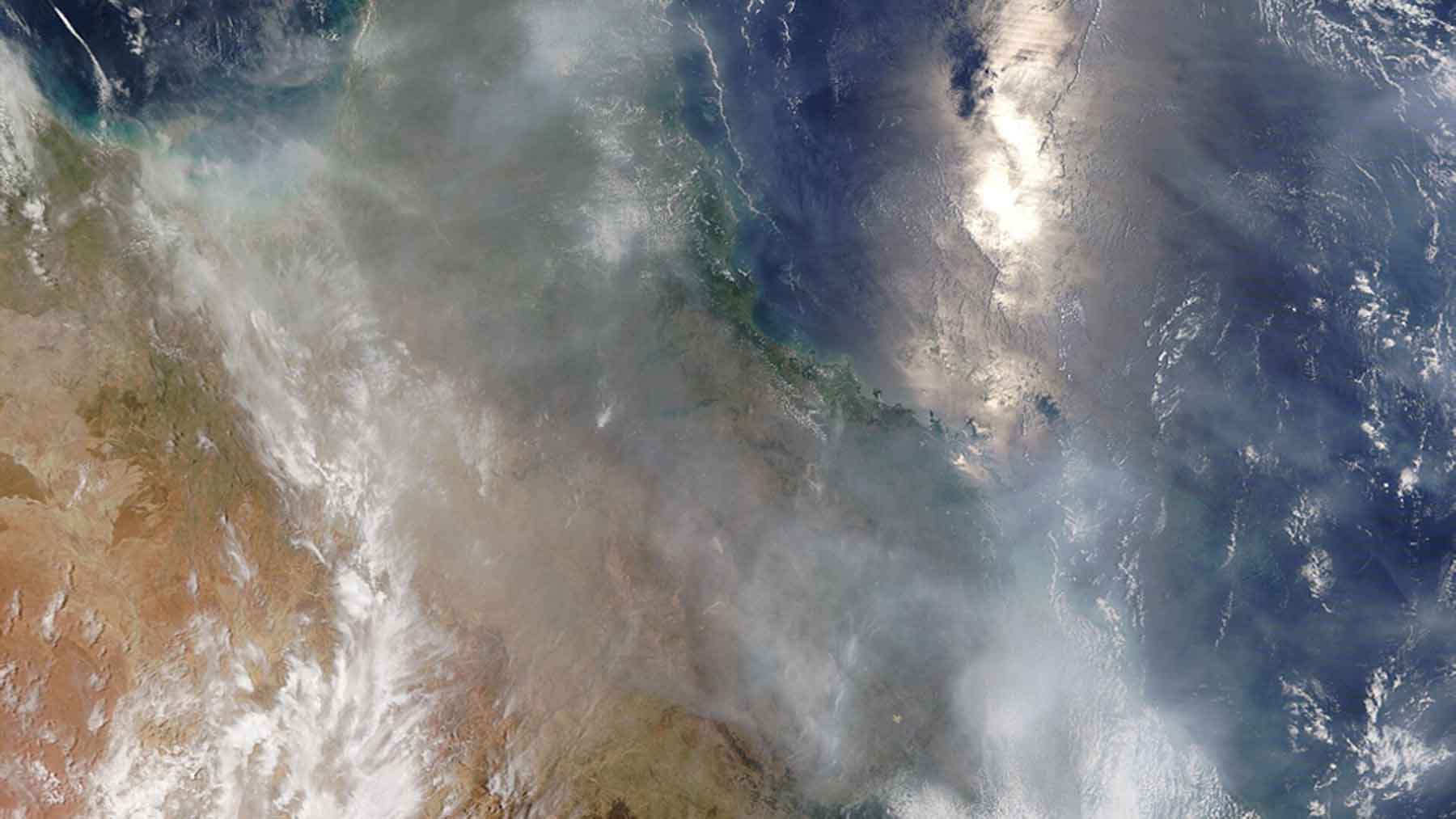 Volcanic ash over Queensland, Australia - Public Domain via Wikimedia Commons
When Hunga Tonga-Hunga Ha’apai erupted beneath the South Pacific in January 2022, it was a historic event. The underwater blast sent ash, steam, and gas high into the stratosphere. Shockwaves circled the planet twice.
Years later, researchers combing through satellite data found an unexpected anomaly drifting inside the cloud. A strange chemical signature was moving steadily across the Pacific Ocean.
It indicated that an unprecedented natural process was actively breaking down greenhouse gases high above Earth.
While deliberate atmospheric intervention carries risks, Hunga Tonga proved that ocean salt and sunlight can clear potent greenhouse gases from our sky.
A chemical fingerprint hiding in plain sight
Detecting faint chemical signals high in the atmosphere is notoriously difficult. Scientists relied on the TROPOMI instrument aboard the European Space Agency’s Sentinel-5P satellite to track the volcanic cloud.
Extracting reliable readings from a stratospheric plume pushed the instrument far beyond its standard operating limits. The research team had to carefully correct for extreme altitudes. They also had to eliminate interference from dense sulfur dioxide concentrations.
Their final data revealed that the volcanic cloud was not emitting a brief, single burst. Instead, it was driving continuous chemical reactions across thousands of miles of open water.
Remarkably, this drifting plume maintained its reactive potency for ten full days all the way to South America.
Salt, ash, and sunlight: An unlikely chemical team
The unusual atmospheric activity stemmed from a unique geographic accident. Because Hunga Tonga erupted beneath the ocean, it launched massive amounts of salty seawater alongside volcanic ash into the sky.
Intense sunlight then struck this elevated mixture of mineral ash and ocean salt. Scientists propose that this interaction released highly reactive chlorine atoms into the stratosphere.
These aggressive chlorine atoms immediately attacked background gas molecules, breaking them apart.
A similar sea-salt and mineral dust reaction was identified over the Atlantic Ocean in 2023. However, observing this chlorine-driven destruction inside the cold stratosphere was entirely unprecedented.
How much methane was actually destroyed?
The total scale of this chemical destruction was surprisingly large. The eruption released roughly 300 gigagrams of methane into the atmosphere. That volume equals the annual emissions of more than two million cows.
Simultaneously, the plume removed approximately 900 megagrams of methane every single day. That daily destruction matches the daily output of that same animal population.
While the process did not eliminate all released gas, it was large enough to track clearly from space.
Furthermore, current global methane budgets ignore volcanic ash and mineral dust. These findings suggest that global climate models may need significant revision.
Why methane is the climate target scientists most want to hit fast
Methane is responsible for about one-third of current global warming. Although it is less abundant than carbon dioxide, it traps heat far more effectively. Over a 20-year period, methane is roughly 80 times more potent than CO2.
However, methane breaks down in the atmosphere in about ten years. In contrast, carbon dioxide can persist for centuries.
Cutting methane emissions offers a rapid way to slow near-term warming trends. Scientists often call methane reduction an emergency brake for climate change.
Reducing it provides quick climate relief while society works on long-term carbon reduction.
Could engineers replicate what a volcano did by accident?
This unexpected phenomenon offers valuable insights for climate engineering and atmospheric research.
The ultimate revelation came when satellite analysts identified the precise chemical signal hiding in the plume. Sensors detected record-high concentrations of formaldehyde, a short-lived compound created when methane breaks apart.
Because formaldehyde decomposes within hours, its persistent presence over ten days proved active, large-scale methane destruction across the Pacific. This marks the first time scientists have tracked localized methane removal from space using formaldehyde as a proxy.
Engineers studying atmospheric methane removal now have a real-world model to evaluate.
While deliberate atmospheric intervention carries risks, Hunga Tonga proved that ocean salt and sunlight can clear potent greenhouse gases from our sky.
Read the full study here: Maarten M.J.W. van Herpen, Isabelle De Smedt, Daphne Meidan, Alfonso Saiz-Lopez, Matthew S. Johnson, Thomas Röckmann, Jos de Laat. Satellite quantification of enhanced methane oxidation applied to the stratospheric plume following Hunga Tonga-Hunga Ha’apai eruption. Nature Communications, 2026; 17 (1) DOI: 10.1038/s41467-026-72191-4

Kelly is an experienced writer with 15 years of experience exploring the big stories that shape our world, from tech breakthroughs and space exploration to climate, energy, and the fascinating quirks of science. She has a talent for turning complex ideas into sharp, memorable insights that stay with readers long after they’ve finished reading.
