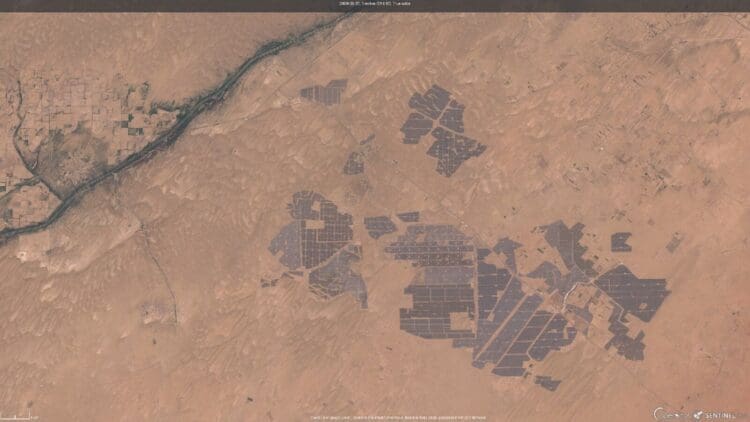

Bigger is always better, especially when you are going green. While not everyone may agree with this statement, India certainly does and has even proven it, as India is installing 10 million solar modules with a capacity meant to hit more than 2,000 MW. Meanwhile, China’s next-generation challenge begins. India has made its way to the top with the biggest solar park globally, and what’s more, this park does more than produce substantial power. Find out more below.
India’s solar strike versus China’s next-gen challenge
When it comes to solar energy production, one may tend to automatically think of China, the global leader in renewable energies. However, as true as this may be, the country itself is now facing its next-gen challenge. According to Global Energy Monitor, China expanded its solar capacity by 278 GW in 2024, and several experts have predicted that the country’s total capacity would surpass 1.1 TW by the end of 2025.
This is most likely why the country feels confident to start its move towards tech self-reliance. China will be focusing on the following key areas to become a leader in global industries:



- Future industries
- 6G, humanoid robot development, quantum technology, brain-computer interfaces, etc.
- AI integration for an intelligent society by 2035
- Integration into healthcare and manufacturing
- Expanding data center infrastructure
- Biotechnology
- Advancing with the Genesis Project
- Clean energy
- Expanding capacities for global energy demands
As China tries to manage too many irons in the fire, India slowly but steadily moved ahead with its solar capacity and has even beaten China by owning the world’s largest solar park.
10 million modules meant to hit 2,000 MW
India will be adding 4.8 GW of solar capacity, but for now, its gigantic solar park more than gets the job done. While it’s hard to miss, the gigantic Bhadla Solar Park is situated in the state of Rajasthan in the village of Bhadla. To imagine the scale of this park, some have stated that its size is nearly equivalent to 7,000 football fields. The 14,000-acre site was chosen for solar production, as temperatures typically reach a maximum of 47 degrees Celsius.
With the vast size and significant heat, it is no wonder that the site was covered with nearly 10 million solar panels, which generate a total of 2,245 MW of solar power. This solar project helped the country to meet and to surpass its 2022 climate targets four years ahead of the deadline. Beyond producing substantial amounts of clean power, this gigantic project has other advantages as well.
Producing so much more than substantial power
The Bhadla Solar Park was developed over four stages, with stages 3 and 4 reaching completion in approximately March 2020. The Solar Energy Corporation of India (SECI) is now responsible for the solar park. One thing is certain, this scale of the project cannot be overlooked, but the same also goes for its other advantages, which include:
- Helping India achieve its climate goals
- Supporting the goal of “Har Ghar Bijli” (power in every home)
- Removing nearly 5.6 million tonnes of carbon emissions each year
- Decreasing pollution
- Saving money on power in the long-term
- Expanding access to clean electricity
- Decreases the reliance on fossil fuels
The success of this gigantic project proves that adequate infrastructure and motives are key to transitioning from fossil fuels to renewable energy sources. India has become a great example for other countries, and may even inspire others to invest in developing their own gigantic solar projects. Rajasthan is already home to other massive solar parks as well, including India’s first solar park integrated with battery storage in Bikaner. If the country continues at this successful rate, China may wake up to find itself no longer at the top.
Disclaimer: Our coverage of events affecting companies is purely informative and descriptive. Under no circumstances does it seek to promote an opinion or create a trend, nor can it be taken as investment advice or a recommendation of any kind.