
INEOS and Recuro sign MoU to build advanced plastic recycling plant in Norway powered by renewable energy
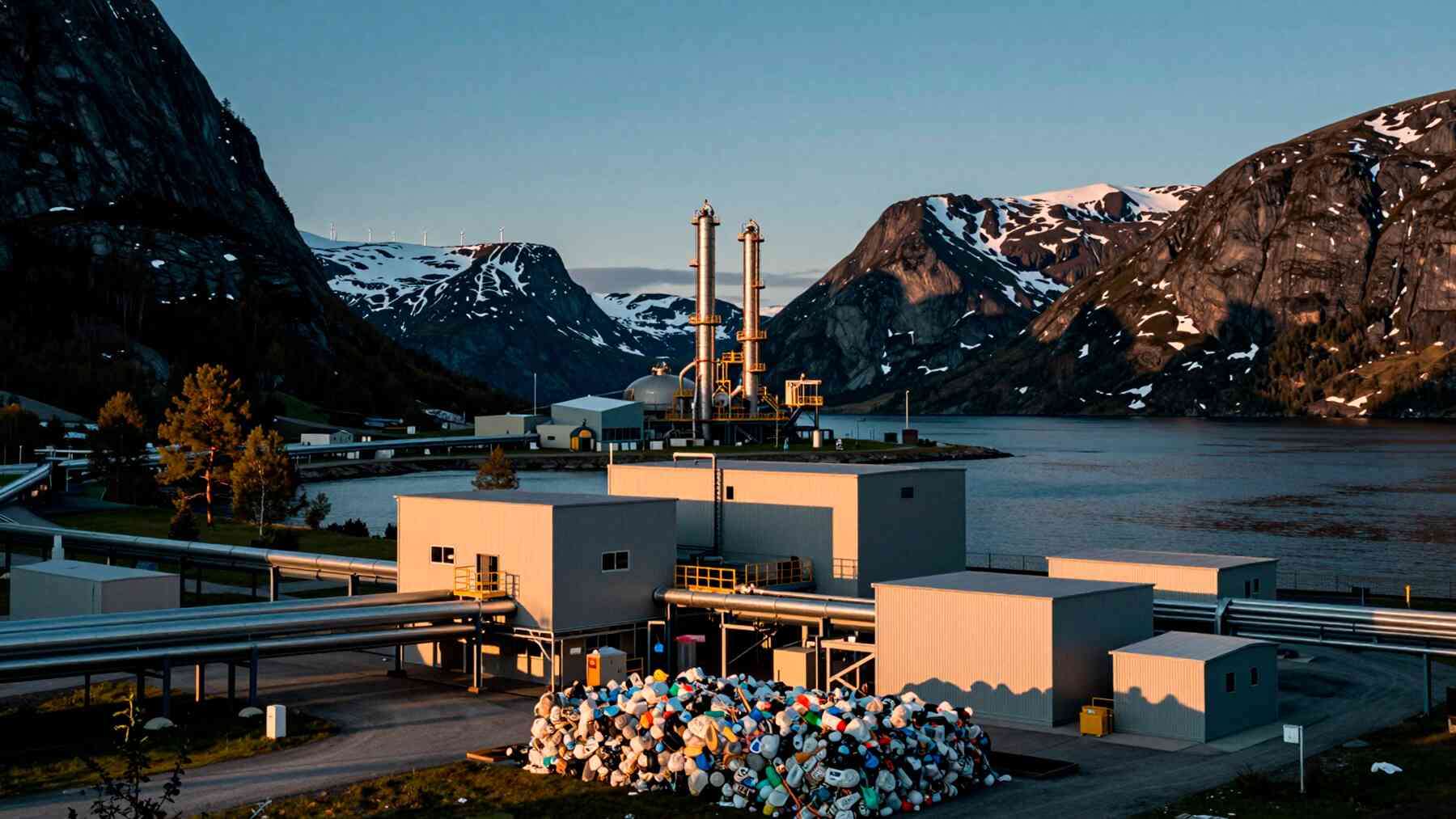 AI-made
INEOS and Norwegian recycling company Recuro have signed a memorandum of understanding to develop an advanced plastic recycling facility in Norway. The project, named ‘Full Circle,’ is designed to use pyrolysis technology to convert plastic waste into recycled feedstock destined for INEOS’s Rafnes steam cracker—turning discarded plastics into a direct input for new petrochemical production.
Companies sign MoU for pyrolysis recycling plant in Norway
‘Full Circle’ brings together INEOS, one of Europe’s largest petrochemical producers, and Recuro, a Norwegian recycling company with ambitions to become a major sector player. Their MoU lays out a shared plan to build an advanced plastic recycling facility in Norway — one running entirely on renewable Norwegian energy.
The plant is designed to operate with minimal emissions, and two factors drive that goal. One is the energy source. The other is location: rather than breaking ground on a greenfield site, the project will reuse an existing industrial location, tapping into land, infrastructure, and services already in place. That decision directly lowers capital costs and shrinks the environmental footprint before a single piece of equipment is installed.
Plastic waste goes in at one end; material suitable for demanding, regulated end uses comes out the other—without the carbon leaving the production loop.
Pyrolysis sits at the heart of the operation. It works by breaking down plastic waste at high temperatures with no oxygen present, producing oil and gas fractions that can be recovered and reused as chemical feedstock.
Why pyrolysis and co-location were chosen for the project
The choice of pyrolysis wasn’t arbitrary. What sets it apart from other recycling approaches is what happens to the outputs — rather than routing the gas fraction to energy generation, this plant is designed to keep both the oil and gas streams for further use, maximizing recovery of the carbon locked inside the plastic waste.
Co-location is the other key piece. Placing the recycling facility next to INEOS’s Rafnes steam cracker means both output streams can be fed straight into existing petrochemical infrastructure without long-distance transport. That proximity isn’t just logistically convenient — it’s what makes full recovery of both fractions economically viable at all.
Recuro CEO Arve Jakobsen put it plainly: “By reusing an existing industrial site, optimizing infrastructure, and locating the plant next to a steam cracker facility, we can recover and reuse both oil and gas streams. This is circularity in its truest form.”
External backing also played a role. Support from Innovation Norway and technology partner Vixla helped push the initiative forward, and Jakobsen acknowledged that without those partnerships—alongside INEOS—the project wouldn’t have made it this far.
Recycled output to feed Rafnes’ cracker and Bamble’s polyethylene plant
Once operational, the facility’s recycled output will flow directly into INEOS’s nearby Rafnes steam cracker, where it’ll serve as feedstock to produce recycled ethylene. That ethylene then travels a short distance further—to the Bamble plant—where it’ll be used to manufacture recycled polyethylene.
The polyethylene produced at Bamble is expected to meet EU regulatory standards for virgin-quality recycled material. That matters because it opens the door to high-performance applications: food packaging, medical packaging, and other uses where both regulatory requirements and material performance demands are unforgiving.
This is where the circular logic of the project becomes concrete. Plastic waste goes in at one end; material suitable for demanding, regulated end uses comes out the other—without the carbon leaving the production loop. According to the companies, that setup is expected to increase overall recycling rates by keeping plastic carbon in active circulation rather than letting it escape to landfills or incineration.
Advanced recycling’s role in EU circular economy policy
‘Full Circle’ doesn’t exist in a policy vacuum. Advanced recycling — which includes pyrolysis and similar chemical processes — is increasingly seen as essential for handling plastics that can’t go through conventional mechanical recycling. Mixed, contaminated, or multi-layer plastics often fall into that category, and there are few alternatives for processing them at scale.
Liz Rittweger, CEO of INEOS Olefins & Polymers Europe, was direct about what the sector needs from regulators: “Regulators can support this effort with clear, harmonized rules that recognize advanced recycling outputs, create legal certainty, and give investors the confidence to invest in new technologies at scale.”
That call reflects a real tension in the market. Investment in advanced recycling infrastructure is capital-intensive, and without a stable regulatory framework that formally recognizes pyrolysis outputs, building investor confidence becomes significantly harder. Rittweger also connected the project to the broader climate picture—keeping carbon-based materials in circulation rather than releasing that carbon through incineration or degradation is presented as a meaningful lever for reducing CO₂ emissions. Not just a recycling metric.
Scaling advanced recycling is the plan
The INEOS-Recuro MoU marks an early but concrete step toward a commercial-scale advanced recycling facility in Norway. The ‘Full Circle’ project will use pyrolysis technology, run on renewable energy, and occupy an existing industrial site — a combination aimed at keeping both costs and emissions in check. Innovation Norway and technology partner Vixla have already come on board.
Recycled feedstock from the plant will supply INEOS’s Rafnes cracker and ultimately the Bamble polyethylene plant, producing material suitable for food and medical packaging under EU standards.
Both companies are pointing to clearer EU regulation as a prerequisite for scaling advanced recycling more broadly. The MoU is a starting point — detailed development work will determine whether ‘Full Circle’ can deliver on its promise.
Kelly is an experienced writer with 15 years of experience exploring the big stories that shape our world, from tech breakthroughs and space exploration to climate, energy, and the fascinating quirks of science. She has a talent for turning complex ideas into sharp, memorable insights that stay with readers long after they’ve finished reading.
