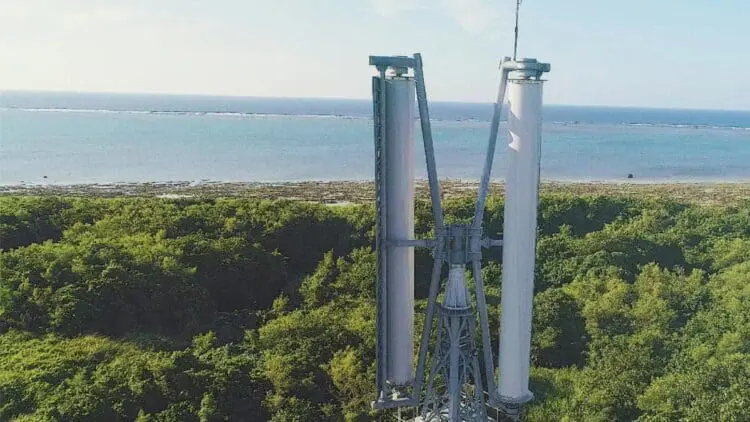
Japan has featured on the pages of history books on numerous occasions. However, the country’s latest invention will allow Japan to move from the nuclear disaster to the power of a natural disaster. Thanks to its ‘Typhoon catcher,’ Japan makes history with 50 years of wind power from 179 mph extreme winds. That is one way to get back on the horse! Discover how Japan plans on rewriting the laws of energy with its Typhoon catcher to benefit not only the sovereign country but also the world.
Moving from a nuclear disaster to the power of a natural disaster
Japan, along with several other countries worldwide, has joined the global mission to achieve net-zero by 2050. In addition, the sovereign country also has its own set of climate targets, such as reducing emissions compared to its 2013 levels, with the following deadlines:
- 2030 – lowering emissions by 46%
- 2035 – decreasing emissions by 60%
- 2040 – cutting emissions by 73%
However, while Japan wants to increase its renewable capacity to 50% by 2040, it still heavily relies on nuclear power’s contribution to its power capacity, despite the nuclear disaster on March 11, 2011. On that tragic day, the Fukushima Daiichi Nuclear Power Plant in Ōkuma, Fukushima, suffered substantial damage after an earthquake with a magnitude of 9.0 and a following tsunami.


This led to a nuclear accident, which cost the lives of 2,300 people in disaster-related deaths. This is why Atsushi Shimizu, an engineer at Challenergy, believes the country must break away from nuclear power, and that the ‘Typhoon catcher’ may be the first step in the right direction.
Japan’s ‘Typhoon catcher’ makes history
Japan has been focusing on expanding its renewable capacity, with a focus on new offshore wind expansions in coastal areas. However, in a country prone to typhoons, traditional turbine designs may not always be the best choice. Fortunately, Shimuzu has engineered a groundbreaking turbine design that not only stands its ground but also harnesses wind power from this natural disaster.
Enter the ‘Typhoon catcher,’ or rather, the typhoon turbine. This vertical turbine has an omnidirectional axis, allowing it to rotate and operate in all wind directions. It also produces energy with the Magnus effect, where rotation increases airflow on one side while slowing it down on the other. This creates a perpendicular force to the wind, resulting in it curving.
It is thanks to this ingenious design that the typhoon turbine can stand its ground, even in extreme and potentially disastrous conditions.
50 years of power from 179 mph extreme winds
This turbine will allow Japan to once again grace the pages of history books, as, according to Typhoon Mitag, it was the first of its kind to produce clean power during the event of a real typhoon. According to the Atlantic Oceanographic & Meteorological Laboratory, a substantial typhoon (with 179 mph winds) can generate enough energy that is equal to nearly 50% of the global power capacity.
Shimizu stated that, in theory, if we harness and store the energy from one typhoon, this energy could provide Japan with 50 years of power. According to a report by CNN, in reality, the typhoon turbine operates in wind speeds as low as 9 mph and cuts out at 78-90 mph. Remarkably, it can withstand speeds of more than 156 mph.
So, while it may not be possible to harness all the energy from one typhoon (yet), this turbine marks a significant breakthrough, potentially creating an entirely new market in the world of renewables with a target group focused on areas prone to natural disasters such as typhoons. Not only will its power production be lifesaving in emergencies, but it will also significantly boost Japan’s renewable capacity, and perhaps help the country leave nuclear power behind. Meanwhile, Japan and the U.S. have finalized their $550 billion energy and infrastructure investment framework.