
Middle Eastern LNG buyers seek Canadian supply contracts as Strait of Hormuz disruptions drive global diversification push
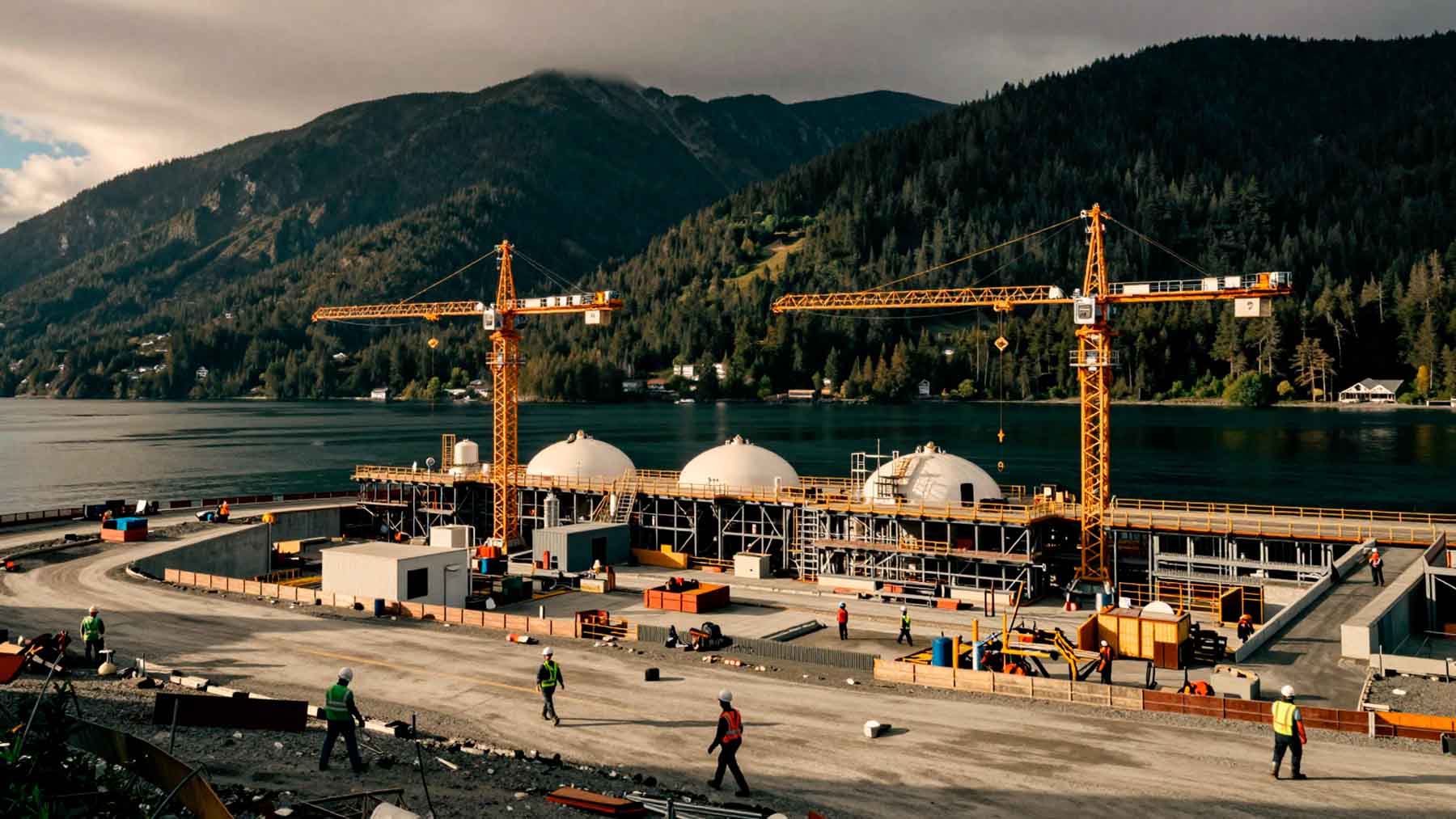 Image generated with artificial intelligence
Near Squamish, B.C., construction crews are still building Woodfibre LNG—and yet, almost every week, someone is already calling to ask if there’s room in the project’s cargo schedule. The callers aren’t just Asian utilities hedging their bets. They’re LNG producers from the Middle East. Woodfibre’s president Ratnesh Bedi, who runs parent company Pacific Energy from Singapore, has been fielding these inquiries directly. Canada’s federal government says it’s hearing the same thing.
Middle Eastern buyers approach fully contracted Woodfibre project
The interest would be easier to act on if there were anything left to sell. There isn’t. Woodfibre’s entire 2.1 million metric tons-per-year output is already contracted to BP—locked up, committed, and gone. So when Bedi describes the pace of inbound calls, there’s a certain irony to it. “Almost every week, someone is approaching us to say, ‘Hey, do you still have capacity?'” he told reporters. The answer is no.
Pacific Energy holds a 70% ownership stake in Woodfibre. Bedi’s Singapore base puts him close to the Asian energy markets driving much of this demand, giving him an unusually direct read on how buyer sentiment is shifting.
Woodfibre is targeting December 2027 for its first export cargo, placing it in the next wave of new global LNG supply coming online in the second half of the decade.
The federal government is picking up the same signal from a different vantage point. Charlotte Power, a spokeswoman for Energy Minister Tim Hodgson, confirmed it in writing: “The federal government has heard strong interest from Middle Eastern companies in pursuing both LNG equity investments and offtake deals.” That’s not just industry chatter—it’s an official acknowledgment of a trend Bedi has been watching build for months.
Strait of Hormuz disruptions and the Iran conflict reshape buyer strategies
The war in Iran has accelerated something that years of price swings never quite managed to do: it’s forcing LNG buyers to rebuild their supply strategies from the ground up. The Strait of Hormuz—a narrow waterway carrying a major share of global LNG—has gone from a theoretical vulnerability to an active operational concern.
What’s caught Bedi off guard is who’s doing the asking. It’s not just end-users in northeast Asia. LNG producers from the Middle East itself are calling, their own export routes running directly through Hormuz. “Very interestingly, not only is it north Asia that is coming, but to my surprise, even LNG suppliers out of the Middle East are coming to find alternate supplies for their customers,” he said.
The logic is pretty simple. Buyers are running contingency scenarios and want supply relationships in place before something goes wrong—not after. As Bedi put it: “They are thinking, ‘Tomorrow, if something goes wrong, I should already be a customer of Canada.'” Waiting until a crisis hits means competing on the spot market, where prices spike and supply dries up fast. Canada’s west coast export routes don’t pass through any contested chokepoint, and for buyers stress-testing their portfolios right now, that’s not a minor detail.
Shorter shipping times to Asia give Canadian west coast projects a competitive edge
Route security is one part of the pitch. Geography is another—and arguably just as important. Canadian west coast LNG projects sit closer to major Asian import terminals than U.S. Gulf Coast competitors, which have to route cargoes through the Panama Canal or around the Cape of Good Hope. Shorter transit means lower shipping costs and faster turnaround, real advantages when managing a complex import schedule.
Bedi says Asian buyers are starting to see Canada as a preferred supplier, not just a fallback. Woodfibre is targeting December 2027 for its first export cargo, placing it in the next wave of new global LNG supply coming online in the second half of the decade. Canada’s production depth also matters here—the country is the world’s fifth-largest natural gas producer, which gives buyers confidence that real upstream supply backs these export projects.
Long-term deals and equity investments signal broader international interest in Canadian LNG
Woodfibre isn’t fielding this attention alone. Germany’s SEFE and Uniper have both signed long-term offtake agreements with Ksi Lisims LNG, another project on Canada’s Pacific coast. These aren’t exploratory conversations—they’re binding commercial commitments, which says something about how seriously international buyers are treating Canadian LNG as a durable option rather than a hedge.
The equity side is just as telling. MidOcean, backed by EIG and Saudi Aramco, purchased a stake in Petronas’ share of LNG Canada last year. Saudi Aramco’s indirect involvement carries particular weight given the broader Middle Eastern interest currently driving inbound calls to projects like Woodfibre.
Bedi doesn’t pretend Canada is cheap to build in. Regulatory timelines are long and development costs are high—true even when natural gas prices are low. Still, he says he’s encouraged by Prime Minister Mark Carney’s recent push to speed up permitting for energy projects. On whether Woodfibre might eventually expand, Bedi left the door open, barely. “Market demand is very exciting. Government support is very exciting. But we are at that very critical juncture of our project where we need to bring it to the finish line,” he said.
A durable shift in how global buyers are thinking
Here’s where things stand. Middle Eastern buyers and producers are actively pursuing Canadian LNG supply, pushed by Strait of Hormuz disruptions tied to the war in Iran. Woodfibre LNG is the most visible project fielding these calls—and it has nothing left to offer, with its full 2.1 million metric tons per year contracted to BP. Canada’s federal government has independently confirmed that Middle Eastern companies are interested in both physical cargoes and equity stakes. Add in German offtake deals at Ksi Lisims and Saudi Aramco-backed investment in LNG Canada, and this starts to look less like a temporary spike in curiosity and more like a durable shift in how global buyers are thinking about Canadian LNG.
Kelly is an experienced writer with 15 years of experience exploring the big stories that shape our world, from tech breakthroughs and space exploration to climate, energy, and the fascinating quirks of science. She has a talent for turning complex ideas into sharp, memorable insights that stay with readers long after they’ve finished reading.
