
A North Dakota farmer cashes his first wind check while his neighbors wish the turbines had never come as coal politics and a federal tax credit rollback threaten to end the state’s wind boom for good
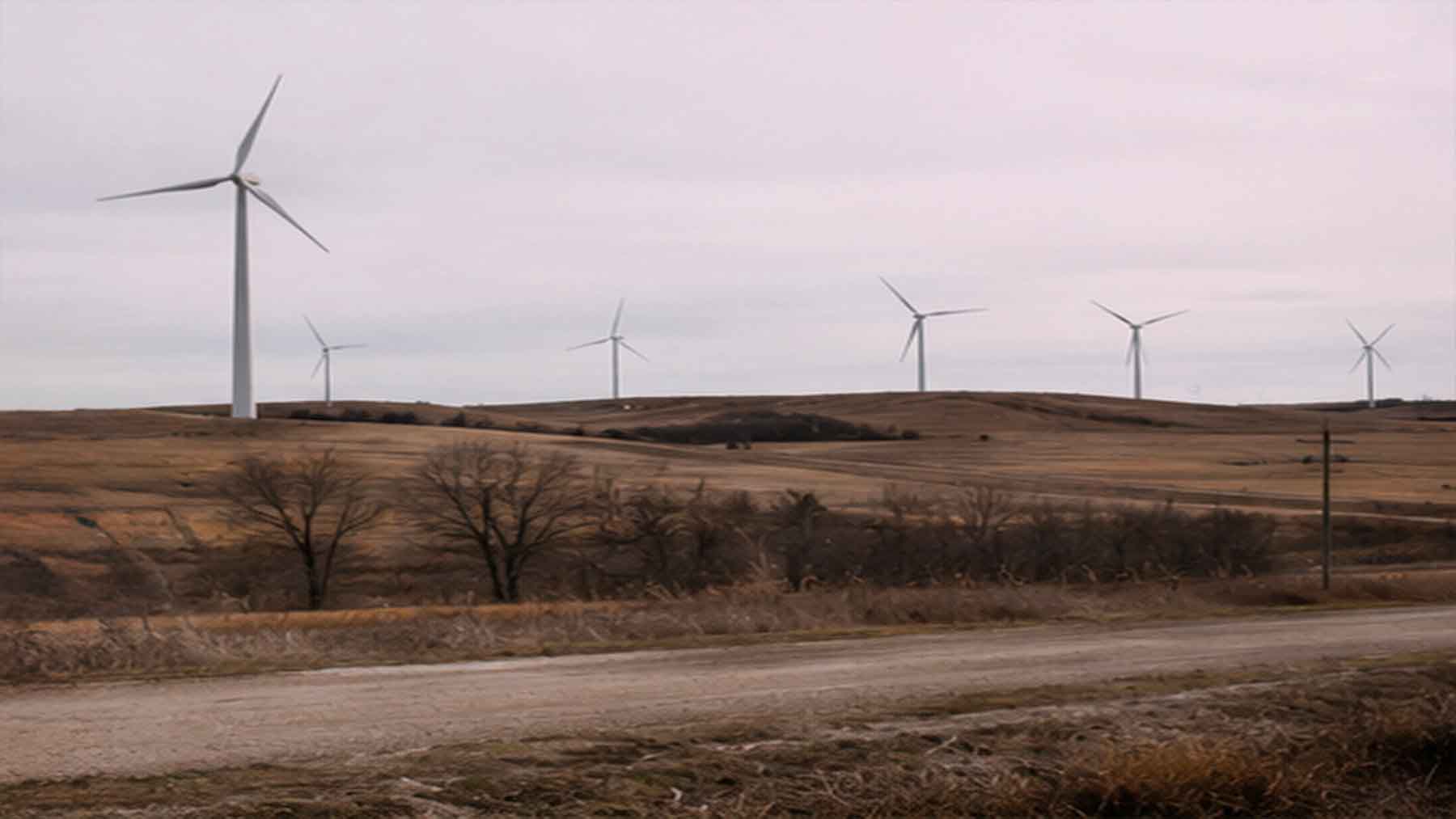 Image generated with artificial intelligence
George Wolff was still wiping the day off his hands when he leaned out to greet a visitor from the window of a parked truck — mud on his forehead, muck on his boots, a ballcap tipped back against the May heat. Behind him, Angus cattle grazed a hillside pasture. Behind them, two turbines rose above his 3,500-acre spread, blades turning in a 20-mile-per-hour wind.
Wolff is one of the few people in Wishek, North Dakota, who quietly welcomes what those turbines represent. Much of this town of 850 does not — and the fault lines run deeper than anyone here expected.
A town divided by its own wind farm
Wishek, North Dakota — population 850 — sits about 90 miles southeast of Bismarck in McIntosh County. In January, it became home to the Badger Wind Farm: 92 turbines, 250 megawatts, built by Danish energy giant Ørsted. It’s the largest economic development project in the town’s history.
Early on, some residents hoped the project would deliver a quiet windfall — steady tax revenue, a few construction jobs, a boost to a county of roughly 2,500 people.
Early on, some residents hoped the project would deliver a quiet windfall — steady tax revenue, a few construction jobs, a boost to a county of roughly 2,500 people. That optimism, for many, has curdled.
“We used to live in open country, right?” said Larry Wald, a lifelong resident and former mayor. “Now, these towers are the first thing you see when you come into Wishek and the last thing you see on your way out.”
Lila Raile built her dream home on a low hill about a mile west of town and never imagined turbines would surround it. “Welcome to my nightmare,” she wrote before a recent visit. She blames Ørsted for what she calls a dollar-waving appeal to landowners — but she also blames county and state officials for leaving residents to fend for themselves. “They claim to protect rural communities from these outside energy companies,” she said. “But people around here don’t feel protected at all.”
A particular source of anger: absentee landowners who signed leases but have no personal connection to Wishek. Wald was direct. When Ørsted came looking for land, he said, “it was like light in their eyes. They were going to get their $10,000 per lease, or whatever it is, and never have to look at these towers.”
Real money, real trade-offs
The economics are harder to dismiss than critics might prefer. McIntosh County expects roughly $1.3 million per year in wind generation taxes from Badger — money earmarked for roads, bridges, schools, hospitals, senior care, and emergency services. Statewide, landowners hosting turbines have netted between $25 million and $30 million annually since 2020, according to industry figures.
Ørsted also contributed $150,000 in direct goodwill donations to Wishek. The city used it to build a new firehouse, a public swimming pool, and make repairs to the community center. Former mayor Brenda Dohn said the company was straightforward about its intentions. “They wanted to make sure there was some payback to the community,” she said.
For Wolff, the math is personal. A few days after his first conversation with a reporter, he received his first quarterly check from Ørsted — each turbine on his property netting around $5,000. He plans to put that money toward fuel, fertilizer, and feed, all of which have gotten more expensive. It may also give him and his wife, Janet, a chance to step away from the farm during North Dakota’s brutal winters. That’s not a fortune. But for a fourth-generation farmer watching input costs climb, it’s real.
North Dakota’s two-decade wind boom — and its sudden chill
North Dakota got its first large-scale wind farm in 2003. What followed was a sustained run: 38 wind farms came online between 2005 and 2020, drawn by the state’s wide-open land and proximity to Minnesota, which needed clean energy to meet its decarbonization goals. Officials called it an “all of the above” energy policy — coal, oil, gas, and wind, coexisting.
Only four projects have been completed since 2020. Badger is one of them.
The pipeline ahead looks thin. The state Public Service Commission is currently weighing just one other project: the 67-turbine Homestead Wind Farm proposed for Williams County. In August, the commission approved the Longspur wind project north of Bismarck — the first such approval this year — but the regulatory mood has shifted noticeably. McIntosh County made that shift concrete. Just months after Badger came online, the county adopted a one-year moratorium on new wind projects, citing concerns about a second proposed Ørsted installation in the county’s southern area.
Coal politics and the war on turbines
The argument driving much of the backlash is straightforward: wind energy displaces coal, and coal is North Dakota’s identity.
Seventy-six percent of the electricity consumed in-state comes from five lignite coal plants. PSC Chair Randy Christmann has repeatedly argued that expanding wind advances an environmentalist agenda to shut those plants down. During public testimony this spring, he pressed a rancher who hosts turbines on his property: “One is being added and the other one is being pushed out. That’s how they’re working together, is it?”
State Rep. Anna Novak, who represents coal country and chairs key legislative energy committees, frames it as a zero-sum problem. “More wind on the line, specifically in coal country, means that there’s less coal that’s mined and used for electricity generation,” she said. At the federal level, freshman Rep. Julie Fedorchak — North Dakota’s sole House member — sponsored legislation to phase out federal tax credits for wind and solar. That effort succeeded in the 2025 Republican tax and spending bill known as the One Big Beautiful Bill Act.
Fedorchak has also been among President Trump’s strongest supporters for reviving the coal industry. Her office didn’t respond to requests for comment, but she told Axios that North Dakota’s wind expansion has primarily served neighboring states’ climate goals. “Those aren’t the goals in my state of North Dakota,” she said.
What comes next for farmers caught in the middle
Wolff doesn’t fit neatly into either camp. He still supports an all-of-the-above energy policy, though he’s quick to clarify he’s no ideologue. “If someone came out here and said they wanted to put an oil well on the farm, I’d listen,” he said. He sees the turbines the way he sees any other enterprise on his land — as something that produces something people use.
“Some of the farmers here, they think if you don’t make your money off a bushel of wheat or a pound of beef, it’s not right,” he said. “I don’t feel that way.”
His neighbors who do feel that way aren’t simply being stubborn. For many, farming isn’t just an occupation — it’s a way of understanding the land and their place on it. Turbines signal an outside world encroaching on something they’ve spent generations building.
Dohn, the former mayor, doesn’t have much patience for paralysis. The turbines are there. They’re not going anywhere. “You can’t light them on fire, you can’t kick them over,” she said. “So how do we move forward from this?”
Wolff’s answer is quieter. He’s nearing the end of his farming years, and he knows it. “It will eventually be my son’s decision on how to handle it,” he said. “Either way, I plan to do what my forefathers did, which is pass this on to my kids. They’ll figure out the best way forward.”
That passing of the decision — from one generation to the next, from one set of values to another — may be the most honest summary of where rural America stands right now. The turbines are already built. The tax credits that might have funded the next ones are being stripped away. And the communities left holding all of it are still trying to decide what they actually want from the land they’ve farmed for a hundred years.

Carlos is an engineer with strong expertise in technical and industrial topics. He previously worked at international companies such as Siemens and is multilingual.
