
An old North Sea gas platform began producing hydrogen using wind power and sent it ashore through the same pipeline it was already using
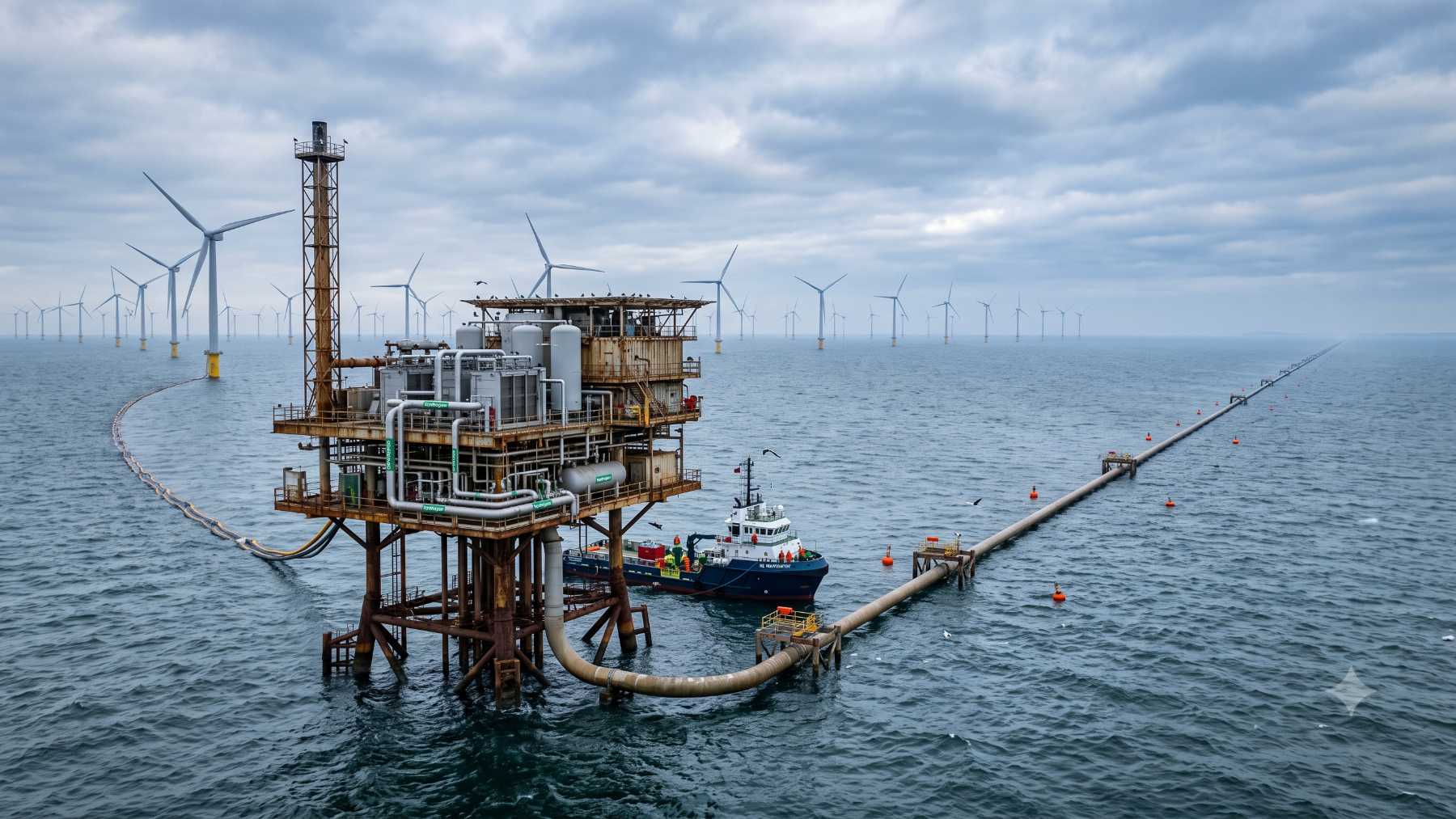 Image generated with artificial intelligence
An old gas platform has been repurposed to produce hydrogen using variable wind power.
Governments globally are under pressure to decarbonize their economies to meet strict climate targets.
However, some sectors remain inherently hard to abate, as they require long-term, high-capacity storage.
Ultimately, the PosHYdon project proves that coastal communities can benefit from offshore green hydrogen by repurposing aging oil and gas infrastructure.
Meanwhile, aging fossil fuel assets are rising in numbers and becoming white elephants out at sea.
Will converting these infrastructures help enable the production of clean fuel worldwide?
How hard-to-abate sectors struggle to meet climate regulations
As the planet continues to warm at an unforeseen rate, the global race to lower carbon emissions becomes more urgent.
Climate mandates have become stricter to encourage rapid carbon reductions.
Renewable energy sources have become central to shifting away from fossil fuels.
Some sectors have enjoyed great success in raising their green capacity, but others still struggle to meet these regulations.
These hard-to-abate sectors include chemical manufacturing, steel production, maritime shipping, and heavy industry.
Together, they represent roughly 30% of global carbon emissions.
Their fundamental challenge is that they require high energy density and heat.
Some operations depend on extreme heat, often surpassing 1,800 degrees Fahrenheit.
Others need hydrogen as a raw material for chemical processing.
Combining renewable energy sources with battery storage systems has been key to lowering carbon footprints through electrification.
However, this combination does not meet these high energy demands.
Fortunately, a clean fuel such as green hydrogen does.
The coastal bottlenecks of green hydrogen
There are nine colors of hydrogen in total, but only one matters for the global renewable energy transition.
That color is green, offering a versatile solution to decarbonize hard-to-abate sectors.
Instead of relying on fossil fuels, high-heat manufacturing can use it as an energy source.
Chemical processing and steel production can use it as a clean feedstock.
It can also be stored in vast amounts for long periods, ensuring reliable, high-capacity energy reserves.
The main challenge is scaling up its production in onshore coastal regions.
These regions are often densely populated, making land scarce and expensive.
Furthermore, locals, ports, and wildlife conservation groups heavily oppose the development of the infrastructure.
Beyond requiring vast space, onshore electrolyzer plants need high-capacity power connections.
Existing grids struggle with congestion, and power line upgrades usually take years and immense capital.
To address these bottlenecks, a pilot program called PosHYdon was launched on the Dutch North Sea.
Producing a high-capacity clean fuel offshore
The Netherlands is actively moving toward net-zero emissions thanks to its major clean energy projects.
Roughly 8 miles off the coast of Scheveningen in the Dutch North Sea lies a world-first pilot project.
PosHYdon operates directly on an active gas platform operated by Eni Energy Netherlands.
Q13a-A was the first fully electrified platform in the Dutch sector.
Now, it is the ideal testing site for a combination of wind power, natural gas, and hydrogen.
A process taking place entirely at sea
Seawater is converted into demineralized water using equipment on the platform.
Offshore wind powers an electrolyzer unit on the deck.
The clean electricity is used to split water into oxygen and green hydrogen.
The green hydrogen gas is blended into the platform’s existing natural gas stream.
The gas mixture is sent back ashore with the existing underwater pipeline.
In July 2026, the pilot program officially produced its first hydrogen on the Q13a-A platform.
This success helped to establish baseline operations. The next step is testing how the electrolyzer manages power fluctuations due to offshore wind’s variability.
The trial’s findings will help shape maintenance models and reduce operational costs.
Ultimately, the PosHYdon project proves that coastal communities can benefit from offshore green hydrogen by repurposing aging oil and gas infrastructure.

Anke Maree is a writer with a clear and engaging editorial style. Her work focuses on making complex topics accessible, informative, and relevant for readers across different areas of interest.
