
We thought storms were offshore wind’s biggest enemy, until engineers discovered what quietly grows on turbine foundations between port and the open sea
Floating offshore wind is moving fast. Twenty-seven countries have set offshore wind targets, Japan just brought its first commercial floating farm online, and France, the UK, Norway, and Korea are all racing to follow. The technology that once existed only in pilot projects is now scaling toward gigawatts.
But as these massive hybrid structures — part energy platform, part marine vessel — head out to some of the ocean’s deepest waters, a quieter challenge is emerging. Keeping them operational may depend less on engineering breakthroughs than on lessons borrowed from an older industry that has spent decades fighting the sea.
A new frontier opens — and brings new problems
Research from the Global Wind Energy Council suggests that 80% of the world’s offshore wind potential sits in waters deeper than 60 meters. Fixed-bottom turbines become cost-prohibitive at that depth, making floating platforms the only viable path to those resources.
France’s EFGL project — three 10-MW turbines in the Gulf of Lion — began supplying power and is designed to pave the way for larger Mediterranean developments.
The policy momentum is real. Japan’s 16.8-MW Goto Floating Wind Farm is now online, contributing to the country’s ambition of reaching 15 GW of floating capacity by 2040. France’s EFGL project — three 10-MW turbines in the Gulf of Lion — began supplying power and is designed to pave the way for larger Mediterranean developments.
Floating platforms are fundamentally more complex than fixed towers, and that gap matters. They must resist pitch motion caused by wind and wave forces, requiring stabilizing systems that fixed structures simply don’t need. That added complexity creates new surfaces, new geometries, and protection challenges nobody fully resolved during the pilot phase.
Platform designs: borrowed from oil rigs, refined for wind
Early floating wind concepts drew directly from offshore oil and gas engineering, adapting decades of deep-water experience to a new purpose. More than 20 platform designs have been field-tested — tension leg platforms, semi-submersibles, spar-buoys, ballast-stabilized structures, and others.
Each design handles ocean forces differently, and each creates distinct structural surfaces that protective coatings must accommodate. A spar-buoy’s long ballasted draft behaves nothing like a semi-submersible’s column-and-brace geometry when it comes to application and long-term performance.
Rising capital costs and supply chain disruptions have already delayed or restructured multiple floating wind contracts. Reducing the levelized cost of electricity isn’t optional — it’s the condition under which the entire sector scales.
The hidden hazard: months at sea before the turbine even spins
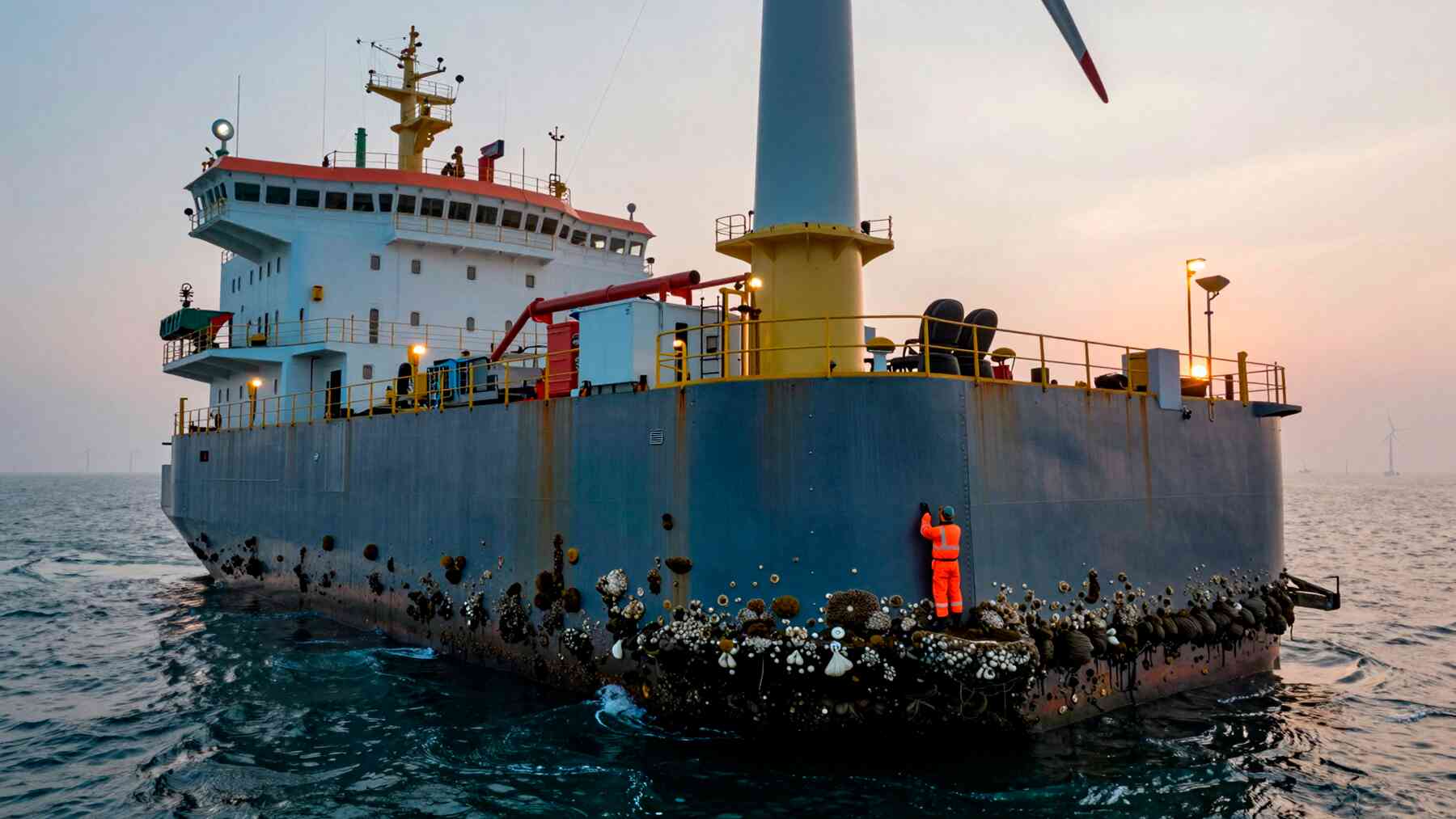
One of the least-discussed risks in floating wind isn’t operational at all — it’s pre-operational. Many floating components require wet storage during staging and assembly. Unlike monopiles, which can sit on land until installation, floating tanks and platforms may spend weeks or months in integration ports waiting for components or favorable weather windows.
During that time, submerged surfaces face the same marine fouling that affects idling ships. Algae and barnacles begin colonizing steel before the turbine has generated a single kilowatt-hour.
Then comes the tow-out. Anchor handling tug supply vessels haul completed structures to the wind farm site, exposing coatings to abrasion and continuous seawater. Fouling organisms accumulated during storage increase drag, forcing vessels to burn more fuel — raising costs and emissions before the platform is even installed.
Marine coatings step in: antifouling and ballast tank protection
The maritime industry has spent decades developing solutions for exactly these conditions, and floating wind developers are now applying them directly. Antifouling coatings, long standard on ship hulls, prevent marine organisms from attaching to submerged surfaces. Applied to floating turbine exteriors, they reduce drag during tow-out and limit the corrosion that fouling organisms can accelerate on steel substrates.
Ballast tanks present a separate but equally demanding challenge. These internal compartments experience continuous seawater exposure and are difficult to access for inspection or maintenance. Coatings meeting IMO Performance Standard for Protective Coatings requirements — already routine in the marine vessel industry — are now being specified for floating wind ballast systems.
Next-generation epoxies: durability meets sustainability
Epoxy coatings have long protected offshore structures, with glass-flake reinforced systems commonly specified for splash zones. New high-build formulations now match that abrasion resistance while offering better sprayability and extended pot life — practical improvements that matter when you’re coating large, complex structures under time pressure.
Solvent-free versions deliver low-VOC content while meeting NORSOK and ISO standards for offshore protective coatings. Some of these formulations have already been selected for floating wind prototypes expected to go online in 2026.
The broader shift is toward integrated lifecycle strategies. Rather than treating antifouling, ballast protection, and structural epoxies as separate decisions, developers are combining them into coordinated corrosion management plans that span the full asset life — from wet storage through decades of open-ocean operation. The coatings chosen today will be tested by conditions no pilot project fully anticipated, and what’s learned will shape how the next generation of projects gets designed.

Carlos is an engineer with strong expertise in technical and industrial topics. He previously worked at international companies such as Siemens and is multilingual.
