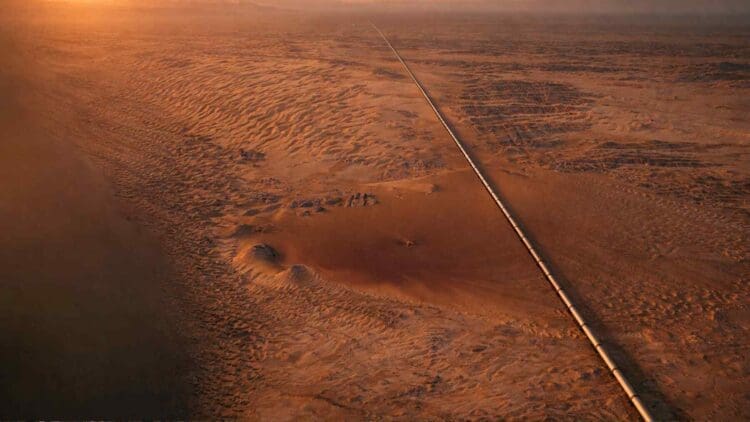

Following the long path through the desert that leads to a global energy supply.
Fortunately, when the going gets tough, the tough get going, even if it takes 745 miles or more to do it.
Desperate times call for desperate measures, especially when two nations are at war, disrupting livelihoods worldwide.

Will this detour lead to a global economy victory, or will ongoing tensions also disrupt the world’s Plan B?
How rising tensions usually impact the entire world
All is fair in love and war, but what happens when the impact of the battle moves beyond enemy lines?
Some fights you do not want to become a part of and are completely avoidable. Yet, somehow, you and your loved ones end up pulling the short straw.
This happens when the battlefield is no longer contained within its borders, which is rarely the case anyway.
This is due to the modern world and its economy being hyper-connected. When two nations conflict, the global economy experiences a “system shock.”
War causes disruptions in supply chains, energy grids, and even kitchen tables thousands of miles away from the front lines.
The perfect “textbook example” is the current crisis in the Middle East. The ongoing geopolitical “disagreements” are causing severe universal economic devastation.
Nations that have pledged neutrality and advocate peace do not remain unaffected, highlighting the seriousness of the matter.
The effect of when Plan A suddenly falls short
The transition to clean energies is inevitable. Yet, the world is caught between a rock and a hard place when it comes to fossil fuels.
For the majority of the world, fossil fuels remain “Plan A.” Nations are even going as far as “greenwashing” them, especially when it comes to drilling offshore for vast blue oil.
And this reliance is becoming more ill-advised by the day.
On March 2, 2026, the Strait of Hormuz was closed effectively. The sudden closure triggered a domino effect on the world, proving how fragile “Plan A” is.
The supply disruption resulted in 21 million oil barrels and a quarter of global liquefied natural gas being sidelined. This led to market stability drastically declining.
The U.S. and ADNOC recently announced strategic energy agreements. But what about the rest of the world?
Global hope is now in the hands of a certain desert’s lifeline bypass.
A global energy Plan B is stretching across arid grounds
At the moment, the world is struggling with the reality of Brent crude peaking at $126 per barrel.
This battle between major powers is severely affecting neutral nations and developing economies. Without private strategic reserves, they are left in the dark.
There are several large offshore oil and gas leases proposed for later in 2026. However, by then, it will be too late.
This is where we get to Saudi Arabia’s “Plan B,” or the 1,200 km (approximately 745-mile) East-West Pipeline.
The oil lifeline aimed to provide power to the rest of the world
The scorching Saudi desert has ramped up its pipeline capacity to serve as the most critical energy detour worldwide.
Saudi Aramco has altered parallel natural gas lines to transport crude oil instead. This increased the oil capacity to 7 million barrels daily.
Thanks to this, some prices did not skyrocket as expected.
Unfortunately, this lifeline is only a temporary solution. The global economy is still in a critical condition.
With “Plan A” having sunk in the Strait of Hormuz, this worldwide crisis presents a significant opportunity for resource-rich nations.
But perhaps this energy disaster is what the world needed to open its eyes.
Reliance on fossil fuels can shoot you in the foot. This means that diversifying renewable energy portfolios is key to surviving the battle.