
A single retired oil platform can turn into nearly 3 acres of underwater habitat, and off California the reef of rockfish on the rusting legs ranks among the most productive fish habitats on Earth
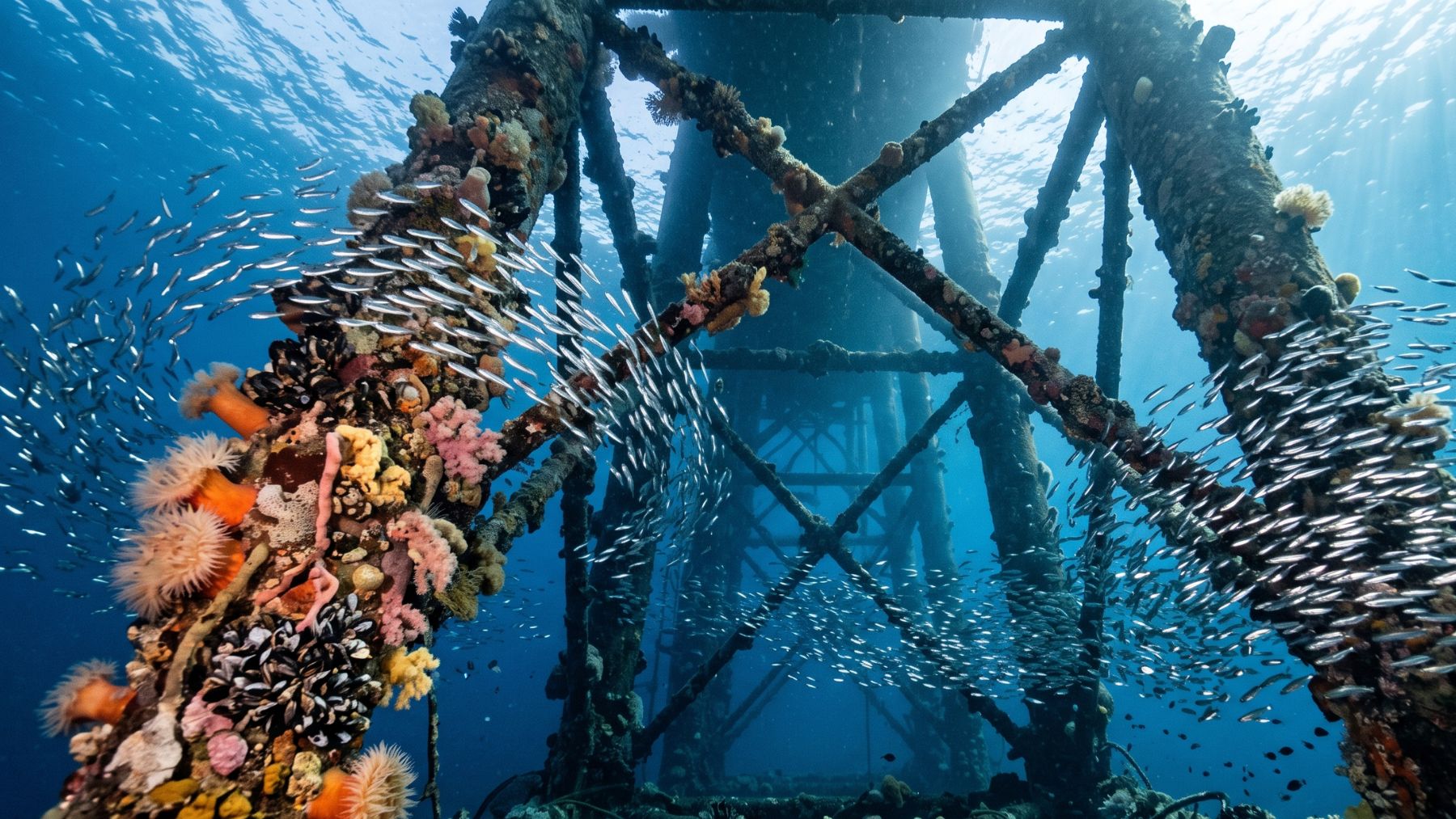
Off the coast of California, a steel giant rises from the waves.
It is an oil platform, a tower of girders bolted to the seabed.
For decades it pumped crude from deep beneath the ocean floor.
The same steel that scarred the sea now shelters it, a tension seen elsewhere, from clever octopuses to the seals near an offshore wind farm.
Ships came and went, and the flares burned day and night.
Then the oil ran out, and the pumps fell silent.
You might expect the whole rig to be hauled away.
But under the water, something remarkable has taken hold.
When the oil runs dry
Every offshore platform eventually reaches the end of its life.
The wells run dry, and pumping no longer pays.
By law, the company must deal with the abandoned structure.
The usual plan is to cut it up and drag it to shore.
That means slicing through steel legs far below the surface.
It is slow, dangerous, and wildly expensive work.
A full removal can cost many millions of dollars.
Heavy ships and divers are needed for months on end.
And it tears out whatever has grown on the frame.
Decades of marine life get ripped up in a single job.
So engineers began asking a different question.
What if the steel could simply stay behind?
What if the rig became part of the sea?
The idea called Rigs to Reefs
That idea became a program known as Rigs to Reefs.
It began in the Gulf of Mexico back in the 1980s.
Instead of removing a platform, crews leave its base in place.
Sometimes they topple the frame onto its side on the seabed.
Other times they cut off the top and leave the legs standing.
The steel skeleton stays underwater as an artificial reef.
Hundreds of old platforms have been converted this way.
Most of them sit in the warm waters of the Gulf.
Together they form the largest artificial reef system on Earth.
A single platform can offer nearly three acres of habitat.
That is a whole underwater forest made of steel beams.
That hidden steel becomes home to thousands of fish.
An oil rig slowly turns into a wild oasis.
How bare steel becomes a living reef
The change starts the moment the pumping stops.
Bare metal underwater does not stay bare for long.
First come barnacles, mussels, and soft coral on the legs.
They coat the steel in a thick crust of life.
Those tiny creatures draw in clouds of small fish to feed.
Crabs and starfish crawl across the crowded beams.
Bigger fish arrive to hunt the smaller ones.
The tall frame reaches from the seabed to near the surface.
That gives fish a rare wall of habitat through the water column.
Few natural reefs offer so much vertical space.
Sea lions and even whales sometimes pass through to hunt.
The rig becomes a busy tower stacked with marine life.
Each level holds its own crowd of species.
California’s surprising record
Here is the part that stunned scientists.
According to one report, California’s oil platforms are among the most productive fish habitats on Earth.
Researchers measured how much fish life each habitat produces.
The platforms topped almost every natural reef they studied.
Their output was roughly ten times that of most other habitats.
Much of that life is young rockfish, a prized local species.
The deep steel gives their larvae a safe place to grow.
Rockfish can live for decades and are slow to mature.
A shelter like this helps a whole generation survive.
A structure built to pump oil became a nursery for fish.
Few people ever imagined such a thing would be possible at all.
The rusting legs now rank among the sea’s richest nurseries.
An industrial relic turned into a fish factory.
A debate with no easy answer
Not everyone agrees the rigs should stay.
Some argue the seabed should be returned to its natural state.
Leaving steel behind can also let companies save on removal.
Critics worry that lets the industry off the hook too cheaply.
Others point to the thriving reef and the fish it feeds.
Tearing it out would kill an ecosystem decades in the making.
Fishermen and divers often favor keeping the reefs in place.
Each side can point to real science to back its case.
Often the money saved is split with state conservation funds.
According to one account, the debate over reefing old rigs is still unsettled.
The same steel that scarred the sea now shelters it, a tension seen elsewhere, from clever octopuses to the seals near an offshore wind farm.
For the moment, many of the old platforms are staying right where they are.
And beneath the waves, the reef keeps growing on the steel, fish by flashing fish.
Hugo is an engineer with strong technical expertise. Multilingual from an early age, his writing combines technical clarity with a strong interest in science and energy.
