
Wind turbines spinning above French vineyards acted like “invisible heaters” on the night a catastrophic frost struck
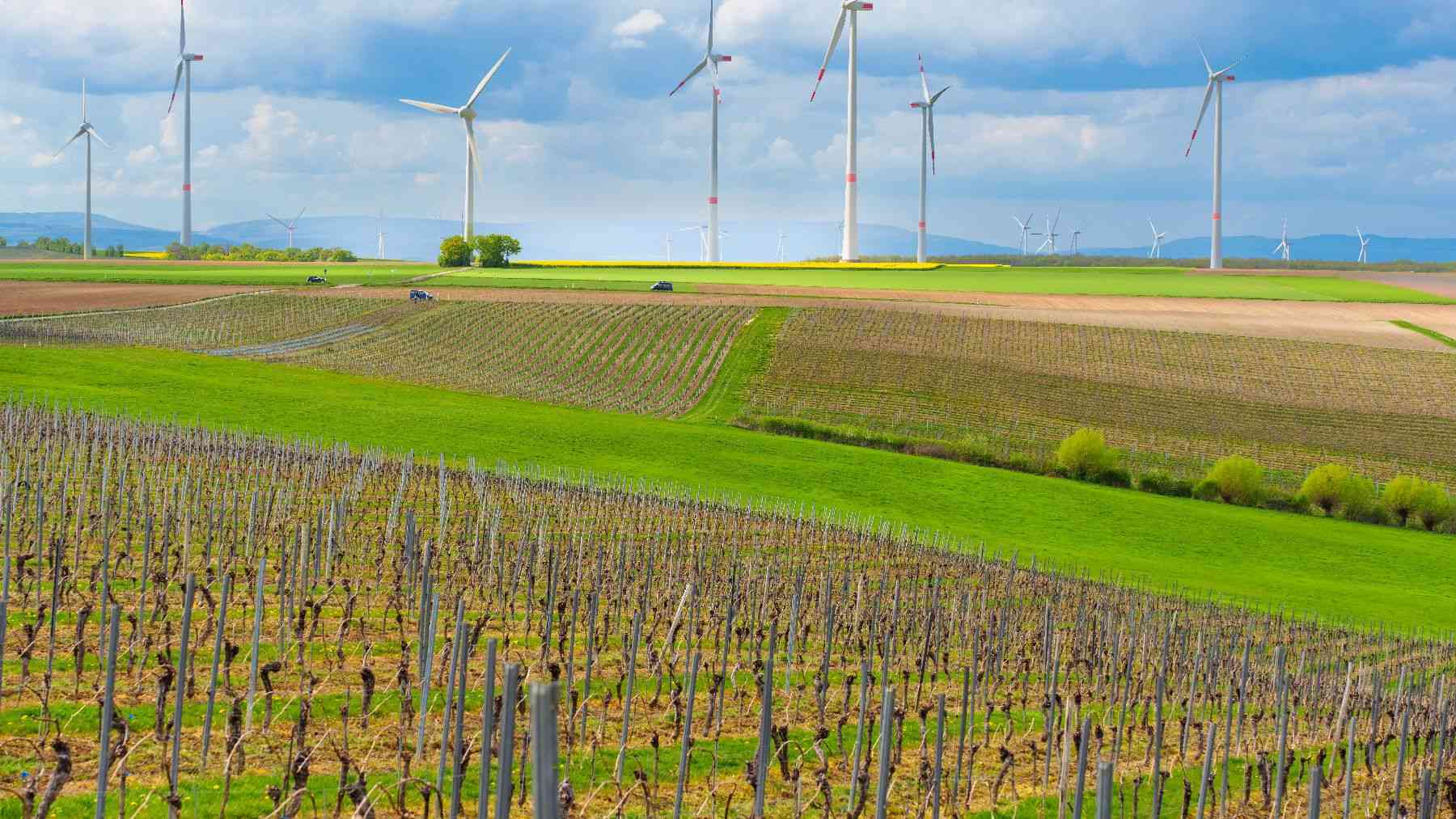
On the night of April 7–8, 2021, a catastrophic frost swept across France, destroying up to one-third of the country’s vineyard production — a loss estimated at nearly $2.2 billion. In the Languedoc-Roussillon region alone, roughly 70% of vineyard areas were damaged, with temperatures plunging as low as −22.1 °F. Spinning above those same vines were 35 wind turbines of the Ensemble Éolien Catalan farm. A new study asks what those turbines were doing to the air just above the ground — and whether growers standing in the frost had any idea what was turning overhead.
A catastrophic frost and a wind farm overhead
The April 7–8 frost was no ordinary cold snap. A persistent anticyclone south of Iceland, combined with a low-pressure system over the Iberian Peninsula, produced clear skies and dry air across France — ideal conditions for intense radiative cooling. Two intrusions of cold polar air had already chilled the continent during early April, and that night, temperatures in Languedoc-Roussillon vineyards dropped as low as −22.1 °F.
The Ensemble Éolien Catalan farm sits west of Perpignan, arranged in roughly four east-northeast-oriented rows stretching about 5 km long and 2 km wide. Its 35 turbines — nine Vestas V80 units and 26 Vestas V90 units — total 96 MW of installed capacity, sitting directly amid the vineyards that suffered some of the worst losses that night.
Those located within valleys generated the strongest temperature increases, since cold air naturally pools in low terrain and deepens the nocturnal inversion.
Why stable nights make turbines powerful temperature mixers
On a clear, calm night, the ground loses heat rapidly to the sky through radiation. The surface cools faster than the air above it, creating a layered atmosphere — cold air near the ground, warmer air aloft. This is called a nocturnal temperature inversion. Spinning turbine blades disrupt that layering, pulling warmer air downward toward the surface. Under stable stratification, even modest turbine-induced mixing can produce outsized temperature effects near the ground.
What the high-resolution simulation revealed
Researchers used a four-domain nested modeling framework, downscaling atmospheric conditions from France’s operational AROME weather forecast model at 1.3 km resolution down to 5 m — fine enough to represent individual turbine wakes using actuator disk models for each of the 35 turbines.
The core result: a mean near-surface warming of approximately 0.72 °F across the wind farm. Locally, immediately downstream of individual turbines, temperature increases reached up to 2.88 °F. The wind farm also shifted the position of a katabatic convergence zone by roughly 328 to 1312 feet, producing warming anomalies of up to 3.6 °F along that displaced front. Ground surface temperatures ranged from -1.26 °F to +2.88 °F, reflecting both warming and localized cooling depending on each location’s position relative to the turbines.
Valleys amplify the effect — and blockage can cool the ground
Not all turbines produced equal warming. Those located within valleys generated the strongest temperature increases, since cold air naturally pools in low terrain and deepens the nocturnal inversion. Turbine 32, sitting in a small valley a few tens of feet deep, produced downstream warming of up to 2.88ºF — among the highest recorded across the farm.
Upstream of turbine rows, a different process operated. Turbines slow the approaching wind before it reaches the rotor — a blockage effect — and that deceleration weakens turbulent exchange between the air and the ground, allowing radiative cooling to intensify. Small cold patches formed in these upstream zones as a result. The overall spatial pattern was highly heterogeneous, shaped by local terrain and flow direction.
Implications for frost protection and future wind farm design
The numbers invite a direct comparison. Dedicated vineyard frost-protection fans — small towers winemakers deploy specifically to mix cold surface air — produce temperature increases of a similar order of magnitude to what the turbines generated here.
The limitations are real. Wind turbines only operate when hub-height wind speeds exceed their cut-in threshold, and radiative frost events are typically associated with very weak winds — precisely the calm, cold nights when frost risk peaks. Turbines may also be shut down under icing forecasts, removing them from the picture when growers need mixing most.
Some vineyard parcels could see reduced frost risk while adjacent areas experience little benefit, or slight cooling from upstream blockage. The study points to future research on wind farm layout orientation and simulations across a wider range of stability conditions.
Thinking beyond one frost night
What happened above those Languedoc vines on April 7–8, 2021 wasn’t simple. The turbines weren’t passive observers of the frost — they were actively reshaping the air near the ground, warming some patches, cooling others, and shifting the boundary between two air masses by hundreds of feet.
As wind farms expand across hilly agricultural landscapes, their influence on local microclimates will only grow. Understanding that influence fully may eventually shape not just how wind farms are built, but where — and whether the vines planted beneath them fare better or worse for it.
Reference: Boumendil, P., Joulin, P.-A., Rodier, Q., and Masson, V.: Multi-scale simulations of wind farm impacts on nighttime near-surface temperature in complex terrain, Wind Energ. Sci., 11, 4255–4280, https://doi.org/10.5194/wes-11-4255-2026, 2026.
Daniel García is an Editor-in-Chief with strong expertise in structural work and engineering principles. He combines this technical foundation with deep knowledge of energy, spatial design, and emerging technologies, bringing a forward-thinking and analytical approach to editorial leadership.
