
ORNL and A.J. Tuck Company develop hybrid 3D printing and electroforming method for manufacturing nuclear reactor HIP cans
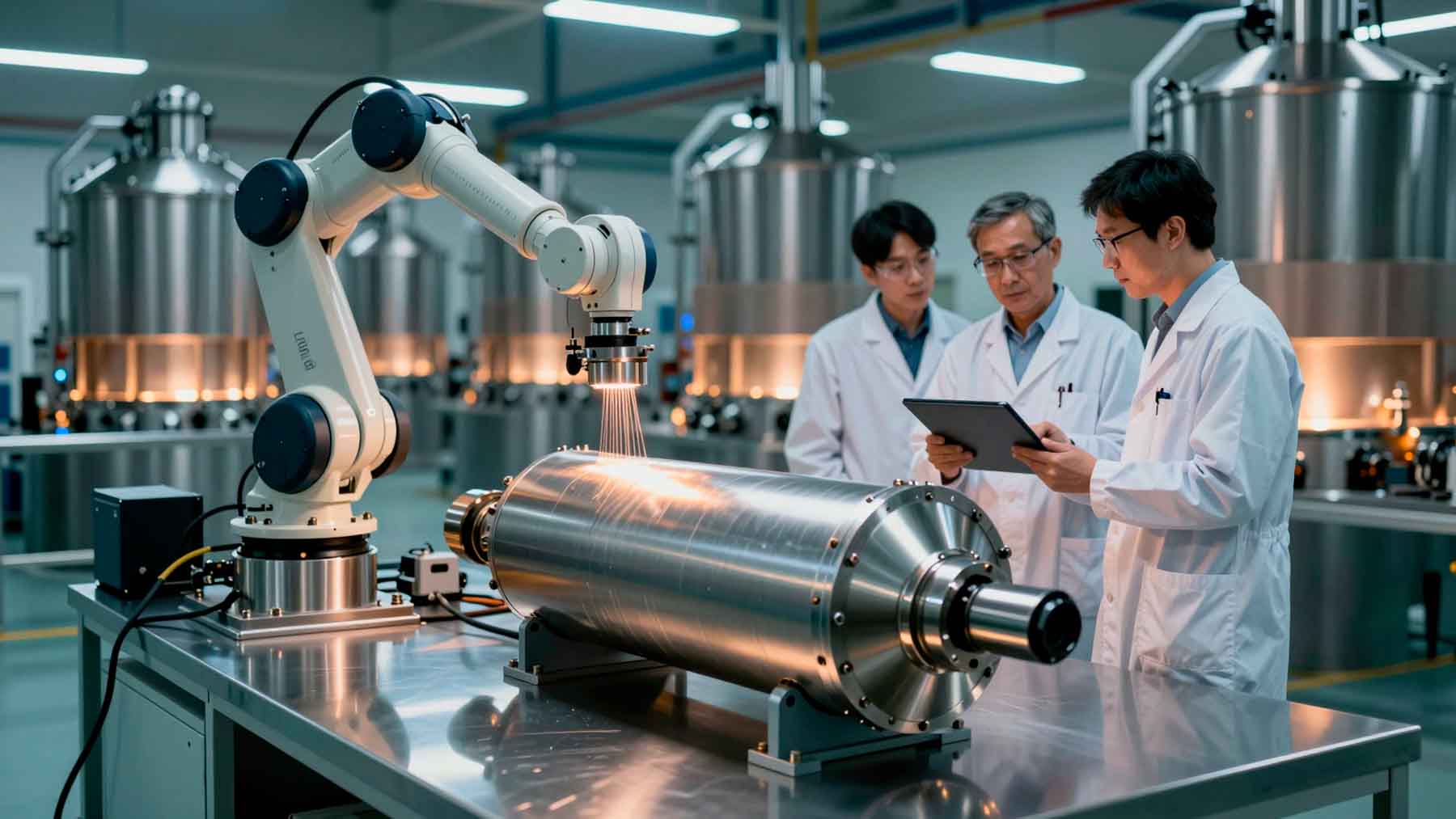 Image generated with artificial intelligence
Oak Ridge National Laboratory scientists and A.J. Tuck Company have developed a hybrid manufacturing approach that combines 3D printing and electroforming to produce HIP cans — the metal containers used in hot isostatic pressing to form reactor components from powder materials. The method aims to simplify how these critical parts are made, at a time when the nuclear industry is actively looking for more efficient production techniques.
ORNL and A.J. Tuck partner on new HIP can manufacturing method
Oak Ridge National Laboratory has a long track record of pushing advanced manufacturing into nuclear applications. This latest project, done in partnership with A.J. Tuck Company, is a clear continuation of that work.
The two organizations developed a process that layers two distinct fabrication techniques: 3D printing and electroforming. Together, they produce the HIP cans that define the shape of metal components during hot isostatic pressing. The goal isn’t just technical novelty — it’s to make these containers faster, simpler, and more practical to produce at scale.
In nuclear reactor development — where schedules stretch long and supply chains are often constrained — that kind of efficiency gain carries real weight.
HIP cans are essential to the process itself. They act as the mold and containment vessel for metal powder, holding everything in place while high pressure and temperature consolidate the material into a dense, solid part. Getting the can right matters enormously — it directly determines the geometry and integrity of the finished component.
Simplifying HIP can production isn’t a minor manufacturing detail. For nuclear reactor programs, it could mean shorter timelines and fewer bottlenecks in an already complex supply chain.
Why a hybrid approach was pursued
Neither 3D printing nor electroforming is new. What’s notable here is the decision to use them together, and the reasoning behind that choice.
Traditional HIP can manufacturing tends to be labor-intensive and costly. Fabricating these containers to the tight tolerances required for reactor-grade components involves significant machining and welding — complexity that drives up both cost and lead time, two factors the nuclear industry is under real pressure to bring down.
3D printing offers a faster path to complex geometries. Additive manufacturing can build shapes that would be difficult or time-consuming to machine conventionally. On its own, though, it doesn’t always meet the dimensional precision or material property requirements nuclear applications demand. The layer-by-layer deposition process can introduce surface roughness or internal inconsistencies that prove hard to eliminate.
Electroforming addresses exactly that problem. It deposits metal conformally onto a surface using an electrochemical process, building up precise layers that follow the exact contours of the substrate — complementing additive manufacturing by handling the surface and precision limitations that 3D printing alone tends to leave behind.
Combining the two methods lets each technique do what it does best. 3D printing handles the initial geometry and structure; electroforming refines and reinforces. The result is a hybrid process designed to be more capable than either approach working in isolation.
Potential impact on nuclear component production
If the method proves out at scale, the downstream effects could be significant for nuclear manufacturing programs.
Reducing the complexity of HIP can fabrication directly translates to lower costs and shorter lead times for the components produced inside those cans. In nuclear reactor development — where schedules stretch long and supply chains are often constrained — that kind of efficiency gain carries real weight.
Advanced reactor programs stand to benefit in particular. Many are working with novel component designs that don’t fit neatly into existing manufacturing workflows, and a more flexible HIP can production method could make it easier to prototype and iterate on those designs without hitting fabrication bottlenecks at every turn.
The collaboration between ORNL and A.J. Tuck also signals something broader. The nuclear industry is increasingly willing to treat advanced manufacturing as a serious part of the solution, and partnerships between national laboratories and specialized manufacturers are one of the more practical ways to move new methods from research into production-ready applications.
Technical feasibility in a lab setting and real-world manufacturability are two different things. Having an experienced fabrication company involved from the start helps bridge that gap in ways purely academic research rarely can.
Background: Hot isostatic pressing in nuclear manufacturing
Hot isostatic pressing is a well-established process in high-performance manufacturing. It works by placing a powder-filled HIP can inside a pressure vessel, then applying heat and pressure simultaneously — typically at very high levels — to consolidate the powder into a fully dense metal part.
The appeal in nuclear manufacturing is clear. HIP produces near-net-shape components with excellent material integrity, meaning less machining waste and fewer opportunities for defects to develop. For parts that need to perform reliably under demanding reactor conditions, that combination of precision and material quality is hard to beat.
HIP cans are the linchpin of that entire process. They define the final shape of the part, contain the powder during processing, and must withstand extreme conditions inside the pressure vessel. Producing them accurately and efficiently is fundamental to getting good results from HIP — which is precisely why improving their fabrication matters.
ORNL has been involved in advanced manufacturing research for the nuclear sector for years, and this project fits squarely within that mission. The lab’s collaboration with A.J. Tuck Company (via LinkedIn) brings together research expertise and practical fabrication experience — a pairing well-suited to developing a method that could actually make it into production workflows rather than staying confined to the lab.
The key takeaways are straightforward: a hybrid 3D printing and electroforming process has been developed for HIP can manufacturing, it’s designed to address the cost and complexity limitations of traditional methods, and it has the potential to support both near-term reactor programs and longer-term advanced reactor development.
Kelly is an experienced writer with 15 years of experience exploring the big stories that shape our world, from tech breakthroughs and space exploration to climate, energy, and the fascinating quirks of science. She has a talent for turning complex ideas into sharp, memorable insights that stay with readers long after they’ve finished reading.
